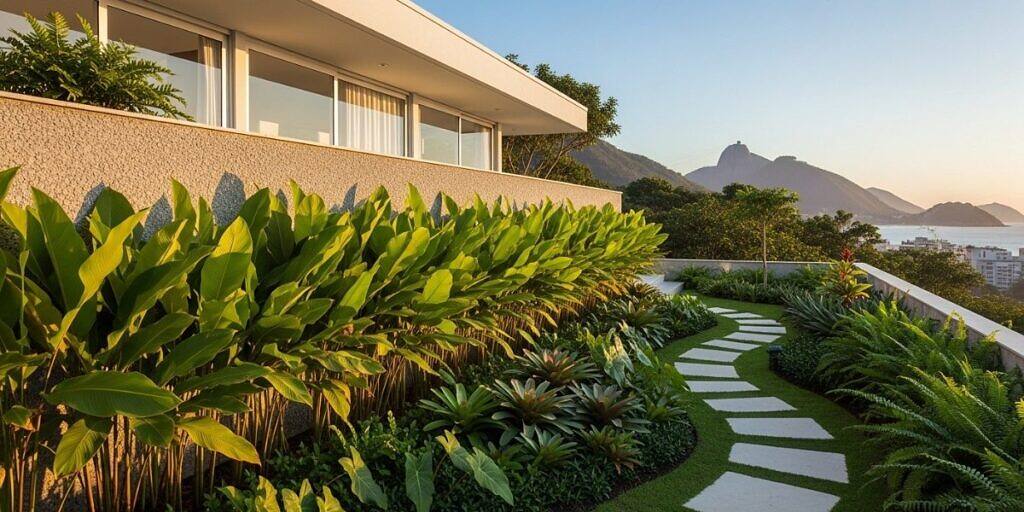
Few plants can transform a garden as quickly and dramatically as Cigar Calathea (Calathea lutea). A light breeze is enough for its gigantic leaves to reveal their silvery undersides and create that striking “wow” effect that grabs the attention even of those who know nothing about plants. It is no coincidence that Cigar Calathea has become one of the darlings of contemporary landscape design, especially in tropical-style projects and medium- to large-scale residential gardens.
However, despite its lush appearance, Cigar Calathea is not a “plant it and forget it” species, as many landscape professionals still tend to treat it. Its success in landscaping depends on everyday garden care and on the right choice of location, visual role, and overall composition.
In this guide, you will learn how to use Cigar Calathea strategically in landscape design, avoiding common mistakes and making full use of the ornamental potential of this species.
Why has Cigar Calathea become a focal point in landscape projects?
Cigar Calathea has earned its place in modern landscaping because it delivers exactly what many clients are looking for today: instant visual impact with a refined tropical aesthetic.
It can reach from 6.5 to 13 feet (2 to 4 meters) tall, forming large clumps with leaves up to about 24 inches (60 cm) long. In landscape design, this translates into volume, texture, and fast coverage—three highly valuable features when the goal is to create striking outdoor spaces without relying solely on trees.

Where does Cigar Calathea work best in landscape design?
1) Tropical mass plantings that impress at first glance
The most common—and also most effective—use of Cigar Calathea in landscaping is in dense mass plantings and rows, especially along walls, fences, and property boundaries. In a short time, the plant creates a living “green wall,” elegant and bold, with a look reminiscent of high-end resort gardens.
In outdoor living areas such as pools and patios, Cigar Calathea helps create a sense of retreat, as if the space were wrapped in natural vegetation.
Design tip: ideal spacing is about 32 to 40 inches (80 cm to 1 meter) between plants. This way, the mass planting fills in quickly without compromising the healthy development of each clump.
2) Background plant in tropical compositions
In landscape compositions, Cigar Calathea really stands out as a background plant.
Its large leaves create a perfect backdrop for medium- and low-growing species, enhancing the overall composition of the tropical garden.
It pairs beautifully with plants that have contrasting textures, tropical flowers, and palms, helping to create visual layers—one of the basic principles of a well-designed landscape project. Try combining this tropical garden plant with:
- Wavy philodendron (Philodendron undulatum)
- Swiss cheese plant (Monstera deliciosa)
- Heliconia (Heliconia spp.)
- Red ginger (Alpinia purpurata)
- Areca palm (Dypsis lutescens)
- Tree fern (Dicksonia sellowiana)
- Fat boy philodendron (Philodendron martianum)
- Garden canna (Canna x generalis)
- Ornamental banana (Musa ornata)
- Bird of paradise (Strelitzia reginae)
- Porto Seguro bromeliad (Aechmea blanchetiana)
- Lantana (Lantana camara)
The result is a tropical garden with depth, diversity, movement, and that timeless, elegant resort feel that never goes out of style.
3) Defining spaces without walls
Another smart function of cigar calathea in a tropical garden is defining spaces. Instead of solid walls or rigid fencing, it behaves like a true “living screen” and can be used to separate areas such as:
- Outdoor kitchen or grill area
- Pool area
- Paths and walkways
- Cozy lounge or reading nooks
Besides being functional, this solution makes the tropical garden design lighter and more visually connected to nature.
Light and placement: the detail that defines success
In landscaping, knowing that a plant “likes light” is not enough.
You need to understand how light behaves in the space throughout the day.
Cigar calathea performs best in sites with:
- Filtered light
- Gentle morning sun
- Partial shade during the hottest hours
In very hot regions, strong afternoon sun can scorch the leaves and compromise the look of the landscape design. In milder climates, it can tolerate a bit more sun, as long as the soil stays consistently moist.
Practical rule for landscape design: if the spot feels uncomfortably hot for people at midday, it’s probably not the best place for cigar calathea either.
Water and soil: less gardening, more planning
This is where many landscape projects go wrong. Cigar calathea appreciates humidity but dislikes waterlogged or high-salt soil. In landscaping, this should be solved during construction, not afterwards.
- Choose well-drained planting beds
- Avoid areas where water pools after rain
- In coastal areas, be extra careful with salinity
When the soil is prepared properly, maintenance becomes minimal — exactly what property owners and managers are looking for today.

Use in coastal gardens: reliable choice or ongoing problem?
This is a common question. Like other calatheas, cigar calathea is not very tolerant of hard water or dissolved salts — in other words, it is not the best companion for salty sea air. That does not mean it is off-limits in coastal landscapes.
The secret lies in positioning:
- Avoid spots exposed to direct ocean winds
- Use plantings or walls as windbreaks
- Create raised beds with fresh, high-quality soil
- Use tap water for irrigation
In this way, cigar calathea can perform very well in protected coastal gardens, maintaining a lush, tropical look without constant damage. However, if you consistently notice burned leaf edges, it is time to reconsider its placement and care regime.
Common mistakes that compromise the landscape design
Even though cigar plant is an impressive species, a few mistakes can ruin the visual impact of the landscape design:
- Planting too close to walls or built structures
- Using it in areas with intense, full sun all day long
- Ignoring soil drainage
- Forcing its use in regions with frequent frost
- Heavy chemical fertilization (salts build up in the soil and burn the foliage)
In landscape design, anticipating these problems is what separates a garden that looks good for a few months from a garden that looks good for years.

Maintenance: simple, when well planned
From a landscaping standpoint, cigar plant is a low-maintenance plant. Its care basically comes down to:
- Occasional removal of old or damaged leaves
- Irrigation control
- Light, consistent fertilization throughout the year (prefer organic or slow‑release fertilizers)
When the cigar plant is placed in the right spot and managed correctly, it practically “takes care of itself”, maintaining both its volume and the overall look of the landscape design.
Why cigar plant remains a favorite in landscape design
Because this cigar plant delivers something rare: immediate impact, tropical aesthetics, and versatility. Whether in private gardens, residential communities, or leisure areas, cigar plant helps create spaces that look established from the very first year.
It is a plant that can turn almost any outdoor area into a true tropical oasis — as long as cigar plant is used thoughtfully.
If the goal is to create a striking, modern garden with a strong identity, cigar plant is not just an option. It is a strategic choice.