The impossible engineering behind the Hanging Gardens of Babylon
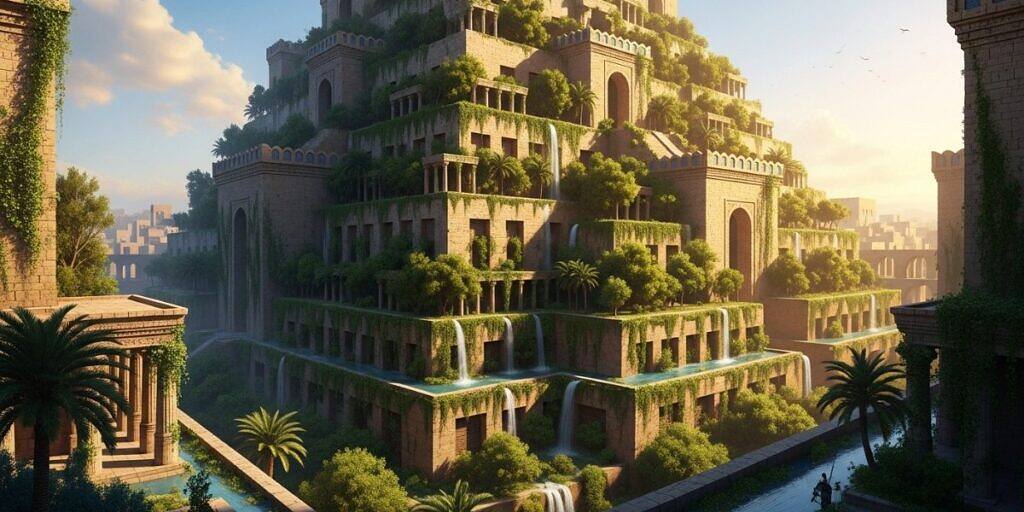
Imagine a series of green terraces, filled with trees and lush plants, rising in the middle of the arid landscape of Antiquity. Flowing water, shade, and cool air where normally there would be dust and extreme heat. This image sums up the enduring fascination with the Hanging Gardens of Babylon—and also explains why they are considered one of the most “impossible” achievements in ancient engineering.
But what truly defies logic is not just the beauty of the garden, but how it could have functioned technically in a world without engines, electric pumps, or reinforced concrete.
What the ancient sources actually describe
The most famous accounts of the Hanging Gardens come from Greek and Roman authors such as Diodorus Siculus and Strabo, who wrote centuries after Babylon’s peak. They describe a multi-level structure, with elevated terraces supported by arcades, covered by a thick layer of soil where large trees could grow.
These texts are not technical manuals, but they make it clear that this was not a simple ornamental garden. It was a monumental structure, designed to impress and, above all, to operate continuously.
The greatest challenge: lifting water to the top
The most critical engineering challenge of the Hanging Gardens was always water. To keep plants alive in such a dry environment, it would have been necessary to raise large volumes of water from the Euphrates River up to the upper levels of the garden—every single day.
The most widely accepted hypothesis is the use of a mechanical lifting system, possibly similar to what would later be known as the Archimedes’ screw. Even though the name is later, the physical principle—rotating a mechanism to lift water continuously—could already have existed in primitive versions.
Without such a system, the garden simply would not have survived.

Canals, aqueducts, and an invisible hydraulic network
Lifting the water was only part of the problem. For the garden to operate in a stable way, it would have been necessary to capture, convey, and distribute water on a regular basis. This is where the most solid evidence associated with Assyria comes into play.
Archaeological records from Nineveh reveal a vast network of canals, aqueducts, and reservoirs built during the reign of Sennacherib. Some of these aqueducts are so sophisticated that they rival later Roman engineering works. This infrastructure has strengthened the hypothesis that the hanging gardens described by Greek authors might, in fact, have been connected to this Assyrian hydraulic system—an interpretation acknowledged by institutions such as the Encyclopaedia Britannica.

Supporting soil, trees, and moisture without collapse
Another often overlooked factor is weight. A hanging garden does not support only plants, but tons of waterlogged soil, deep root systems, and a constant water supply. To sustain this, the structure would have needed to be extremely robust.
In addition, waterproofing was crucial. Without protective and drainage layers, water would seep into the brickwork and undermine the foundations. The use of bitumen—common in ancient Mesopotamia—may have been the key to sealing the structure, a concept very close to what is now known as modern green roof engineering.
Babylon or Nineveh? The controversy continues
Despite its fame, there is no absolute consensus on the exact location of the Hanging Gardens. The absence of direct archaeological evidence in Babylon and the abundance of hydraulic remains at Nineveh continue to fuel the debate.
This does not weaken the history of the hanging gardens—quite the opposite. It shows that the engineering described was not fantasy, but something technically feasible within the capabilities of the ancient Near East.
A legacy that still shapes modern landscaping
The supposedly “impossible engineering” of the Hanging Gardens may simply be misunderstood. The core principles—water lifting, drainage, waterproofing, and the integration of architecture with vegetation—are exactly the same as those used today in vertical gardens and contemporary green roofs.
The difference is that, more than two thousand years ago, all of this had to work without electricity, relying solely on human ingenuity.