
If your vegetable garden never works, try the mandala. This phrase sums up the experience of many people who have tried growing in straight rows, followed random tips from the internet and, even so, ended up giving up. The problem is almost never lack of care or not having a “green thumb.” Most of the time, it’s the system you chose.
The mandala garden is designed as a layout that makes growing easier, especially for beginners. It reduces walking distances, improves soil use, and makes day‑to‑day management more intuitive. Below, you’ll learn how to make a mandala garden step by step, in a practical way, without too much theory and with a focus on getting your hands in the soil.
Before you start: what you really need
You don’t need expensive materials to set up a mandala garden. To get started, you just need:
- A spot with full sun for at least 4 to 6 hours a day
- Soil (from your yard or purchased) and organic matter (compost, well‑rotted manure, or worm castings)
- String or a garden hose to mark the circles, and stakes (optional)
- Dry straw, leaves, or grass clippings for mulch, if available
If your growing space is small, that’s fine: the mandala garden can be compact. The key is to start with a size you can easily take care of.
How to make a mandala garden step by step
1) Choose the spot and observe the sun
Choose an area that gets direct sun, preferably in the morning. Avoid spots that get waterlogged when it rains. If the ground has a steep slope, you can level it a bit or adapt the paths, but for your first mandala garden, a relatively flat area makes everything much easier.
Practical tip: spend a day watching how the sun moves across the space. The point that gets the most light is usually the best place.

2) Mark the center and draw the first circle
Drive a stake into the ground at the center (or mark it with a rock). Tie a piece of string to it and use it as a compass to mark the ground. For beginners, a diameter between 2 and 3 meters (about 6½ to 10 feet) is ideal: you can reach the beds without having to step into them.
You can mark the circle with a stick, flour, sand, or simply by “pressing” the outline into the ground with your foot.
3) Draw the layout of your mandala garden
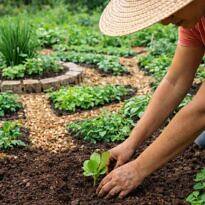
Now it’s time to define the shape. The key is to keep a circular format, but you can divide it into “slices,” like a pizza, or create 2 to 4 concentric circles (rings) around the center. These become layered planting beds.
- For a mandala garden between 2 and 3 meters (6.5–10 ft) across, start with 2 or 3 rings.
- Make each ring wide enough to plant comfortably and still reach the center: something around 30 to 50 cm (12–20 in) usually works well.
You will have, for example: a center + an inner ring + an outer ring. Simple and efficient.
4) Create radial paths (the “spokes”) for full access
For a truly practical mandala garden design, create 2 to 4 paths running from the outer edge toward the center, like “spokes.” These access paths are what allow you to reach any point in the mandala garden without stepping on the planting beds.
This is where the “pizza-style” versions come in: some mandala gardens use many spokes and become several segments. Others use fewer spokes and keep the rings as the main feature. Both approaches work — choose what fits your space and your gardening style.
On the paths, you can use straw, sawdust, gravel, dry leaves, or even bricks or pavers to prevent mud and soil compaction.
5) Prepare the soil in the beds (without overcomplicating)
Once the layout is ready, prepare the soil in each ring of the mandala garden. Loosen the soil with a hoe or hand trowel, breaking up large clods. Mix in organic matter to improve fertility and make the soil lighter and easier to work.
A simple, reliable starting ratio is:
- 2 parts soil + 1 part compost/worm castings
If your soil is very clay-heavy (hard and compact), adding organic matter and a layer of mulch on top will greatly improve structure over time. If it’s very sandy, organic matter will also help with water retention and overall health of the mandala garden.
6) Decide what goes in the center (optional, but useful)
The center can serve only as a visual reference point, but it can also become a functional “heart” of the mandala garden. You can:
- leave it open for circulation and general maintenance;
- plant a larger aromatic herb (for example, rosemary or lemongrass);
- place a discreet pot or bucket to make watering easier (if it makes sense in your space).
For beginners, it’s best to keep the center simple: nothing that makes maintenance harder.
7) Start planting on a small scale (what works best for beginners)
The biggest secret to making a mandala garden work from the start is not trying to do everything at once.
Start with just a few easy species that grow quickly and that you actually enjoy eating:
- Leafy greens: lettuce, arugula, kale
- Herbs: chives, parsley, cilantro, basil
A simple layout that works very well:
- Outer ring: leafy greens (they grow fast and you can harvest them soon).
- Inner ring: herbs (they add fragrance and look attractive).
If you’re planting from seed, follow the spacing recommendations on the packet. If you’re using seedlings, don’t pack them too tightly: crowded plants are harder to care for and yield less.

8) Water and finish with mulch
Water preferably early in the morning or late in the afternoon. The goal is to keep the soil consistently moist, not waterlogged. Then add a thin layer of mulch (straw, dried leaves, dried grass clippings) over the soil surface, without touching the base of the seedlings.
This mulch layer is one of the most research-backed and practical steps for anyone who wants consistent results in a mandala garden: it helps retain moisture, suppresses volunteer weeds, and protects the soil from intense sun. The result is less work and more stability.
Why this layout makes growing so much easier
The main advantage of a mandala garden is its ergonomics and the smart use of space. You can reach every bed without strain, keep a closer eye on your plants, and step in quickly whenever something needs adjustment. That cuts down on common mistakes and makes mandala gardening more intuitive.
For anyone who has tried a vegetable garden before and didn’t get great results, a mandala garden often represents a simpler, more efficient fresh start. Instead of working against the system, you begin to work in harmony with it.