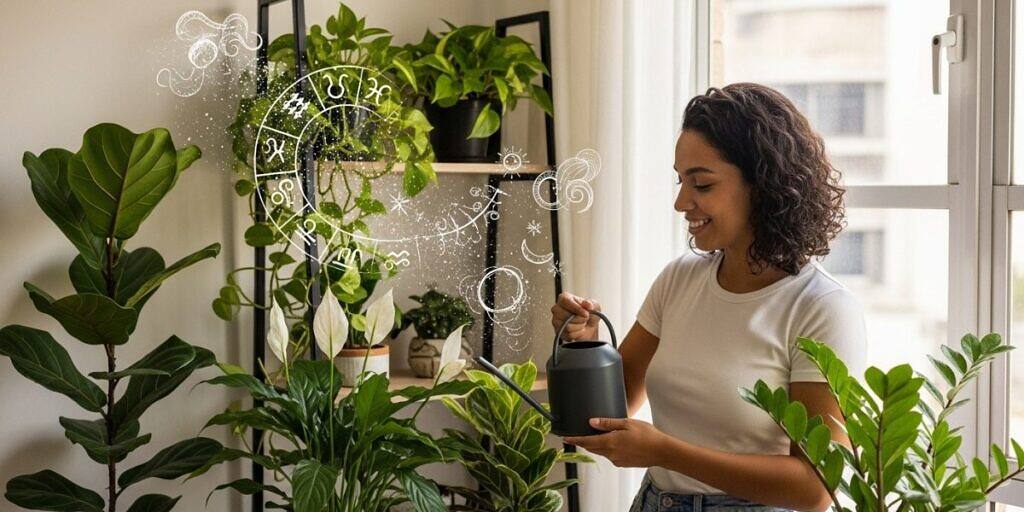
I always found it curious that my friend Claudia chose a pothos while I, a classic Taurus, fell in love with the Ficus lyrata (fiddle-leaf fig). We didn’t plan it. But when I noticed she could forget to water hers for weeks (and the plant still looked amazing), while I had to check mine almost every day, it clicked: there is an invisible connection between our personality and the houseplants we choose. And it’s not just mystical talk — it’s about identification, daily routine, and that sense of belonging that actually makes us care for them properly.
The houseplant market has figured this out too. In recent years, the use of astrology as a curation tool in garden centers has grown significantly since the pandemic. It’s not just cute marketing: when you identify with a plant, it has a much higher chance of surviving in your home. That’s what I call personalized biophilic gardening.
The rise of astro-marketing in the plant world
Have you noticed how some plant stores have started labeling species by “behavior profile”? Signs like “For people who forget to water” or “Perfect for low-light spaces” have become sales strategies. But when you add the astrological layer — “Plants for Virgo” or “Perfect for Leos” — conversion rates skyrocket.
Why? Because a sense of belonging reduces stress and increases commitment. You’re not just buying a houseplant. You’re bringing home something that “speaks your language.” And that’s not nonsense: research on biophilic design shows that personalizing green spaces improves mental health and increases the survival rate of cultivated species.
Now to what really matters: which houseplant matches your zodiac sign and, more importantly, how to make it truly thrive.
Fire signs: energy, bold colors, and full sun
Fire signs (Aries, Leo, and Sagittarius) call for houseplants that are as bold as they are. Forget shy foliage or dull greens. Here, it’s all about vibrant colors, striking structure, and plenty — really, plenty — of light.
Aries and Croton: intense colors and the need for light

Croton (Codiaeum variegatum) is one of those plants that never goes unnoticed. Leaves in red, orange, yellow, and green, all on the same plant. It looks like an abstract painting. And, like every Aries native, it hates being moved around. If you change its spot, be ready to see leaves dropping in protest.
I learned this the hard way. I bought a gorgeous Croton at a garden center and, all excited, kept testing where it would look best. In a week, half the leaves were on the floor. The plant needs full sun to keep those vibrant colors — and stability. Pick the right place from the start and leave it there. A potting mix rich in organic matter and regular watering (without waterlogging) complete the care routine. (For the record, I did manage to save my Croton!)
Leo and Guzmania bromeliad: eccentric rosettes and the legacy of pups

The Guzmania bromeliad (Guzmania lingulata) is pure theater. That colorful central rosette (which many people think is the flower, but in fact they are bracts) steals the show in any space. And there is a poetic detail I love: after it blooms, the mother plant dies, but leaves side pups as an inheritance. It is the king’s legacy.
In cultivation, it is epiphytic — in nature, it grows attached to trees. So filtered light (never direct sun) and water in the central “cup” of the rosette are essential. I use rainwater when I can, because Guzmania is sensitive to chlorine. And yes, you can grow this Guzmania bromeliad in decorative cachepots without drainage holes, as long as you carefully control how much water you add. It looks exotic, but it is surprisingly easy to grow.
Sagittarius and the Bird of Paradise: expansion, toughness, and sun‑driven blooms

Strelitzia reginae (Bird of Paradise) is the plant for Sagittarians who are not afraid to take up space. It grows, it spreads, and when it blooms, it looks like a real bird perched in the garden. But it only flowers if it gets direct sun — and many people don’t know that.
I see so many people who buy this plant expecting those orange and purple flowers, but then keep it in the shade. The result? Only huge leaves. Beautiful, but no flowers. If you want the full show, make sure it gets at least 4 hours of direct sun per day and feed it with a 04-14-08 NPK fertilizer before spring. Its hardiness makes up for everything — it’s a plant that forgives watering mistakes and still delivers maximum visual drama.
Earth Signs: stability, technique, and functionality
Taurus, Virgo, and Capricorn tend to have a practical relationship with gardening. They do want beauty, but they also want the plant to make sense in the space. Slow growth, reliable structure, and preferably some function beyond pure aesthetics.
Taurus and the Fiddle Leaf Fig: luxury appeal, slow growth, and flawless aesthetics

The Ficus lyrata, or fiddle leaf fig, became a social‑media darling, but I assure you: it is much more than a trend. Those huge, lyre‑shaped leaves have a sculptural presence. It’s an investment plant — it grows slowly, but elevates the room like few others.
The secret I discovered (and that has saved a lot of people) is simple: wipe the leaves with a damp cloth every 15 days. It may sound fussy, but it’s not — dust blocks photosynthesis and the plant starts to decline for no obvious reason. Use a well‑draining potting mix (a blend of enriched garden soil and pine bark) and water only when the potting mix is dry in the top 1–1.5 inches (3 cm). Taurus loves ritual, and this zodiac plant rewards consistency. Speaking from experience!
Virgo and the Spider Plant: perfection in air purification

The spider plant (Chlorophytum comosum) is a NASA favorite — literally. In the well‑known Clean Air Study, this zodiac plant ranked among the top for removing formaldehyde and carbon monoxide. Functional, efficient, and beautiful. Virgo in plant form.
I keep three at home, and each one has a purpose: one in the home office (because I work at the computer all day), another in the kitchen, and a third in the bedroom. They produce those hanging plantlets you can re‑pot — it’s practically a little plant factory.
The only catch: its roots are tuberous and store water. Be careful not to overwater — less is more. Use a light, well‑aerated potting mix and provide bright, indirect light. That’s all it needs.
Capricorn and the Happiness Tree: longevity, woody structure, and mature soil

The Happiness Tree (Polyscias fruticosa) has a woody trunk that conveys stability. It’s the kind of plant you buy thinking long term — it grows as the potting mix matures, with no rush. Capricorn doesn’t want drama, it wants endurance.
It does not tolerate cold drafts or constant air currents (like air conditioning blowing directly on it). I once lost one because I left it too close to a window in winter. Painful lesson. Rich, organic potting mix, moderate watering, and patience. It rewards anyone who respects its timing.
Air signs: adaptability, movement, and lightness
Gemini, Libra, and Aquarius need plants that breathe. Plants that adapt, that have visual movement, that don’t tie you to rigid care routines. Lightness here is quite literal.
Gemini and pothos: versatile in any space and the duality of water propagation

Epipremnum aureum (pothos) is one of the most adaptable houseplants there is. Bright, indirect light? Perfect. Low light? It copes too. Forgot to water? It will forgive you. And you can propagate pothos in water or directly in potting mix — the famous Geminian duality.
I have a pothos that started as a 4 in (10 cm) cutting a friend gave me. Today it’s over 6.5 ft (2 m) long and has already produced 15 cuttings I’ve shared around. It’s the plant of generosity and experimentation. Just avoid direct sun (it scorches the leaves) and water when the potting mix is almost dry. Almost too easy to be true — but it is.
Libra and the Boston fern: the search for thermal balance and classic aesthetics

The Boston fern (Nephrolepis exaltata) is exuberance and elegance in plant form.
Those arching, symmetrical leaves demand balance in everything: temperature, humidity, light, moisture. It’s the plant of the middle ground — no extremes.
I learned how to create a microclimate for mine: a saucer with pebbles and water under the pot (without letting the water touch the bottom of the pot). This increases the humidity in the air around it. Provide filtered light, water frequently (but never let it get waterlogged), and mist the leaves from time to time. It responds very well to consistent care — it won’t tolerate being forgotten for weeks.
Aquarius and the Air Plant (Tillandsia): soil‑free independence and innovative growing

Have you noticed that Tillandsias seem like they’re from another planet? They don’t need potting soil — they absorb moisture from the air and thrive in bright, indirect light. Very on brand for Aquarius, pure innovation. And the care routine is almost meditative: once a week, you soak them in water for about 15 minutes. Simple, different, and surprisingly liberating.
I keep a Tillandsia ionantha hanging from a small wire near a bathroom window. The steam from showers already helps, but the weekly immersion bath is non‑negotiable. Afterward, let it dry upside down so water doesn’t pool in the center. It’s the perfect air plant for anyone who wants something unique and truly low‑maintenance.
Water Signs: intuition, sensitivity, and moisture
Cancer, Scorpio, and Pisces have an emotional relationship with their plants. They sense when something is wrong — and the air plant and other species associated with these signs reflect this sensitivity to water and environment.
Cancer and the Peace Lily: water sensitivity and toxin filtration

The Spathiphyllum wallisii, or peace lily, can be dramatic. When it lacks water, it wilts in spectacular fashion — but it bounces back quickly as soon as you water it. It’s almost like direct communication: “Hey, I need you right now.” And this sensitivity extends to the environment: the peace lily helps filter toxins from the air, purifying the space both emotionally and physically.
I use dechlorinated water to water mine — tap water with chlorine can cause brown, burned tips on the leaves. And yes, it tolerates low light, but it blooms more reliably in bright, indirect light. It’s the plant for attentive care — and for forgiveness, because even when it’s almost dry, it comes back.
Scorpio and the ZZ plant: resilience in low light and the mystery of sparse watering

The Zamioculcas zamiifolia, commonly known as the ZZ plant, is full of mysteries. It survives in low light, goes for weeks without water and still keeps growing. But it has a deadly secret: if you water it too often, the rhizome (that underground “potato”) will rot.
I see many people losing their ZZ plant out of sheer overcare. They water it every week, thinking they are “doing the right thing.” The golden rule: only water when the potting mix is 100% dry. And if you are in doubt, wait a few more days. This houseplant is toxic if ingested, so be cautious with pets and children. But as a low-light indoor plant, the ZZ plant is hard to beat.
Pisces and the prayer plant: nictinastic movement and a spiritual connection with water

The Maranta leuconeura, known as the prayer plant, still hypnotizes me with one simple gesture: it folds its leaves at night as if it were praying (hence the common name). This is a nictinastic movement — a daily dance that connects you to the natural rhythm of day and night.
This prayer plant needs shade and consistently high humidity. And here is the key detail: if possible, use rainwater or filtered water. It is sensitive to the mineral salts found in treated tap water. I keep mine in a bright bathroom corner (with a window), and it is thriving. Keep the potting mix slightly moist (never waterlogged) and provide filtered, indirect light. For many people, the prayer plant is the houseplant of practical spirituality.
Cultivating your well-being through the zodiac
In the end, choosing houseplants by zodiac sign is really about self-knowledge. It is about understanding your own pace and limitations and turning that into practical plant care. It is not about getting everything right the first time — I have lost more plants than I can count. But each loss taught me something about patience, about observation, and about respecting nature’s timing (and my own).
If you are the kind of person who constantly forgets to water, do not push yourself with a prayer plant. Choose a ZZ plant or a pothos instead. If you love daily rituals, a peace lily or a fern will reward you. The right plant for you is the one that fits into your real life — not into the life you wish you had.
So choose a plant species aligned with your zodiac sign (or with a friend’s, if you’re planning a gift), prepare the potting mix with care, make sure the drainage is right, and get started. Turn a small corner of your home into a green sanctuary. And tell me how it goes afterward — I love hearing the stories of people who get their hands in the soil and reconnect with nature, one plant pot at a time.