
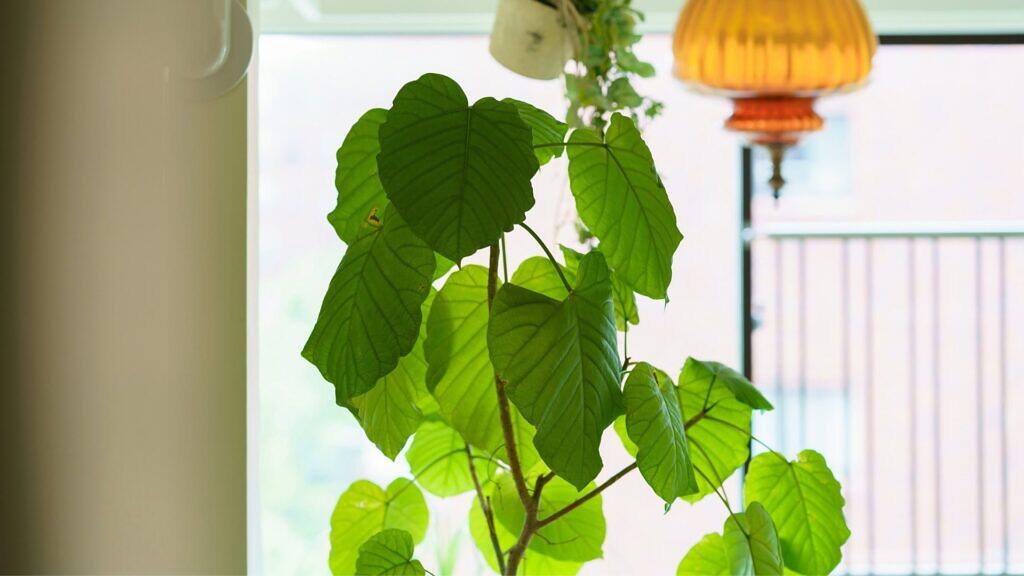
The Umbrella Tree Fig (Ficus umbellata) is an ornamental tree with a striking presence that has quickly risen to it-plant status in interior design. Unlike its sturdier relatives, it stands out for its light, organic silhouette, crowned by monumental leaves that seem to float on slender, graceful stems. Ficus umbellata is prized for its ability to transform living rooms, entry halls, and offices with an Urban Jungle aesthetic. It acts as a high-impact structural element, capable of turning stiff, uninspiring spaces into sophisticated tropical retreats, offering a more resilient and visually fluid alternative to the popular Fiddle-leaf Fig (Ficus lyrata).
Although native to Africa, the Umbrella Tree Fig first became a decorating trend in Japan. Japanese landscape designers explored the potential of its gray stems in contrast with its giant leaves in minimalist settings. More recently, the species has gained strong momentum in the Brazilian market, taking a prominent place in landscaping and architecture showcases.
The satin sheen of its deep-green foliage and the heart-shaped form of its leaves create a play of light and shadow that is pleasing to the eye. Although it is a giant of African forests, its adaptability to containers makes it versatile for apartments and offices, where its broad, flat canopy lives up to its name, resembling a generous green umbrella sheltering the space beneath its shade.

Origin, Habitat, and Etymology
The Umbrella Tree Fig is native to Central and West Tropical Africa, with a natural range extending from Senegal to Ethiopia and Angola. Its habitat includes moist tropical forests and wooded savannas, where the climate is warm and highly humid. In these regions, it grows under the protection of the canopy of larger trees or in clearings with filtered light.
The genus name Ficus is the Latin name for the classic fig tree. The specific epithet umbellata comes from the Latin umbellatus, meaning “umbrella-shaped.” The term refers to the arrangement of the branches and the way the canopy opens horizontally, creating a cover that resembles an open umbrella, as well as describing the structure of its inflorescences.
Decorative and Landscape Use of the Umbrella Tree Fig
Although it can be used in outdoor landscaping, Ficus umbellata truly shines in interior design, standing out as one of the most sought-after species in the Urban Jungle trend and in biophilic design. With its enormous cordate (heart-shaped) leaves and slender structure, it acts as a true living sculpture, bringing sophistication, volume, and a strong focal point to living rooms, offices, and well-lit balconies.

In the garden, its planting is considered controversial among landscape designers. Like other trees in the Ficus genus, it develops an expansive, aggressive root system over time. If planted in the garden, it can reach up to 33 feet tall (10 meters), requiring a strict distance of at least 20 feet (6 meters) from walls, sidewalks, pipes, and foundations to prevent serious structural damage. In addition, it is an exotic tree, and a sustainable choice that prioritizes native species is recommended over any trend or fashion.
For this reason, growing it in large containers is the safest and most visually appealing option. In these conditions, Ficus umbellata works as an elegant small tree. To create a balanced composition and hide the potting mix, trailing groundcovers provide an excellent finishing touch. Pairing it with foliage such as Pothos (Epipremnum aureum) or Brazil philodendron (Philodendron hederaceum ‘Brasil’) creates a beautiful contrast, allowing these plants to spill over the edge beneath the tree’s enormous leaves. Playing with contrasts in color and texture, combining it with Turtle vine (Callisia repens) or Wandering Jew (Tradescantia fluminensis), is also very appealing.
Aesthetically, the purity of its leaf lines allows it to blend perfectly into Minimalist styles, while also enhancing Contemporary and Tropical designs. To ensure its vigor indoors, it is best to place it in locations with high ceilings or enough space for the canopy to expand. It is also essential to avoid placing it where there are constant cold drafts or near air-conditioning units, as these factors cause premature leaf drop and compromise the plant’s health.

How to care for Umbrella Tree Fig: growing guide
- Light: Indoors, it should be kept near large, bright windows, out of direct sun during the hottest hours. If planted in the garden, it can be gradually acclimated to full sun. Keep in mind that nursery plants are young and have been grown under protection, so a sudden increase in sunlight exposure can be fatal.
- Soil: In the garden, the soil should be deep, rich in organic matter, and well drained. The pH should be kept between 6.0 and 7.0 (slightly acidic to neutral). For pots, use a potting mix of organic compost with materials that improve aeration and drainage, such as coarse construction sand, perlite, expanded clay, composted pine bark, or peat, making sure water does not collect at the bottom. A layer of geotextile fabric, and gravel helps maintain proper drainage.
- Watering: Unlike other thick-leaved figs, the leaves of this species wilt and lose their sheen when the plant needs water. This behavior serves as a biological indicator, allowing watering before serious damage or leaf loss occurs. Keep the potting mix slightly moist, but never waterlogged. Water when the top layer of soil begins to dry to the touch. In summer, watering is more frequent; in winter, it should be reduced.
- Climate: It grows best in tropical and subtropical climates. The ideal temperature range is between 64°F and 82°F (18°C and 28°C). It is extremely sensitive to cold; temperatures below 50°F (10°C) can induce forced dormancy and massive leaf drop.
- Air humidity: It appreciates high humidity, preferably above 60%. In dry environments, mist the leaves early in the day or use humidifiers.
- Fertilizing: Use mineral fertilizers such as NPK 10-10-10, preferably slow-release, or formulas specifically for foliage plants. Apply every 3 months during spring and summer. Organic fertilizers, such as compost, biofertilizer, or bokashi, can be applied once a year, preferably in spring.
- Pruning: Perform cleaning pruning to remove dry or damaged leaves. Carry out shaping pruning at the end of winter to control size and encourage lateral branching. By removing the apical bud (the tip growth), the plant is forced to produce new branches, becoming fuller and more shrub-like. Wear gloves, as the sap can cause irritation.
- Staking: Because it has flexible branches and heavy leaves, young container-grown plants may need support until the trunk becomes more woody.
- Leaf cleaning: Use a shower rinse, or a soft damp cloth, to remove dust from the leaves every two weeks. This improves photosynthesis and helps prevent pests.

How to propagate Umbrella Tree Fig
To propagate it, use stem cuttings. Select a healthy branch and make a diagonal cut of approximately 6 to 8 inches (15 to 20 cm). Remove most of the lower leaves, leaving only one or two at the top, which can be cut in half to reduce transpiration. Using rooting hormone at the base of the cutting increases the chances of success.
Plant the cutting in a light potting mix made of sand and carbonized rice husk or coconut fiber, keeping it moist. Cover the container with a clear plastic bag to create a greenhouse effect and place it in a spot with indirect light. Rooting occurs within 4 to 8 weeks. Another effective method for larger specimens is air layering, done directly on the mother plant’s trunk. Air layering can also be used to reduce the height of specimens that have already reached the ceiling.
Botanical description of Umbrella Tree Fig
Umbrella Tree Fig is an evergreen tree that, in its natural habitat, reaches 6 to 10 meters (19.7 to 32.8 feet) in height. When grown in pots, its size is kept to 1.5 to 3 meters (4.9 to 9.8 feet) through pruning and root growth restriction. It has a woody structure, with a central trunk that supports branches that grow vertically before arching outward due to the weight of the leaves. Its trunk is characterized by smooth bark, gray-green to brown in color, which tends to become slightly fissured with age. The root system is robust, with a tendency to produce strong surface roots.

In open ground, the root system is fibrous and aggressive, capable of damaging sidewalks or pipes if there is not enough space. In pots, the roots adapt well to confinement, but repotting is needed every two or three years to refresh the potting mix. The stem has smooth bark, light gray to beige in color, with small visible lenticels and becoming rough over time.
Leaf morphology is the most distinctive feature: the leaves are simple, alternate, and enormous, measuring 25 to 45 cm (9.8 to 17.7 in) long by 15 to 30 cm (5.9 to 11.8 in) wide. The blade is broadly ovate to heart-shaped, with a deeply cordate base and a short acuminate tip. The texture ranges from papery to somewhat leathery, is hairless, and has a glossy green upper surface. The venation is prominent and palmate-pinnate, with 6 to 9 pairs of lateral veins that stand out visually.
Reproduction occurs through syconium-type inflorescences—fleshy, closed receptacles that protect the tiny flowers inside. These syconia are globose, axillary, and measure 2 to 3 cm (0.8 to 1.2 in), turning yellowish or reddish when ripe. Pollination depends on a specific symbiosis with fig wasps (family Agaonidae), which makes the production of fertile seeds almost impossible in indoor settings or outside its native range. The fruit is a globose syconium 2 to 3 cm (0.8 to 1.2 in) in size, green or yellowish when ripe, containing small seeds inside; in nature, these are dispersed by birds and bats.

Pests, diseases, and solutions
Scale insects are the most common pests, especially mealybugs, which settle in the leaf axils and suck sap. Control involves manual cleaning with cotton soaked in isopropyl alcohol or applying neem oil. Inspect the plant weekly to catch the problem early.
Mites may appear in environments with low humidity and poor air circulation, causing a bronzed appearance on the leaves. They are controlled by increasing ambient humidity. Root rot, on the other hand, is caused by overwatering or poor drainage. If the plant develops yellow leaves that fall easily and the soil has an unpleasant smell, stop watering and check root health, pruning away the affected parts.
Sudden leaf drop is a sign of environmental stress, usually after abrupt changes in location, cold drafts, or large fluctuations in watering. Umbrella Tree Fig uses energy to adapt to the new microclimate; therefore, choose a permanent spot and avoid moving it. Keep the care routine stable so it can produce new shoots.