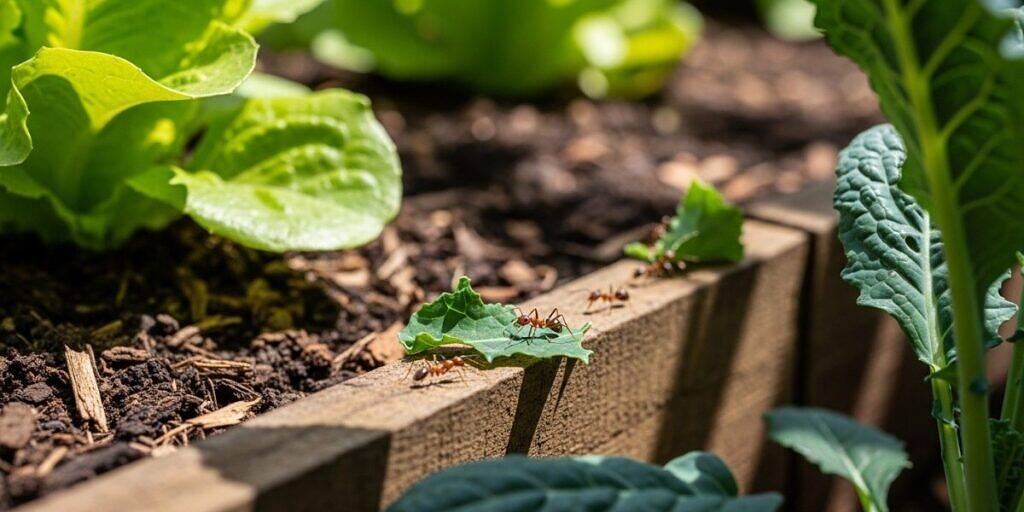
You wake up in the morning, head out to check your vegetable garden with that coffee taste still in your mouth and… where did the kale leaves go? They vanished overnight. It wasn’t slugs, it wasn’t the wind. It was the most organized and voracious army in the pest world: leaf cutter ants. I’ve lost entire seedlings in a single night before I finally understood that dealing with leaf cutter ants is not about killing insects – it’s about understanding their system.
Why leaf cutter ants attack your vegetable garden and how to avoid serious damage
Leaf cutter ants – especially species of Atta and Acromyrmex – do not actually eat your plants. They carry leaves, flowers, and even tree bark into the nest, but that material is not their direct food source. The purpose is far more sophisticated: they are cultivating a fungus.
Inside the underground colony, the leaf cutter ants finely chop the plant material and use it as a growing medium for the symbiotic fungus Leucoagaricus gongylophorus. This fungus is what feeds the entire colony – larvae, queen, and workers. That’s why effective control is not about killing ants along the trail. The key is to sabotage their fungus garden or prevent plant material from ever reaching it.
The damage in a vegetable garden can be devastating. A mature Atta colony can harbor up to 8 million leaf cutter ants and completely defoliate a young tree in just a few hours. In vegetables like kale, lettuce, tomatoes, and basil, the attack is even faster because the leaves are tender and easy to cut.

How to tell Atta and Acromyrmex leaf cutter ants apart and the secret of their food fungus
Knowing which leaf cutter ant species is in your vegetable garden makes a big difference. Atta ants are larger, reddish to dark brown, and have three pairs of visible spines on the upper side of the thorax. They build huge nests, with mounds of loose soil and multiple entrance holes.
On the other hand, Acromyrmex ants are smaller, more discreet, and have four or five pairs of spines. Their nests tend to be smaller and are often hidden under dry leaves, rocks, or even inside large containers.
In my garden, I once found leafcutter ants living literally inside a fern pot – the surprise was realizing the plant was “jumping” because the leafcutter ants were tunneling underneath it.
Both species depend 100% on the fungus to survive. If the fungus dies or becomes contaminated, the entire colony starves or is forced to move. This is the foundation of any smart leafcutter ant control strategy.
How to identify the nest and locate leafcutter ant attack trails
Before doing anything, you need to investigate. And here is a valuable tip: leafcutter ants are nocturnal. During the day, you may see some activity, but the real attack happens at night.
Take a flashlight and go out to the vegetable garden after 8 p.m. Follow the trails of ants carrying leaves – they always walk back to the nest along the same path. You will find the nest entrances, usually surrounded by loose, clean soil.
- If the soil mounds are large (about the size of a large washbasin or bigger), you are dealing with leafcutter ants of the saúva type.
- If they are discreet, hidden, or practically nonexistent, they are the smaller leafcutter ants known as quenquéns.
- Also watch for clear paths on the ground, like “roads” without leaves or twigs. They clean these routes to make transport easier.
Clear the area around the affected beds. Remove dry leaves, tall grass, and debris. Visibility is your ally. The better you can see the flow of leafcutter ants, the easier it will be to plan your control.
Practical guide to leafcutter ant control: from natural methods to chemical control
Now comes the practical part. I will share what truly works, based on my experience and on technical research developed over decades on how to control these ants.
Step 1: Installing physical barriers and using the inverted cone on the trunk
The first line of defense is to block access. If leafcutter ants cannot reach the plant, they give up and look for another food source.
The inverted cone barrier (an upside‑down plastic funnel) is one of the most effective and inexpensive tools for leafcutter ant control.
You can buy it ready-made at garden centers, farm supply stores, or improvise with 2-liter PET bottles:
- Cut the bottle in half.
- Make a hole in the center of the bottom (smooth side).
- Fit it around the plant stem, with the neck facing downward.
- The wide rim stays on top, creating a barrier that the ant colony cannot climb over.
Another option is to use wide double-sided adhesive tape around the stem or along the edge of raised beds. The ants stick to it and give up. In the market you can also find products sold as “Tree Grease” or “Barrier Tape”, which are ready-to-use products made from plant-based resins. I use them a lot on young tomato, apple, and pepper plants.
Step 2: Strategic use of black sesame and natural homemade baits
Here is one of the most underestimated secrets in organic ant control: black sesame. This is not folklore; it is applied science.
Sesame seeds and leaves contain compounds (such as sesamol and sesamin) that are toxic to the fungus cultivated by leaf cutter ants. When they carry sesame into the nest and try to incorporate it into their fungus garden, the fungus becomes diseased and dies. No fungus, no ant colony.
How to use it:
- Spread black sesame seeds directly along the foraging trails and around the nest entrances.
- Sow sesame in a strip or border near the raised bed under attack and, if possible, close to the foraging trails (it does not need to be exactly “in the middle of the path,” so it does not turn into tedious maintenance).
- Let it produce a good amount of foliage: the idea is to offer “available leaves” for several weeks.
- Repeat the application every 3 or 4 days.
- Use it as a complementary strategy, especially for mild or early infestations. For a large, very active ant colony, black sesame alone may not be enough (that is when integrated management and, if needed, professional ant control come in).
Other natural baits I have tested with moderate success include citrus peels—especially orange or lemon peels left to mold, used as bait along the trails or to prepare a spray solution for the beds. The aim here is not to “repel by smell,” but rather the hypothesis that the mold fungus and its microorganisms may interfere with the cultivated fungus that leaf cutter ants grow in the nest (the colony’s real food). In my garden, when consistency matters, black sesame still comes out ahead for organic ant control.
Step 3: Correct application of granular baits and commercial ant control dusts
If the infestation is severe and natural methods are no longer effective, it is time to move on to ant baits. In garden and agricultural supply stores, you will find products with active ingredients such as sulfluramid or fipronil.
Correct application makes all the difference. Many people make mistakes at this stage and end up wasting product:
- Never place bait directly inside the nest opening. This alerts the colony, which seals the entrance and ignores the product.
- Apply it along the foraging trails and near the nest openings in small portions (about one tablespoon is enough for each point).
- Use simple bait stations (a short piece of PVC pipe, a roof tile, or a cut plastic bottle) to protect it from rain. Wet bait quickly loses its effectiveness.
- Never touch the bait with your bare hands. Use gloves or a disposable spoon. In addition to toxicity, human scent can cause the ants to reject the product.
- Apply on dry days and preferably in the late afternoon, when the ants begin their nighttime activity.
There are also ant control dusts that are applied directly into nest openings with a duster. These are more aggressive and effective for large leafcutter ant nests. Always wear a mask and gloves when handling these products.
Step 4: Night monitoring and the use of biological insecticides
After any application, go back at night with a flashlight. Check whether the flow of ants has decreased, whether new nest openings have appeared, and whether they are carrying the bait. This monitoring is essential for adjusting your ant control strategy.
A modern and sustainable alternative is biological insecticides based on entomopathogenic fungi such as Beauveria bassiana or Metarhizium anisopliae. These fungi infect and kill the ants without harming other beneficial insects. On the label, look for products described as “microbial insecticide” or “biological ant control”.
Application is done by spraying or dusting the product along the trails and at the nest entrances. Effectiveness is good, but it takes longer than chemical products—around 10 to 15 days for visible results.

Wait at least 15 days (follow the time indicated on each product label) before harvesting.” width=”1080″ height=”1350″ /> Do not apply ant poison when harvest time is near, or while plants are in bloom. Wait at least 15 days (follow the time indicated on each product label) before harvesting.
Common mistakes that prevent effective ant control and how to avoid them
I will be direct: there are mistakes almost everyone makes. And often this is exactly why you end up thinking that “nothing works” when using ant killer in the garden.
- Touching the bait with bare hands: Your scent contaminates the product and the ants will not carry it back to the nest.
- Applying bait on rainy days: Water dissolves and ruins the bait. Wait for a dry spell.
- Throwing bait directly into the hole: This blocks the entrance and the colony simply opens another exit.
- Giving up too soon: Ant control takes time. It can take 1 to 3 weeks for the colony to die out completely.
- Using homemade ant killer like salt, vinegar or boiling water directly on the soil: This kills nearby plants and can acidify or increase salinity in the soil. Avoid it.
As one reader recently commented: “I tried using salt and vinegar, but all it did was kill my plants. What really worked in my organic garden was surrounding the beds with wide double-sided tape and planting mint and sesame along the borders.”
Safety and precautions with children and pets when using ant killer
Ant baits are toxic to pets and children. Dogs and cats may confuse the granules with food. Therefore:
- Always use protected bait stations (pipes, tiles, or boxes with a small entrance).
- Mark the treated area with tape or small warning signs.
- Keep children and pets away during and after application (for at least 24 hours).
- Store products up high, locked away, and far from food.
- Never apply near streams, ponds, wells, or cisterns.
If accidental ingestion occurs, immediately contact a veterinarian or physician and take the product packaging with you. Contact your local Poison Control Center.
Repellent plants and living barriers to keep your vegetable garden protected in the long term
The smartest strategy is to turn your garden into an environment that is naturally hostile to ants. And the best way to support your ant killer program is with plants.
Sesame planted along the edges works as a chemical barrier.
Leafcutter ants avoid cutting sesame leaves because they already “know” the plant contaminates their cultivated fungus. It is a collective memory of the species.
Other plants with a repellent or sacrificial effect:
- Marigold (Tagetes): The strong scent repels leafcutter ants and other insects.
- Mint (Mentha): When planted in containers or along bed edges, it works as an aromatic barrier.
- Rue (Ruta graveolens): Extremely repellent, but toxic to humans and pets. Use with caution.
- Nasturtium (Tropaeolum majus): Attracts aphids and leafcutter ants away from the main vegetable crops (trap plant).
In my garden, I always keep a belt of sesame and marigolds around the vegetable beds. It is not 100% leafcutter ant‑proof, but it dramatically reduces damage.

Frequently asked questions about controlling leafcutter ants in home vegetable gardens
1. Will the leafcutter ants leave if I destroy the nest with water?
No. You may kill part of the colony, but if the queen survives (and she stays in the deepest chambers), the colony will recover. In addition, soaking the soil with hot water can harm nearby plants by burning roots and causing waterlogging.
2. Can I use coffee grounds or cinnamon to repel leafcutter ants?
They work as a temporary repellent along the foraging trails, but they do not solve the problem at its source (the nest). They are useful to protect a specific plant for a few days.
3. How long does it take for bait to work?
From 7 to 21 days, depending on the size of the colony and how much bait is carried inside.
4. Can I plant on top of an old leafcutter ant nest?
Yes, but loosen the soil thoroughly and add compost. Soil from leafcutter ant nests is usually low in nutrients because it has been “sifted” by the ants.
5. Do leafcutter ants come back after control?
Yes, they can. Especially if there are other colonies in the surrounding area. Control is continuous, not a one‑time action.
Patience and observation as keys to a productive vegetable garden
Controlling leafcutter ants is not a one‑day battle. It is a game of strategy, patience, and constant observation. After losing many leaves, I learned that prevention is always better than cure. And that nature offers its own solutions – such as sesame – when we slow down and pay attention.
Start today.
Do a nighttime inspection, install physical barriers around the most vulnerable plants and, if necessary, apply slug and snail baits correctly. Your vegetable garden deserves that level of care. And you can be sure of this: when you harvest that perfect kale leaf, without a single hole, every bit of effort will have been worth it.
Now it’s up to you: choose a method, stick with it for 7–10 days, and really observe what happens (fresh slime trails, intensity of the damage, and which plants are being targeted). Write down what changed — because a productive vegetable garden is not grown with soil and water alone; it’s also built on careful testing and continuous learning.