
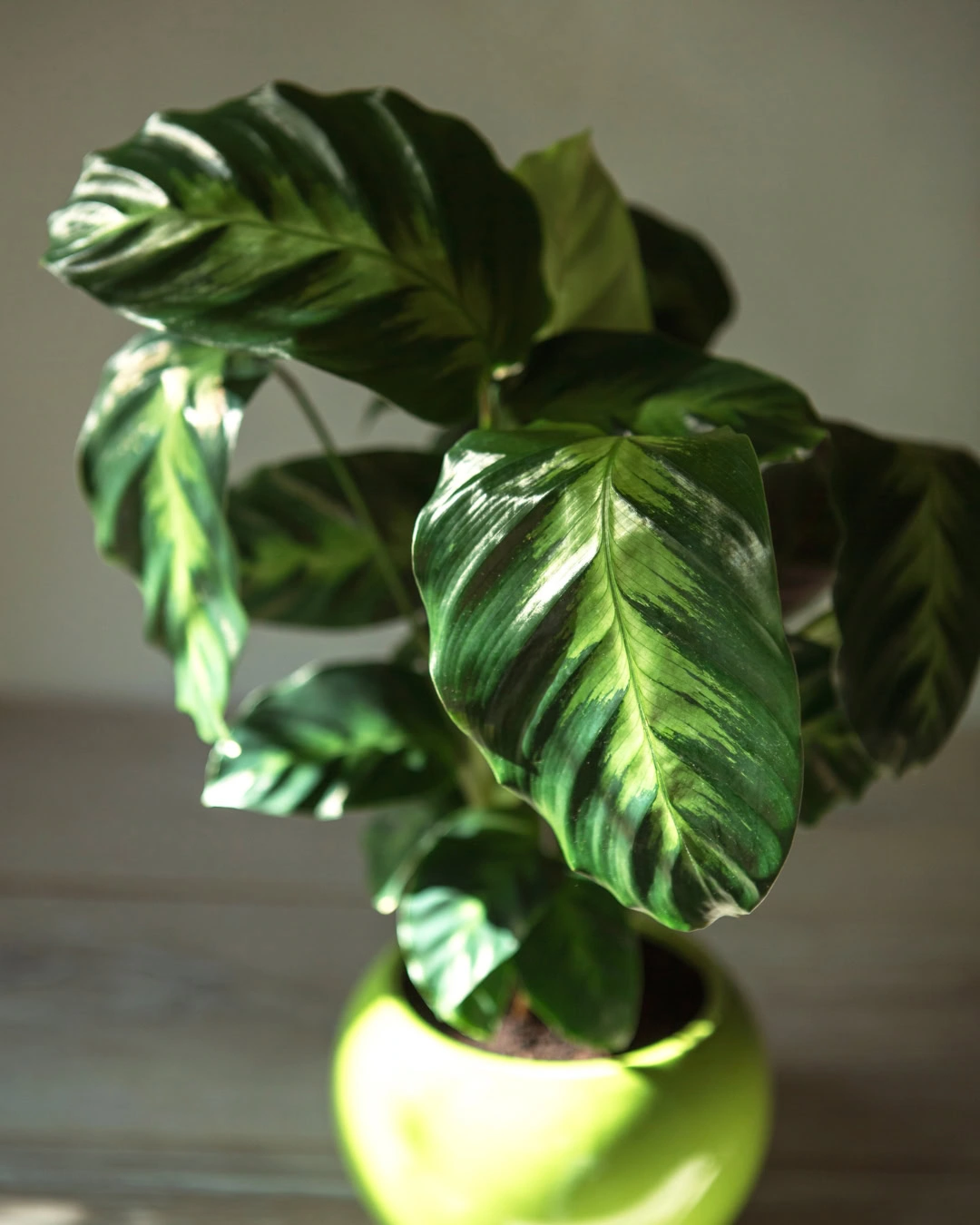
The White Fusion Calathea (Goeppertia lietzei) is a tropical herbaceous plant native to Brazil, prized for the unusual patterning of its foliage. Against the dark green background of the leaves, short, irregular bands of lighter green appear, while the undersides show a purple tint. The contrast shows with every movement of the leaves, making this species stand out even when it takes up very little space. This Brazilian species is also the origin of the famous cultivar ‘White Fusion,’ one of the most sought-after variegated foliage plants in the world.
Also sold in the trade as White Fusion Calathea, the plant forms compact clumps and adapts very well to containers, sunrooms, and protected garden beds. Like other species in the Marantaceae family, it moves its leaves throughout the daily cycle, raising them at night and repositioning them during the day. It is a foliage plant for bright shade: it does not need direct sun, but it also does not appreciate dark, dry conditions or sudden changes. That balance point explains many of the successes and failures in cultivation.
Origin, Habitat, and Etymology
The White Fusion Calathea is native to eastern Brazil, with records from the Northeast and Southeast, where it is associated with the Atlantic Forest, especially the understory of humid forests. Its native habitat helps explain how to grow it: this is an understory plant, accustomed to light filtered through dense tree canopies, soil covered with leaf litter rich in organic matter, and an atmosphere that is more humid and stable than what is found in open sites. Anyone who understands this rainforest heritage can anticipate the most common problems, because strong sun, drying wind, and long dry spells usually damage the leaves quickly.

The currently accepted name is Goeppertia lietzei. The species was described in 1875 by Édouard Morren as Calathea lietzei, the name under which it still appears in stores, collections, and horticultural publications. Maranta lietzei also appears in the literature as a synonym. The transfer to Goeppertia follows the modern reorganization of the Marantaceae family, based on phylogenetic studies and a revision of the boundaries between Calathea and related genera.
Behind these names are two tributes. The genus Goeppertia honors the German botanist and paleobotanist Heinrich Göppert. The epithet lietzei was dedicated to Lietze, the Brazilian correspondent of the former Belgian horticultural establishment Jacob-Makoy.
Landscape Uses for White Fusion Calathea
In landscaping, White Fusion Calathea works as a foreground foliage plant and groundcover for protected areas in humid tropical and subtropical gardens. Its low clump does not hide structural plants. It can be grown under trees, palms, and shrubs with open canopies, as long as it does not face heavy root competition or dry soil. Where frost occurs, it should remain in very sheltered spots or in containers protected during winter.
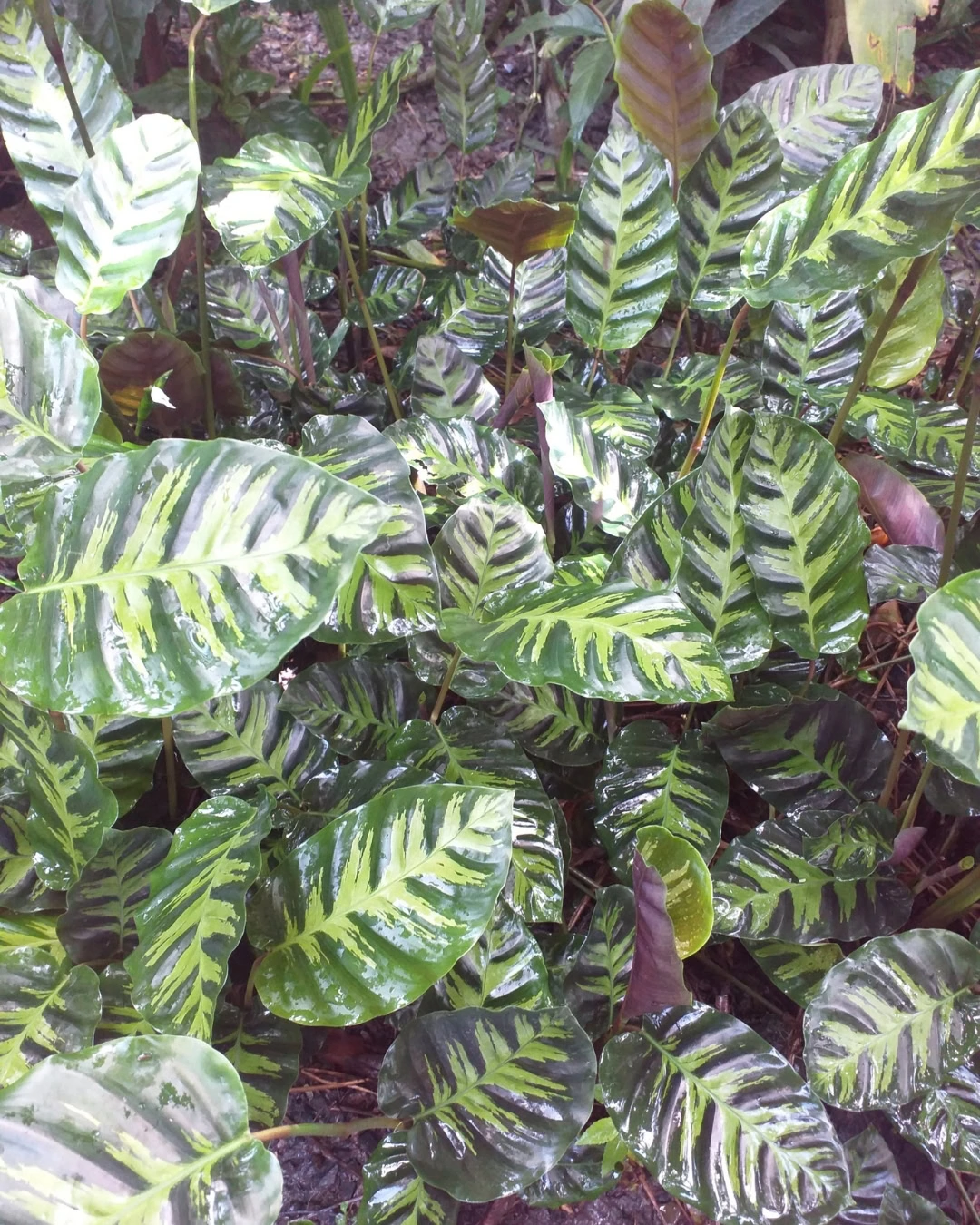
In mass plantings, the striping creates rhythm and highlights shaded beds, but the plant should not be treated as a tough, no-care groundcover. An initial spacing of 14 to 18 in (35 to 45 centimeters) allows the clumps to develop; how quickly the bed fills in will depend on climate, fertility, and available water. It is more realistic to expect moderate bed coverage and fill gaps later with divisions from the plant itself.
Enjoyed this guide? There's more where it came from.
Understanding why plants behave the way they do is what turns guesswork into a thriving garden. That's exactly what we share in the Shrubz newsletter — free, straight to your inbox:
- Seasonal care reminders timed to your gardening calendar
- Propagation and pruning techniques, explained step by step
- Pest and disease alerts — catch problems before they spread
Goeppertia lietzei pairs especially well with larger-scale foliage and simpler forms, or even different shades of green. Under Palmito-juçara (Euterpe edulis) or alongside philodendrons, anthuriums, aspleniums, and other shade plants, its narrow, striped leaves add detail without competing with bolder forms. It can also form edging along protected paths or be used near stones, logs, and dark finishes, surfaces against which the purple undersides and green markings stand out.
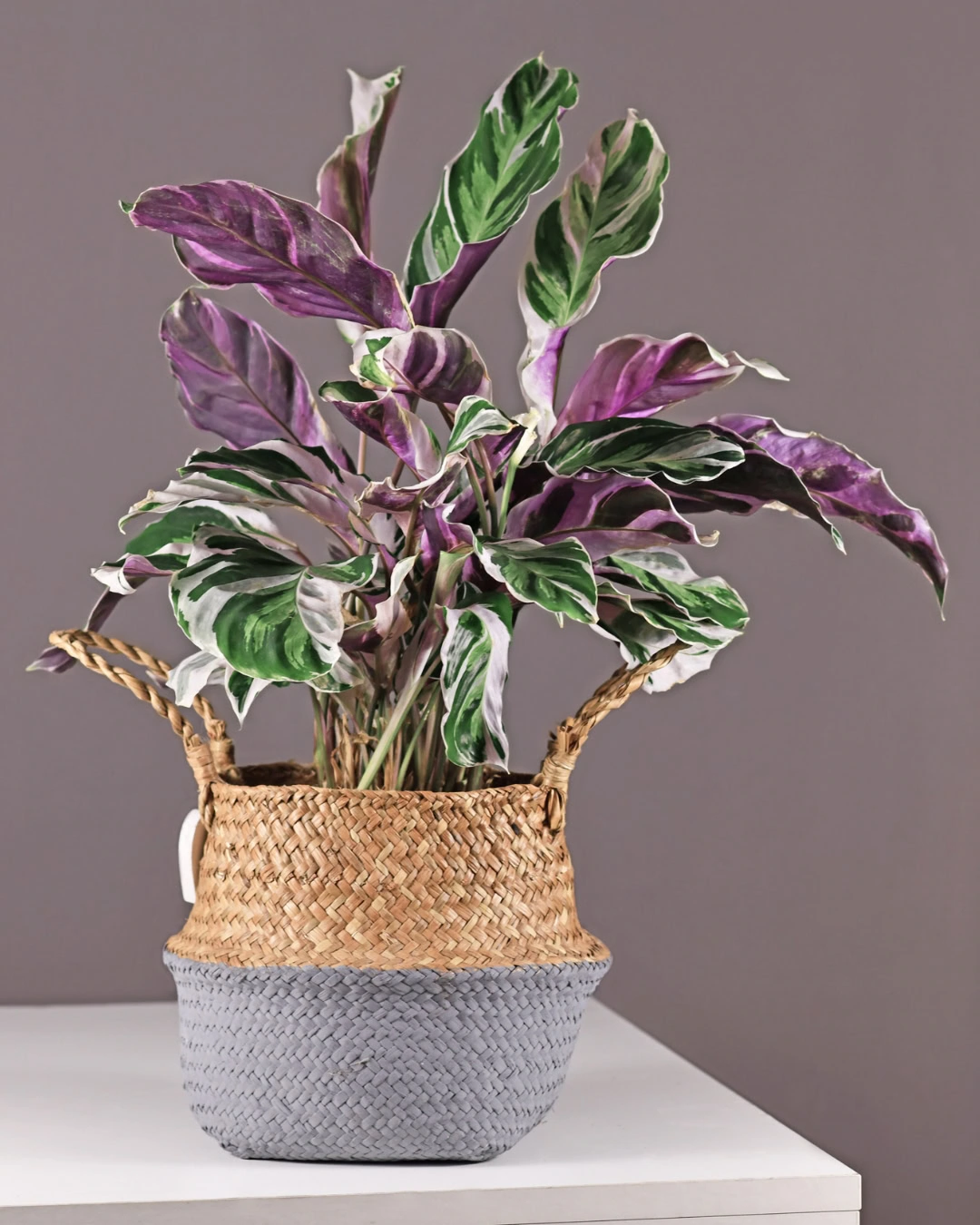
Indoors, its restrained size in containers suits console tables, side tables, low shelves, and plant stands, as long as it gets good indirect light. The pot needs drainage holes and dimensions proportional to the clump; overly large containers hold moisture longer. Decorative cachepots made of ceramic, wood, natural fiber, or metal complete the look, but they should not allow water to collect around the pot.
In decor, the foliage fits naturally with the Urban Jungle style, which brings together plants of different heights and textures. White Fusion Calathea occupies the lower layer of this “indoor understory,” between upright species such as ficus and dracaenas and trailing plants such as philodendrons and pothos. To keep the collection from becoming simple clutter, it helps to repeat materials, distribute volume, and respect the light needs of each species.
The species also fits into biophilic interiors, contemporary tropical design, and compositions with wood, straw, linen, and handcrafted ceramics. In minimalist spaces, a well-grown specimen works as a focal point; in maximalist settings, it can be part of groups of patterned foliage balanced by solid leaves. The cultivar ‘Fusion White,’ sold as White Fusion, is much lighter and pairs well with palettes of white, sand, sage green, and lilac.
Sunrooms are favorable when they receive abundant brightness without intense sun. In vertical gardens, it offers color and volume without producing long trailing stems. It needs pockets with room for the rhizomes and regular irrigation. Walls near air conditioning, ventilation outlets, or heat-reflecting facades should be avoided. The design should also make it possible to remove modules, divide clumps, and remove damaged leaves.
Covered patios, powder rooms with a window, and ventilated bathrooms can also accommodate it. Humidity helps, but it does not make up for lack of light or waterlogged substrate. The best position offers diffused light, protection from drafts, and easy access for maintenance.
How to Care for White Fusion Calathea: Growing Guide
- Light: Grow in filtered light, partial shade, or abundant indirect light. Near a window, filter the strongest sun with a sheer curtain or move the pot out of direct rays.
A little weak early-morning sun can be tolerated after acclimation, but intense direct sun fades the patterning and causes dry patches. - Potting mix: Use a mix that is rich in organic matter but also porous and airy. A good combination includes potting mix or coconut coir, well-aged organic compost, and structural materials such as composted pine bark, perlite, or expanded clay. There is no single recipe or need to lock the pH into a narrow range; the key is that the mix holds moisture without staying saturated and that the pot drains excess water quickly.
- Watering: Keep the potting mix lightly moist, watering when the surface starts to dry. Thoroughly soak the entire root ball and discard any water that collects in the saucer. In cooler weather, increase the interval according to how the potting mix is drying. Burned tips can be made worse by salts, chlorine, or fluoride; in that case, use rainwater or low-mineral water. Letting water sit out may dissipate free chlorine, but it does not remove salts or fluoride.
- Climate: This species prefers moderate warmth, mild nights, and little fluctuation. It grows well at the usual temperatures of comfortable indoor spaces, but loses vigor when exposed to persistent cold. Protect it from frost, cold windows, wind, and sudden temperature swings. In areas with cold winters, keep the pot indoors or in a heated, bright greenhouse.
- Humidity: Moderate to high humidity encourages full, well-opened leaves, especially in the cultivar ‘White Fusion’. Air conditioning, heaters, and dry air often cause brown edges. A humidifier and grouping plants together are more effective than occasional misting. Also provide air circulation, since stagnant conditions and leaves that stay wet for many hours create opportunities for diseases and pests.
- Fertilizing: During the growing phase, preferably use organic fertilizer or a controlled-release fertilizer, type ‘cote’, following the manufacturer’s rate. Light, regular applications are better than heavy feeding, because excess salts burn the roots and leaf edges. Controlled-release fertilizers can also be used in pots. In the garden, well-aged organic compost helps maintain soil structure.
- Pruning: Only clean up the clump. Cut off dry, heavily spotted, or broken leaves at the base of the petiole using clean scissors. Isolated brown edges can be trimmed to follow the natural outline of the leaf without cutting into living tissue, but this is only cosmetic: to keep the problem from returning, correct the watering, water quality, excess fertilizer, or low humidity.
- Repotting: Over time, old potting mix becomes depleted, salt-laden, and compacted, and it should be replaced with fresh mix to restore the plant’s vigor. Repot preferably every two years, choosing a pot proportional to the clump. Carry out periodic flushing of the potting mix to extend its useful life.
- Leaf movement (nyctinasty): The nighttime lifting of the leaves is normal and varies with light, the plant’s biological clock, and its water status. This movement should not be used by itself as a “thermometer” of health. Persistently curled or drooping leaves, or leaves that cannot regain turgor, however, are a reason to check the moisture in the potting mix, the condition of the roots, the temperature, the presence of spider mites, and the light intensity.
How to Propagate White Fusion Calathea
The safest way to propagate White Fusion Calathea is by dividing a mature clump. This can be done at the beginning of an active growth phase (spring and summer), when warmer temperatures and bright days support recovery. Avoid dividing newly purchased, weakened, infested, or sparsely sprouted plants, since each division needs to retain enough reserves to reestablish itself.
Remove the root ball from the pot and observe how the groups of leaves are connected by the rhizomes. In many specimens, the natural divisions can be gently separated by hand. Where firm tissue is holding the sections together, use a clean, sharp knife. There is no need to wash the roots completely, a practice that increases stress and can break the finer structures.
Each division should keep healthy roots and at least one vigorous set of leaves and growing points. Very small divisions take longer to recover and dehydrate easily.
Remove only roots that are clearly dead, dark, and mushy; firm roots, even if stained by the potting mix, should be preserved.
Plant the divisions in pots only slightly larger than the root mass, using fresh, moist, well-aerated potting mix. Keep them in indirect light, a warm environment, and sheltered from wind. Humidity can be increased with a humidifier or with a temporary clear cover, but in that case, leave openings for ventilation and remove the cover gradually. A completely closed dome in warm conditions encourages condensation and rot.
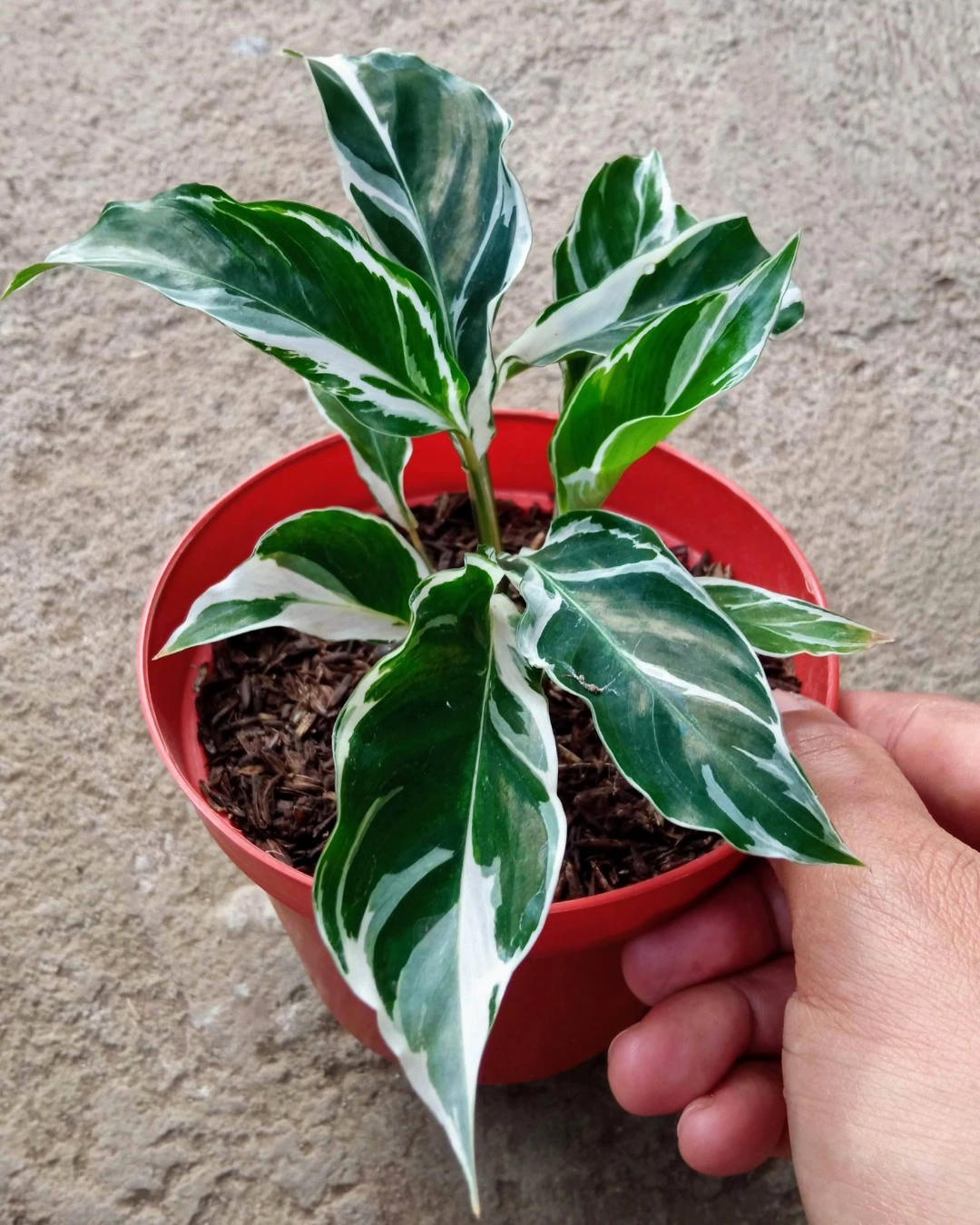
In the first few weeks, the potting mix should stay lightly moist, not soggy. Wait for signs of renewed growth before fertilizing. Some older leaves may lose firmness after division; that alone does not mean the division has failed. The best indicator of successful rooting is the emergence of new shoots.
Botanical description of Goeppertia lietzei
White Fusion Calathea is a herbaceous, rhizomatous plant in the Marantaceae family. It forms compact clumps, generally reaching about 12 to 20 inches (30 to 50 centimeters) in height and width in cultivation. The plant produces leaves clustered from the base. Botanical descriptions record Goeppertia lietzei as an acaulescent species, or one with a short, upright stem ending in leaves. The petioles are upright, green, and sheathing at the base. Between the petiole and the blade is the pulvinus, a thickened region capable of changing its internal pressure and repositioning the leaf throughout the day (nyctinasty).
The leaves are slightly asymmetrical, ovate-lanceolate to elliptic-lanceolate, with entire, wavy margins, a base that is truncate to rounded, and a narrowed tip. They measure about 7.1 inches (18 centimeters) long by 3.3 inches (8.5 centimeters) wide, with petioles up to about 5.9 inches (15 centimeters). Cultivated specimens may show different dimensions.
On the upper surface, the dark green background is interrupted by short, incomplete bands of lighter green radiating from the midrib in an irregular arrangement. The pattern does not form continuous stripes to the margin, a useful characteristic for recognizing the species. The undersides are purple and may have a silky appearance, especially on new leaves. The leaves emerge rolled up and gradually expand. When young, they are more delicate and vulnerable to strong sun, handling, and low humidity. Once mature, they retain some flexibility and move through the action of the pulvinus.

Flowering is subtle and much less frequent indoors than on established plants growing under favorable conditions. The flowers are small, tubular, and whitish to light green, grouped in spike-type inflorescences protected by bracts. The ornamental value of the species is concentrated mainly in the foliage. In indoor cultivation, the plant rarely completes its life cycle by seed.
Main varieties and cultivars
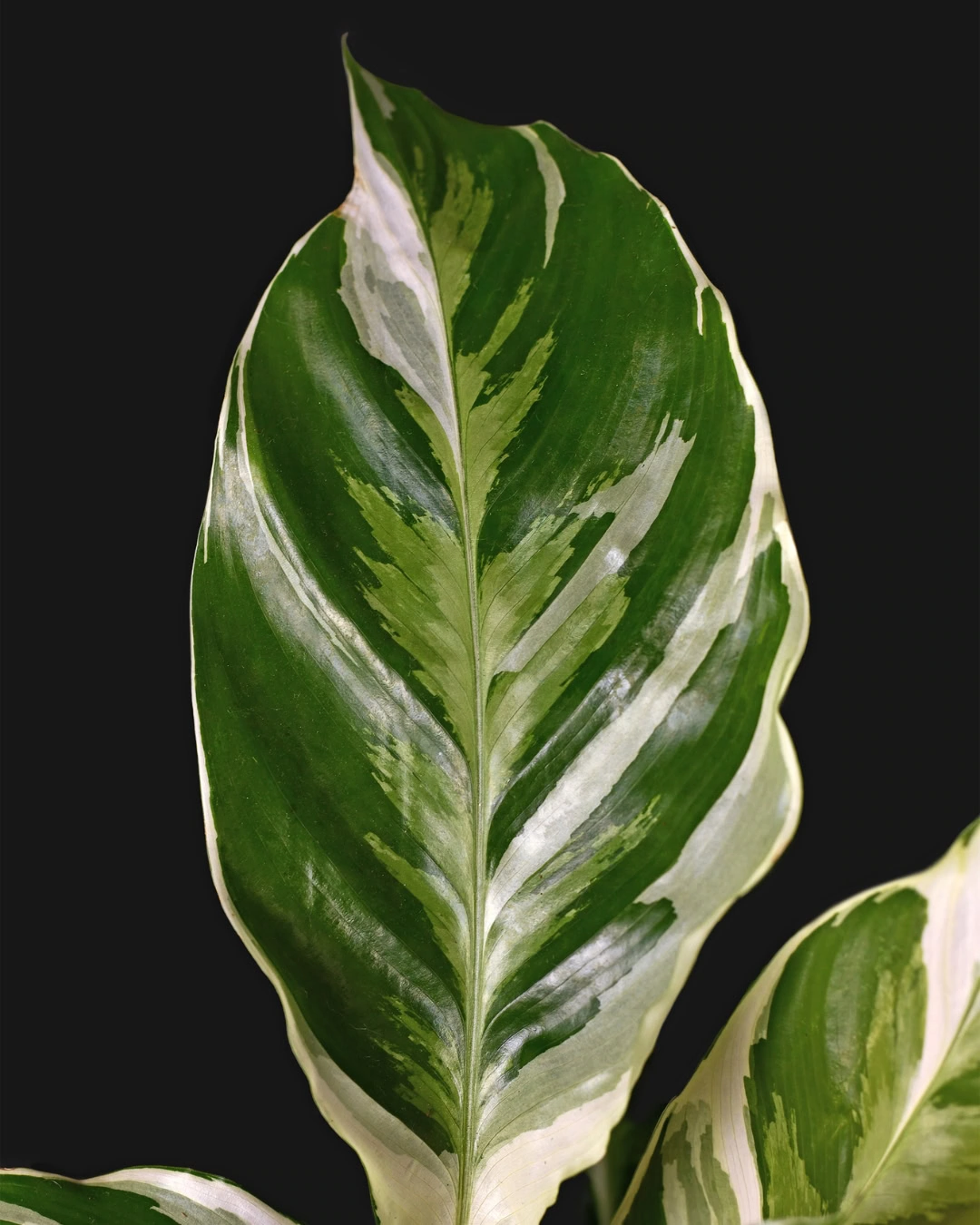
- Goeppertia lietzei ‘Fusion White’ (known as Calathea ‘White Fusion’): This is the best-known and most commercially important selection of the species. Although “White Fusion” has become established as the trade name, the denomination registered in the patent document is ‘Fusion White’. The cultivar arose as a spontaneous mutation found in 2007 in a commercial planting of Goeppertia lietzei in Malaysia. After being propagated vegetatively and observed for a few years, it showed enough stability to be registered in the United States in 2015. Its leaves display irregular marbling in white, light green, and dark green, with each blade forming a different pattern. The undersides take on tones of lilac and translucent purple, which appear along the wavy margins and during nighttime movement. Compared with the green form from which it originated, ‘White Fusion’ is more compact, has smaller leaves, and grows less vigorously, but it produces side shoots readily. This combination of light variegation, a size well suited to pots, and visible differences from leaf to leaf explains its importance among collectors and in the world of variegated plants. White, however, represents areas with little or no chlorophyll. The cultivar grows more slowly, is sensitive to intense light, and quickly shows stress in the form of dry edges. It needs bright indirect light to maintain good contrast, but it should be protected from strong direct sun. Regular watering, water with a low concentration of salts, airy potting mix, and stable ambient humidity make more difference than occasional misting. In decor, it works best as a focal plant viewed up close.
It can sit on a side table, a console, or in the foreground of an indoor garden room, where the marbled pattern looks like watercolor brushstrokes. It should not be tucked away at the back of a planting bed or placed in a hard-to-maintain vertical garden: because it is more sensitive and valuable than the typical form, it benefits from an accessible spot for inspection, watering, and spider mite control. Completely green new growth or persistent changes in the pattern should be monitored; commercial and home propagation is done only by division or tissue culture, never by seed.

Pests, diseases, and solutions
Spider mites, especially two-spotted spider mites, are among the most common problems indoors in warm, dry conditions. Fine pale stippling, a washed-out look, and delicate webbing on the undersides of the leaves call for isolating the plant and inspecting nearby plants as well. Wash the foliage carefully and use a miticide or sulfur-based products labeled for ornamental plants, following the label and repeating treatment according to the pest’s life cycle. Raising humidity improves the growing environment, but by itself will not eliminate an established infestation.
Mealybugs and scale insects can hide in the leaf sheaths, on the petioles, and on the undersides of the leaves. In light infestations, remove them by hand with cotton or cotton swabs moistened with 70% alcohol, testing first on an inconspicuous area to avoid spotting. Heavier infestations require an appropriate product and repeated applications.
General yellowing, a darkened base, and soft roots are usually associated with overwatering and lack of oxygen in the potting mix. Remove the plant from the pot, cut away damaged tissue, disinfect the tool, and repot in a more aerated mix. Leaf spots may be fungal or bacterial in origin and should not automatically be attributed to a particular type of pathogen without a diagnosis. Remove badly affected leaves, avoid wetting the foliage at night, improve air circulation, and do not reuse contaminated potting mix.
Brown tips, curled leaves, and loss of color are not always signs of disease. The most common causes are dry air, irregular watering, salt buildup, highly mineralized water, cold, too much sun, or too little light. Look at the pattern and the plant’s history before applying pesticides. Correcting care usually solves more than a shelf full of sprays; the plant is already naturally striped and does not need extra patterns from overtreatment.