A small garden may look easy to design, but limited space actually makes mistakes stand out more clearly: visual clutter, narrow pathways, poor drainage, a “visual salad”. In a compact space, every choice has impact. The good news is that small garden landscaping techniques can be translated into very objective decisions, with no mystery and with a truly “professional project” look.
In this guide, I’ve gathered 21 practical ideas that bring together principles of composition, circulation, zoning, texture, color, lighting, perspective, and levels. The goal is that you can look at your outdoor space and identify opportunities to reorganize, replace, correct, and enhance what is already there — and not just “fill it up with pretty plants”.
Enjoyed this guide? There's more where it came from.
Understanding why plants behave the way they do is what turns guesswork into a thriving garden. That's exactly what we share in the Shrubz newsletter — free, straight to your inbox:
- Seasonal care reminders timed to your gardening calendar
- Propagation and pruning techniques, explained step by step
- Pest and disease alerts — catch problems before they spread

How a landscape designer sees a small garden
Before getting into specific ideas, it helps to understand how a professional usually looks at a compact outdoor area. The focus is not only on plant species, but on how everything is organized: where people walk, where the eye is naturally drawn, which areas are actually used, and how the garden behaves throughout the day.
Three concepts are practically mandatory when it comes to small garden landscaping:
- Visual hierarchy: having one main focal point and other elements that support it, avoiding confusion.
- Layers: arranging plants at different heights (ground level, mid-height, tall) to gain volume without losing usable space.
- Circulation and proportion: respecting minimum pathway widths and matching plant size to the scale of the space.
From there come the details: textures, colors, paving layout, changes in level, lighting, and accessories. The 21 ideas below work together and can be adapted both to ground-level yards and to small garden landscaping along patios, decks, or side yards.
21 small garden landscaping ideas that look professionally designed
1. Divide the garden into clearly defined use zones
In a small area, trying to “do everything everywhere” is a recipe for chaos. Think of your yard as a miniature site plan: which zone is for relaxing and contemplation, which is for circulation, where the main planting bed goes, and where you fit in a seating nook or a decorative kitchen garden?
Even when the yard is only a few feet (poucos metros) wide, dividing it into sectors with changes in paving, planted borders, or height variations brings a sense of order. A bench against the wall, for example, becomes the “resting area”; a continuous planting bed along the fence defines the planted sector; the path becomes a circulation zone rather than something improvised. Even with these separations, avoid assigning too many different functions to a small space.

2. Ensure comfortable pathways: width is not a detail
Narrow walkways are one of the most common mistakes in a small garden. Below about 32–36 in (0,80–0,90 m), circulation becomes uncomfortable and people start stepping into the planting beds. For main circulation routes, a professional reference is to work with approximately 4 ft (1,20 m), in line with widely adopted accessibility guidelines and universal design principles.
If there is not enough room for a wide path along the entire route, it can narrow in specific stretches, as long as you maintain occasional “breathing points” — widened areas for stopping, seating, or changes in direction. In practice, this makes the garden feel more intentional and prevents that cramped, corridor‑like sensation.
3. Choose a single main focal point
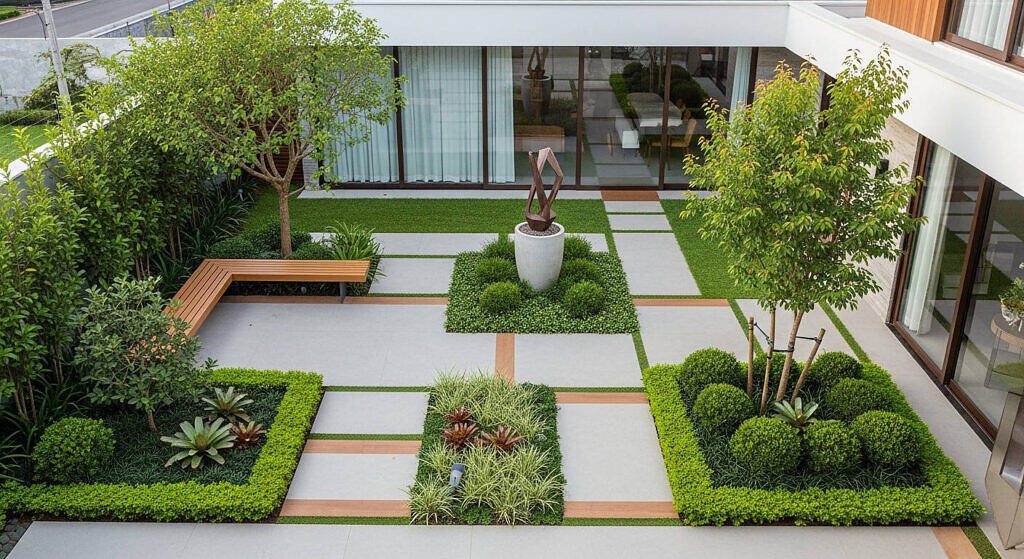
Every small garden deserves a protagonist: a sculpture, a compact fountain, a sculptural container, a small ornamental tree with an interesting canopy, or a striking piece of art. The key is to choose one main focal point and let the rest of the space act as a backdrop.
When too many bold elements are scattered around, the eye doesn’t know where to rest, and the garden loses visual clarity. A reliable trick is to place the main focal point in line with a visual axis coming from inside the house: framed by a patio door, a living‑room window, or the dining table view. This way, the small garden becomes a living picture that visually extends the interior.
4. Use visual axes to increase the sense of depth
Visual axes are imaginary lines that lead the eye toward a destination: a container, a tree, a sculpture, or a framed view of the surrounding landscape. In a small garden, this strategy helps break the feeling of being in a simple outdoor “box.”
You can create visual axes with:
- a path that leads to a focal point;
- a unified row of the same plant species;
- a strip of flooring that continues from the interior of the house out into the garden;
- a bench or armchair placed at the end of the view.
When this axis connects to the interior of the home, it creates visual continuity and makes the garden look larger than it really is.
5. Work with layered plant stratification
Instead of filling the planting bed with plants of random and uneven heights, apply the principle of stratification: ground layer (groundcovers), middle layer (shrubs, planting masses) and upper layer (small trees or trained climbers).
This structure mimics a small woodland and allows the garden to gain volume without taking over the limited hardscape. Low groundcovers near the soil, a “middle” zone with medium-height plants, and taller elements near the back fence or wall create a sense of depth and a more mature small garden.

6. Match plant size to the scale of the space
Scale is one of the main factors that reveals an amateur garden: oversized plants in tiny spaces, tree canopies covering half the yard, roots lifting paving or pushing against walls. In a small garden, trees with aggressive root systems should be avoided.
Choose species with controlled growth and non-invasive roots, such as small ornamental trees and compact specimens. Species like Eugenia uniflora or Lagerstroemia indica are examples of trees that, when used thoughtfully, can work well in more confined residential gardens without the risk of structural damage.
7. Repeat species in planting masses to create unity
A classic mistake in landscaping for small gardens is using too many different species: a single specimen of everything, all competing for attention. In compact areas, fewer species in greater quantities create rhythm, unity, and a professional, cohesive landscape design look.
Instead of planting five different types of shrubs in a single border, choose two or three and plant them in bold groups (drifts). Repeating the same shrub in two or three spots along the path visually connects the landscape design and avoids the effect of a “garden center collection.”
8. Combine foliage textures to add sophistication
Texture is the overall feel that foliage conveys: fine or coarse, smooth or rough, stiff or delicate. In a small garden, working carefully with foliage texture in garden design can reduce the need to fill the space with lots of flower colors.
An elegant planting scheme can mix:
- broad leaves (which add visual weight) at the front of the border;
- fine or lacy foliage at the back, to visually pull the boundary away;
- a few plants with glossy foliage or distinctive coloring, as points of light.
This play of contrasts creates depth and interest even when the garden is not in bloom.

9. Use color strategically, not like fireworks
Color can make a space feel larger or smaller. Cool, light colors (such as blue‑green foliage and flowers in lilac or white tones) tend to recede, creating a sense of greater depth. Warm, intense colors (reds, oranges) visually advance toward the viewer.
In small gardens, it often works best to concentrate the most intense colors close to where people stand or sit, and keep the back of the garden in cooler, softer tones. This principle, similar to the use of color in visual perspective, helps “push” the garden boundary farther away.
10. Create forced perspective with sizes and textures
The forced‑perspective technique is very effective in compact spaces: place plants with larger leaves and bolder textures toward the front of the border, then gradually reduce leaf size and refine texture as you move toward the back.
That way, the brain reads the back of the garden as being farther away than it really is, making the small garden design feel deeper and more spacious.
It works just like in illustrations and stage sets: the foreground is more visually dense, while the background is lighter and more delicate.
11. Position garden beds or paving on the diagonal
You don’t always need to follow the exact orthogonal layout of the house. In many cases, positioning a path or garden bed on the diagonal makes a small garden look bigger by visually stretching the space. A paving axis at a 45° angle to the façade creates a longer sightline than a path running parallel to the fence or wall.
In practice, this can be done with a slightly angled paved strip, planting beds drawn on the diagonal, or even a sequence of containers marking the axis. It’s a simple garden design strategy to break up that “rectangular box” feeling.

12. Hide boundaries and corners so the garden looks larger
When we can clearly see all four corners and the entire perimeter of the fence or wall, our brain quickly defines the size of the area. In a small garden, it’s worth hiding the corners with denser planting, vines, or vertical elements.
You can, for example, place more voluminous plants where the walls or fences meet, keeping the center more open and airy. This deliberate “loss of reference” makes the garden feel less confined and more immersive.
13. Use edging to visually organize the planting bed
Edging — strips of low plants, stones, or other linear elements around beds and paths — helps organize the garden design. In a small garden, a continuous border with uniform height creates a sense of clarity and a finished look.
You can use the same groundcover species as a border for all the beds to reinforce unity. Or you can define a line of pebbles, wood, or another material that clearly separates where you walk from where you plant, reducing damage to the plants.
14. Treat paving layout as part of the design
Paving is one of the strongest allies in landscaping for small gardens. Beyond choosing the material, it’s essential to think about the layout pattern: direction of the pieces, size of the slabs or pavers, joints, bands, and combinations.
Elongated pieces installed in the direction of the garden’s greatest length help stretch how we perceive the space in a small garden.
Alternating paving bands with small strips of planting or gravel creates rhythm. Just be careful not to overdo the cutouts, as too many can interfere with circulation and make cleaning more difficult.
It is also essential to ensure the proper slope of the paving (about 1–2% / 1⁄8–1⁄4 in per 10 ft) toward well‑positioned drains, preventing puddles, moss, and root rot in waterlogged areas.
15. Play with levels: subtle grade changes and raised beds
Even in small, relatively flat yards, slight changes in level enrich the garden design. A single step marking the transition from the living area to the garden, a raised garden bed, or a bench built into a low wall—all of this adds a sense of depth.
Slightly raised planting beds, for example, bring the plants closer to eye level and can reduce the need for many tall species, which occupy a lot of volume and feel visually heavy. It is important, however, to respect safety and ergonomics, avoiding hazardous height differences or unmarked steps.
16. Integrate the garden with the interior of the home
A well‑designed landscape does not treat the garden as an afterthought tacked onto the outside. The more the flooring, colors, and sightlines relate to the interior, the smoother the transition will be.
If the interior has light‑colored flooring and clean, straight lines, for instance, repeating that material—or a similar version—on the patio and along the main path helps visually extend the indoor space into the garden. From that point on, the garden design becomes the main feature, but without an abrupt break. This visual continuity is a classic technique in contemporary residential garden design.

17. Highlight both scenic and functional lighting
In compact garden design, well‑planned lighting transforms the space at night and increases the sense of depth. Instead of relying on a single ceiling fixture, consider:
- low path lights marking the walkway;
- spotlights directed at a trunk, sculpture, or textured wall;
- soft lighting that highlights the main focal point.
Today, relatively affordable lighting automation makes it possible to create different scenes: more functional for circulation and more atmospheric for entertaining or relaxing. This resource aligns with the growing trend of wellness gardens, which enhance the home as a place of rest and connection with nature.
See more about landscape lighting and decks in planning your garden: decks, patios, walls, fences, and lighting.

18. Combine edible gardens and aesthetics without overloading the design
In small spaces, it is absolutely possible to have an ornamental garden with edible elements without losing a sophisticated look. The key is to integrate the vegetable garden into the layout, rather than isolating it as a disorganized “utility bed.”
You can combine herbs and culinary plants with interesting height and texture alongside other ornamental species, as long as you group them according to their light and water requirements. Vegetable gardens in aligned containers, or in planters integrated into benches and low walls, work very well in compact gardens when they follow the same design language as the rest of the project.
19. Choose trees and shrubs responsibly
Unsuitable trees in a small garden can cause serious problems: cracking walls, lifting paving, excessive shade, conflicts with utilities, and poor proportions. For this reason, choosing species with non-aggressive roots and a size that matches the space is essential (always think about the mature size of the tree).
In addition to evaluating the plant’s mature size (height and canopy spread), it is important to keep a minimum distance of 6 to 10 feet (2 to 3 meters) from foundations and walls for medium-sized species. This care helps avoid costly interventions in the future and ensures that the garden remains functional as the landscape matures.
20. Plan drainage and irrigation from the start
In many homes, the small garden is the first place where drainage problems appear: standing water, moss on paving, and stains near the base of walls. A complete garden design includes well-positioned drains (including discreet linear drains in paved areas), the use of drainage layers in pots and beds, and appropriate grading to direct runoff.
Likewise, automating irrigation, even on a smaller scale, helps maintain plant health and prevents waste.
In regions with very hot summers, this is especially important to avoid constantly alternating between drought stress and waterlogged soil.
21. Consider health, safety and maintenance in the design
A beautiful garden that is hard to maintain or poses risks will not be sustainable in the long run. In areas where mosquito-borne diseases are a concern, for example, using ponds or reflecting pools requires a strict maintenance routine to prevent standing water, following public health recommendations.
You should also consider:
- accessibility and safety of steps and level changes;
- ease of pruning and cleaning (avoid planting something that requires a ladder in a narrow passageway);
- safe distance from electrical equipment and built structures.
When these points are built into the small garden design from the very beginning, the project becomes more attractive over time and the garden helps improve quality of life instead of becoming a source of problems.

Get small garden landscaping right
When planning a small garden, think less about “how many plants fit here” and more about how the space will be used and experienced. Define use zones, ensure comfortable pathways, choose a single, well-placed focal point, and use layered planting to create volume without losing usable area.
Work with repetition of species, well-matched textures, and carefully selected colors to create depth. Use diagonals, subtle level changes, edging, and paving layouts as design tools, not just as finishing touches.
Finally, choose trees and shrubs that match the scale of the space, plan drainage and irrigation from the start, and take safety, health, and maintenance into account. This way, your small garden landscaping stops being just a collection of scattered pots and beds and starts working as a complete, cohesive, enjoyable outdoor room—with a professional look, even in just a few square feet.