I remember it like it was yesterday: I received an email from a reader, all excited, telling me she had just fertilized every plant in her living room with castor meal — exactly like she had seen on YouTube. Three days later, she wrote me again, this time in despair. The apartment smelled awful, a strange layer of white mold had spread across the soil of every pot, and her dog had dug into the substrate and ended up at the emergency vet. And the plants? They weren’t any happier about the whole situation either.
Castor meal — also sold as castor cake, castor pomace, or castor de-oiled cake — is one of those products that has built a strong reputation over the years, and not without reason. It really does have fertilizing power. The problem is that there’s a huge gap between using an organic fertilizer in an outdoor bed and applying it indoors, in a pot, in an enclosed space. And that gap is exactly what I want to talk about today, with all the honesty this subject deserves.
What is castor meal?
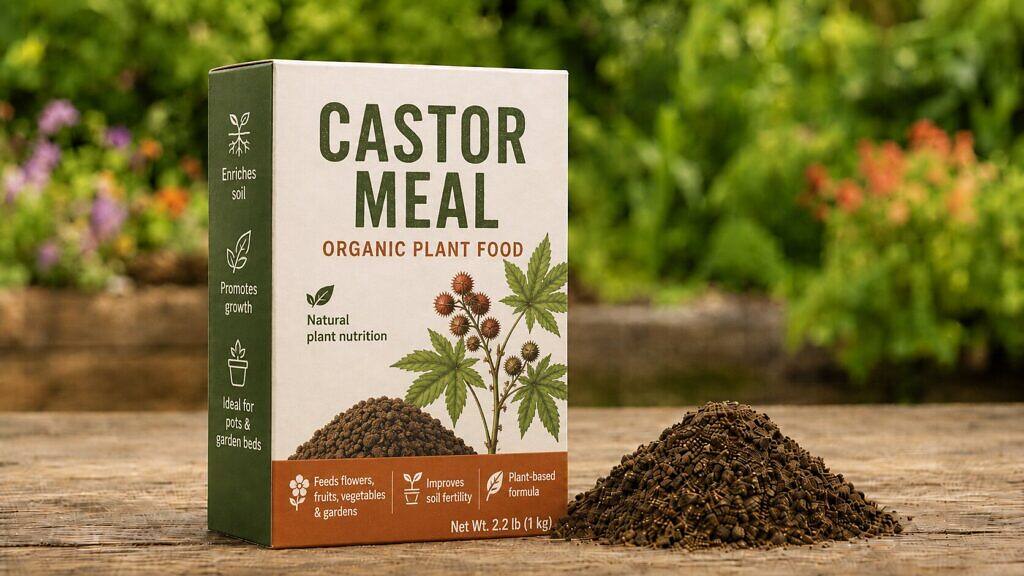
Castor meal is the solid residue left over after castor seeds (Ricinus communis) are pressed for oil. Castor oil, famous for industrial, pharmaceutical, and cosmetic uses, is also used in biodiesel production — and the meal is one of the direct by-products of that chain. In plain terms, it’s the mash that’s left when most of the oil has been squeezed out of the castor seed.
As a fertilizer, it became popular in tropical and subtropical countries because it’s organic, rich in nitrogen, relatively cheap, and easy to find. In English-speaking markets, you’ll see it sold under names like castor pomace, castor cake, castor meal, or castor de-oiled cake — most of it imported from India, the world’s largest producer. Nutritional composition varies depending on seed origin, oil extraction method, and product processing, but generally castor meal contains around 5 to 6% total nitrogen, lower levels of phosphorus and potassium, plus calcium, magnesium, and a healthy fraction of organic matter.
Some commercial products also report meaningful levels of organic carbon and good cation exchange capacity (CEC), which in theory helps the soil retain nutrients better. In other words: from an agronomic standpoint, castor meal has real value. It didn’t get famous by accident.
In an outdoor garden, vegetable patch, or orchard, those properties can genuinely shine. The trouble starts when we try to replicate that use inside a pot, in the living room.

“But isn’t commercial castor meal detoxified?” — let’s look at the evidence
This is a fair question, and one I get a lot from readers in the United States and Australia, where industrial standards are generally tighter than in many producing countries. The honest answer is: yes, detoxification processes exist — and no, they don’t reliably eliminate the risk.
Several methods have been developed over the years to neutralize ricin and ricinine in castor meal: physical treatments (autoclaving at high temperature and pressure), chemical treatments (calcium hydroxide or calcium oxide), and biological treatments (solid-state fermentation with fungi like Aspergillus niger or Paecilomyces variotii). In controlled laboratory conditions, some of these methods do achieve very high removal rates.
The catch is what happens between the lab and the bag on your shelf.
A peer-reviewed study published in Toxins (MDPI, 2011) independently tested commercial organic fertilizer samples from multiple brands and found significant concentrations of active ricin — up to 3000 µg per gram of fertilizer. The authors stated plainly that the detoxification process “is not always performed thoroughly and controlled,” and called for international regulations setting a ricin threshold for fertilizers. As of today, no such international standard exists — there are scattered national regulations, but the global market for castor meal fertilizer remains largely uncontrolled at the toxicology level.
The most cited veterinary case is brutal in its clarity: in April 2007, fifteen dogs accidentally ingested the same commercial soil conditioner containing 10% castor pomace. They presented severe vomiting, abdominal pain, and hemorrhagic diarrhea. Thirteen of those fifteen dogs were dead within a few days. The diagnosis, confirmed by clinical signs and laboratory findings, was ricin toxicosis (Kim et al., Forensic Science International, 2009).
A 2017 review in Nature Scientific Reports summarized the situation bluntly: existing detoxification methods are “still not practical and efficient enough to be used on a large scale.” Translation: even when a manufacturer means well, you have no reliable way of knowing whether the bag in front of you actually contains a safe level of ricin. The label rarely tells you, and independent verification is uncommon.
So while the industrial detoxification angle is real, treating it as a guarantee of safety isn’t supported by the data. The precaution is justified — especially for indoor use, and double-especially in homes with dogs, cats, or small children.
Uncomposted material indoors: why it’s a real problem
Here is the central point I want you to take away from this reading: castor meal is not a finished organic compost. It is concentrated organic matter, rich in nitrogen, that still has to go through microbial decomposition in the soil. And putting that kind of material in a closed, confined space — a pot inside a house — is a recipe for problems.
When you apply castor meal to a pot, what happens over the following days is an active process of decomposition and mineralization. Fungi, bacteria, and other microorganisms start acting on that organic matter, transforming complex organic compounds into simpler forms that the plant can eventually use. So far, so good: this is the basic principle behind many organic fertilizers. The problem is where this process is happening.
In an outdoor bed, with living soil, good airflow, decent soil volume, microorganisms, and small fauna like earthworms working alongside, that decomposition tends to integrate well into the system. It even benefits the natural cycle and soil health. But in a small, moist, poorly aerated pot inside your home, the story changes dramatically.
The most visible result is often that layer of white, grayish, or greenish mold blooming on the surface of the substrate. This mold isn’t always a sign of plant disease — frequently it’s saprophytic fungi doing exactly what they evolved to do: break down organic matter. But indoors, it’s a clear sign that active decomposition is happening on the surface of the pot, and that is undesirable for several reasons. You can probably picture how delightful it is to have those fungal spores floating around the air your family breathes.

Then there’s the odor. Decomposition of a material like castor meal releases ammonia and other volatile compounds, especially when it’s used in excess, poorly incorporated into the substrate, or applied to soils that are too wet and short on air. And because the material reads as “natural and organic,” it’s terribly easy to overdose — people assume they can be generous because it’s “just plant matter.” Indoors, the smell can be strong enough to bother the whole household, and it lasts for days. In a garden, the wind carries it away. In your living room, it does not.
Another effect that gets less attention is the way raw meal attracts fungus gnats — those tiny dark flies that hover around houseplant pots — along with other opportunistic insects. These insects are drawn to moist substrates rich in decomposing organic matter and surface fungal activity. Exactly the conditions you create when you sprinkle raw seed meal into an indoor pot.
The adult gnats are mostly annoying, but the real damage is done by the larvae, which live in the substrate, feed on fungi and decaying organic matter, and — in unbalanced conditions — can chew on the delicate roots of more sensitive plants. Outdoors, this whole process gets diluted into the environment. Indoors, it can turn a single fertilized pot into a small breeding operation for pests you didn’t invite.
There’s also a subtler problem: in a pot with a limited volume of substrate, an excess of raw organic matter can temporarily upset the microbial balance, shift the pH, raise local salinity, and release intermediate compounds that stress the roots. At high doses, there can even be temporary competition for oxygen between roots and decomposing microbes. Instead of nourishing your plant in an elegant, natural way, you may have created a tiny decomposition facility inside the pot. And frankly, your living room is not a compost yard.
The issue here isn’t that every natural or organic fertilizer is forbidden indoors. The issue is that you need criteria when choosing what to put in an indoor pot — something that nourishes the plant while not compromising the comfort and health of the people and animals you live with. The rule is simple: has this material already been composted or stabilized? If yes, you can use it. If not, save it for the outdoor garden, the vegetable bed, or the orchard.
Ricin: the toxin that came with the fertilizer
If the decomposition issues weren’t enough to make you reconsider castor meal indoors, the ricin question is the closing argument — especially in households with pets.
Ricin is a highly toxic protein concentrated primarily in the seeds of Ricinus communis. Although a portion is removed during oil extraction, ricin also remains concentrated in the solid residue, which becomes castor meal or castor pomace. In other words, the toxin partitions into the very by-product that ends up in fertilizer bags.
Ricinine, an alkaloid also present in the castor plant, can be found in plant tissues and processing residues. Its acute toxicity is lower than ricin’s, but it reinforces an important point: castor meal is not just a “natural fertilizer.” It’s a plant residue carrying potentially toxic compounds.
Ricin is considered one of the most toxic plant proteins known to science. In a domestic context, the main risk is ingestion. Dust from the product also deserves respect — fine particles can irritate mucous membranes and the respiratory tract during handling. So the product must be managed carefully, avoiding dust inhalation, eye contact, and access by children or pets.
For dogs and cats, the risk is amplified for obvious reasons. Pets weigh a fraction of an adult human. They dig in pots, sniff substrates, lick soil, and put random objects in their mouths. Any honest pet owner knows: if there’s a pot on the floor, there’s a real chance an animal will mess with it.

Dogs and cats that have access to soil in indoor pots may ingest castor meal while digging, sniffing, or playing in the substrate. Signs of intoxication can include vomiting, diarrhea (sometimes bloody), lethargy, abdominal pain, weakness, tremors, and severe systemic involvement. This is a real veterinary emergency. If you suspect ingestion, call your vet immediately and bring the product packaging if you can. You can also contact a poison helpline: in the United States, the ASPCA Animal Poison Control Center (888-426-4435) and Pet Poison Helpline (855-764-7661) are both available 24/7. In Australia, the Animal Poisons Helpline (1300 869 738) is free and covers Australia and New Zealand. Find more emergency resources in my guide on toxic plants for pet owners.
And here’s a warning that very few sources mention: never mix castor meal with other animal-attracting fertilizers like bone meal, blood meal, feather meal, or any meat-derived organic. Even outdoors. These materials carry strong scents that intensely attract dogs and cats. Combining castor meal with animal-derived meals creates a blend that’s nutritionally interesting from the plant’s perspective and genuinely dangerous from a veterinary perspective.
If you do use castor meal in an outdoor garden and want to supplement it with calcium or phosphorus, do it carefully, in areas pets can’t access, always incorporating the material into the soil and covering it thoroughly with mulch, soil, or straw. Don’t just sprinkle it on the surface and expect the family dog to respect the application. He hasn’t read the label.
Cottonseed meal and neem cake: the shelf companions
Castor meal isn’t the only product of its category on garden center shelves. You’ll also commonly find cottonseed meal and neem cake, both marketed as organic fertilizers and soil amendments.
Cottonseed meal is the residue left after cotton seeds are pressed for oil. Like castor meal, it can be rich in nitrogen and organic matter, and it’s used as an organic fertilizer for beds and soils. One real advantage: it does not contain ricin, so the specific toxicological risk of castor meal doesn’t apply here.
But “no ricin” doesn’t mean “automatically harmless.” Cotton residues can contain gossypol, a polyphenolic compound naturally present in cotton plants, known to cause problems in some animal species — particularly monogastric animals like dogs and pigs — when ingested in significant quantities. Gossypol levels vary with cultivar, processing, and final product. Cottonseed meal is generally less problematic than castor meal as a fertilizer near pets, but it shouldn’t be treated as completely safe either.
Beyond toxicology, the indoor pot problem persists: cottonseed meal is still raw or minimally stabilized organic matter that will undergo decomposition in your substrate. It can still produce odor, surface fungi, and microbial imbalance in enclosed environments — especially when used in excess. The issue isn’t only toxicity. It’s the active decomposition happening inside your apartment.

Neem cake, on the other hand, is the residue left after oil is pressed from the seeds of the neem tree (Azadirachta indica). It’s drawn significant attention because of its content of limonoids like azadirachtin, nimbin, and other biologically active compounds. Azadirachtin is known to interfere with insect feeding, development, molting, and reproduction, which is why neem-based products are used in various pest management strategies.
There’s also literature on nematicidal effects and activity against some soil organisms, which makes neem cake genuinely interesting for outdoor beds, vegetable gardens, and field cultivation. That said, let’s not oversell it. Neem isn’t a miracle solution, doesn’t control all pests, and shouldn’t be presented as completely harmless to all life. It’s natural, yes — but natural doesn’t mean neutral.
Another caveat: although neem compounds are often described as having low mammalian toxicity when used correctly, neem cake should never be offered to animals or treated as risk-free. As a fertilizer, its proper place is in outdoor soil, applied with judgment and out of reach of pets.
For indoor use, the same logic applies: active decomposition in confined space brings odor, surface fungi, and unnecessary risks. If your goal is pest management on indoor plants, use commercial products formulated for that purpose, following the label for dose, interval, and method — don’t put raw cake in the pot.

The rule is simple, and I’ll repeat it: do not use raw or minimally stabilized organic materials inside the house. That material needs to finish its transformation process before it ever reaches your pot.
Real alternatives for feeding your indoor plants
Before we talk about fertilizers, a quick reality check: indoor plants generally grow more slowly than plants in an outdoor garden. They receive less light, run a slower metabolism, produce less biomass, and therefore have a lower nutrient demand. That means fertilization indoors should be more restrained, more spaced out, and far more careful.
The most common mistake with houseplants is trying to fix a weak plant with more fertilizer — when the real problem is somewhere else entirely: not enough light, too much water, compacted substrate, poor drainage, or root-bound conditions. A plant suffocating in old, soggy, or compacted media will not respond to any fertilizer, whether it’s organic, mineral, liquid, granular, or expensive. The root environment comes first; fertilizer comes second. People often invert this order and try to solve a physical cultivation problem with a chemical input. It’s like offering a vitamin to someone who can’t breathe — might help eventually, but it doesn’t fix the immediate problem.
The good news is there are excellent options for fertilizing indoor pots without the risks and inconveniences of raw meals — and without filling your home with the smell of fermentation, fish, or anything else you didn’t sign up for. Whenever possible, prioritize stable products with clean application, controllable dosing, and predictable release. Indoors, my personal preference leans heavily toward formats that are dry, low-odor, and engineered for indoor environments. Here’s what I recommend most:
Slow-release synthetic fertilizers (my top pick for indoor pots)
Slow-release fertilizers — granules or small coated pellets that release nutrients gradually with moisture and temperature — are one of the most practical options for indoor plants, and honestly my personal favorite for low-maintenance houseplant care. Instead of dumping a load of nutrients at once, they meter out a steady supply that matches the slow growth rate of most houseplants.
That predictability is a major advantage in indoor pots. With limited substrate volume, any excess shows up fast: burned leaf tips, salt buildup on the substrate surface, stressed roots, unbalanced growth. A well-dosed slow-release product dramatically reduces the overdose risk. It doesn’t bring the mess of raw organics, doesn’t attract insects through decomposition, and — critically for indoor use — produces no odor, no surface mold, no fermentation.
To use them well, respect the label dose and apply according to pot size, not according to plant-parent anxiety. Small amounts mixed into the top layer of substrate or incorporated at repotting are usually enough for several months. For slow-growing plants like Zamioculcas, snake plants in low light, philodendrons, sansevierias, and most tropical foliage, less is almost always more.
A practical note: “slow-release” doesn’t mean “forever fertilizer.” After the period listed on the label, you’ll need to replenish. And avoid stacking multiple fertilizers at once — slow-release plus liquid plus foliar plus organic top-dress is overkill. Indoor plants don’t need an all-you-can-eat buffet. They need consistency, moderation, and decent substrate.
Organic-mineral blends
If you want the clean predictability of dry application but prefer something with an organic component, blended organic-mineral fertilizers (sometimes called organomineral) are a strong option — granules combining processed and stabilized organic sources with mineral nutrients. They offer better predictability of composition, controlled dosing, and lower risk of unwanted decomposition in the pot, especially compared to raw seed meals.
For indoor ornamentals, these blends are practical, safe, and efficient when used per the label. They don’t carry the romance of composting, I know. But plants don’t feed on romance — they respond to available nutrients, healthy roots, and well-managed substrate. Organic-mineral products also tend to correct the typical imbalance of seed cakes, which run heavy on nitrogen and short on phosphorus and potassium. For container growing, that predictability is a real ally.
Finished, mature compost (incorporated at repotting)
Finished, fully mature compost is one of the best substrate conditioners for potted plants. When it’s truly ready, it has a dark color, a uniform texture, smells faintly of forest floor (not of decomposition), and shows no resemblance to the original feedstock. That’s the key difference compared to raw meals: the main transformation has already happened before the material reaches your pot.
Good compost improves the physical structure of the substrate, increases water retention without waterlogging, supports microbial life, and releases nutrients gently. For indoor pots, it works best when blended into the substrate at the time of repotting — not top-dressed afterward — combined with materials that ensure drainage and aeration: pine bark fines, coconut coir, perlite, coarse sand, or other components appropriate to the species you’re growing.
Critical caveat: mature compost is not partially decomposed organic waste. Food scraps, fresh peels, and materials still in active decomposition belong in your outdoor compost bin, never in an indoor pot. If your compost still smells like the kitchen scraps that went in, it isn’t done. The rule stands: only bring indoors what has already finished the most intense phase of transformation. If in doubt, smell it first — finished compost smells like clean earth, nothing else.

Liquid seaweed and kelp extracts
Seaweed extracts, particularly those derived from Ascophyllum nodosum, are widely used as biostimulants. They contain plant hormones (cytokinins, auxins, gibberellins), micronutrients, and compounds that help plants respond to stress, support rooting, and maintain physiological balance. Concentrated liquid kelp products are easy to find at garden centers across the US, Australia, and New Zealand, typically diluted at 1:50 to 1:200 in water for foliar or soil application.
For indoor use, liquid kelp has a major practical advantage: when applied at label rates, it’s essentially odorless on the plant — none of the fishy or fermented notes that come with many other liquid organics. It also doesn’t add solid organic matter to your substrate, which means no risk of triggering surface decomposition in the pot.
A note on expectations: liquid kelp is a complement, not a replacement for base fertilization. It works beautifully for weakened plants, recent transplants, or houseplants under stress — but it won’t single-handedly carry a hungry plant. Paired with a slow-release granule or an organic-mineral blend, however, it’s one of the cleanest indoor-friendly supplements on the market.
Foliar feeds and biostimulants
To complement base nutrition, foliar products based on plant extracts, amino acids, humic and fulvic acids, and seaweed extracts can be useful allies. Just keep them in proper context: a foliar feed is a supplement, not a substitute for good base fertilization. It can help weakened, recently transplanted, or stressed plants, but don’t sell yourself on it as a universal solution.
For indoor plants, foliar applications work when applied at the right dose, at the right time of day (early morning is usually best), and without excess that leaves residue on the leaves or invites fungal problems. Brands vary widely in composition, concentration, and recommendations — more important than a pretty label is reading the formulation, respecting the dose, and observing the plant’s response. Stick to products that are clearly formulated and odor-light; if a foliar feed smells strongly of fermentation or fish straight from the bottle, that smell will live in your home for a while after you spray it.
What I deliberately leave out of indoor pots
A quick note on materials I love outdoors but keep firmly outside the house: vermicompost (worm castings), worm tea and compost teas, fish emulsion and fish hydrolysate, bokashi, alfalfa meal, kelp meal, and any other raw or fermented organic input that produces a noticeable smell or relies on continued biological activity in the substrate. These are wonderful products in their proper context — outdoor beds, greenhouse benches, vegetable gardens. But in a closed apartment or living room, even the well-managed versions tend to bring odor, surface activity, fungus gnats, or dust I’d rather not breathe.
This is a personal editorial position, and I’ll own it: for indoor pots, I prioritize products that are dry, stable, low-odor, and engineered for predictable behavior in a confined space. Slow-release granules, organic-mineral blends, fully mature compost incorporated at repotting, and a clean liquid kelp do almost everything an indoor plant actually needs.

And in the outdoor garden? What about seed cakes?
I’ll be honest with you: castor and cottonseed cakes make far more sense in the outdoor garden than anywhere else. In beds, in the open ground, decomposition happens within a larger system. Odors dissipate on the wind. The soil fauna — earthworms, beetles, springtails, fungi, bacteria, and others — helps integrate the material far more efficiently.
That said, I need to be equally honest: in recent years, with better organic-mineral blends, more reliable slow-release fertilizers, higher-quality composts, commercial bokashi, well-managed liquid biofertilizers, and other stable products on the market, I’ve largely stopped recommending raw seed cakes for most domestic uses. They have a specific nutritional profile — usually rich in nitrogen but lacking in phosphorus and potassium — and need supplementation. They’re also harder to dose precisely than packaged blends.
There are real agronomic uses for castor meal, particularly when the goal is to supply organic nitrogen and organic matter to depleted soils, and there’s literature on nematicidal effects under certain conditions, which partially explains its continued popularity in some agricultural systems. But in a home garden, it doesn’t always make sense to take on the risks and inconveniences when better-balanced, more predictable, easier-to-manage options exist.
Castor meal was a widely used option because it was available, cheap, and effective in many contexts. Today, we have better alternatives for most home gardens.
If you still want to use castor meal in an outdoor garden, do it with discipline. Always incorporate it into the soil — never leave it sitting on the surface. Keep it away from plant stems. Avoid direct contact with sensitive roots. Respect the dose on the label. Cover with soil, mulch, or straw. And I’ll say it one more time: never apply it in areas where dogs, cats, or wildlife you care about have free access, especially if you’re tempted to mix it with bone meal, blood meal, or any other attractant.
Ecological and sustainability angles: what’s worth knowing
Castor meal does have a legitimate sustainability argument. It’s a by-product of the castor oil production chain, including the biodiesel industry. Instead of being discarded, this nitrogen-rich, organic-matter-rich residue is reused as fertilizer. In principle, that’s a textbook example of circular economy thinking.
The castor plant is also a crop adapted to semi-arid regions and historically associated with smallholder inclusion programs in Brazil’s Northeast and parts of India. So we’re not talking about a material without merit. The point isn’t to demonize castor meal. The point is to use the right product, in the right place, in the right way — and to recognize when it isn’t the best choice.
On the other side of the ledger, studies have investigated the presence and mobility of ricin and ricinine in castor residues, raising questions about leaching and runoff when the product is used carelessly or in large quantities. That doesn’t cancel out responsible agricultural use, but it does show that “organic” and “harmless to the environment” aren’t automatic synonyms.
It’s also one more argument against using raw materials inside indoor containers.
Summary: what to do, what not to do
- Do not use castor meal or any raw seed cake indoors, in houseplant containers.
- Do not use castor meal in pots accessible to dogs, cats, or small children.
- Do not mix castor meal with bone meal, blood meal, feather meal, or any pet-attracting animal-based fertilizer.
- Do not apply castor meal in outdoor gardens without thoroughly incorporating it into the soil and covering it — especially if pets or wildlife frequent the area.
- Do not assume that seed cakes are automatically safe just because they’re “natural” or “industrially detoxified.” The data doesn’t support that confidence.
- Do use slow-release granules, organic-mineral blends, fully mature compost (incorporated at repotting), and clean liquid kelp extracts for indoor pots.
- Save vermicompost, worm tea, compost tea, fish emulsion, bokashi, and other smell-prone or fermenting inputs for outdoor beds and the greenhouse — they have their place, just not in the living room.
- Prefer materials that have already been processed, stabilized, or engineered for controlled release: they’re safer, more predictable, odor-free indoors, and generally far better suited to enclosed spaces.
The golden rule of container fertilization is this: only bring indoors what has already finished its most intense phase of transformation. Actively decomposing organic matter belongs in the garden, the compost pile, or the worm bin — not the living room.
Frequently asked questions about castor meal
Is castor meal toxic to dogs and cats?
Yes. Castor meal can be toxic to dogs and cats because ricin from the seeds remains concentrated in the solid residue after oil extraction, particularly when the product hasn’t undergone thorough detoxification. Independent studies have found significant active ricin in commercial fertilizers, and documented veterinary cases include multiple fatalities. If your pet has access to potting soil, avoid this fertilizer entirely.
My dog ate soil with castor meal. What should I do?
Seek veterinary care immediately. Don’t wait for symptoms to appear, and don’t try to handle it at home. In the US, call the ASPCA Animal Poison Control Center (888-426-4435) or Pet Poison Helpline (855-764-7661) on your way to the vet. In Australia, contact the Animal Poisons Helpline at 1300 869 738. Bring the product packaging, report the approximate amount applied to the pot or bed, and note how long ago the ingestion may have happened. In poisoning cases, time matters.
Is “industrially detoxified” castor meal safe?
Detoxification processes exist (chemical, physical, biological), but independent testing has found significant active ricin remaining in commercial fertilizers from multiple brands. There’s no international standard requiring or verifying detoxification of castor meal sold as fertilizer. Until that changes, treating these products as guaranteed-safe isn’t supported by the evidence. Caution remains warranted — particularly indoors and around pets.
Can I use castor meal in outdoor pots on the balcony?
Even outdoor pots carry real risks. Decomposition in a confined volume can still produce odor, surface fungi, and substrate imbalance, plus the access risk for pets and children. Enclosed or poorly ventilated balconies behave much like indoor conditions. For pots, choose materials that are already composted, fermented, or in organic-mineral blends. If you use castor meal at all, reserve it for in-ground beds, incorporated into the soil and away from animals.
Can neem cake be used indoors?
Neem cake doesn’t contain ricin, but it’s still raw organic matter that will decompose in the substrate. It also contains biologically active compounds (limonoids) that should be used with discretion. In indoor pots, neem cake can generate odor, surface fungi, and management headaches. For indoor plants, use neem-based products specifically formulated for indoor application, or stick to dry stable formats like slow-release granules and organic-mineral blends.
Is cottonseed meal a safer alternative to castor meal?
Cottonseed meal contains no ricin, which removes the main toxicological concern of castor meal. But it may contain gossypol, a natural cotton compound that affects some animal species. Don’t treat it as automatically pet-safe. And as a fertilizer, it’s still raw organic matter that needs to decompose in the soil — for indoor pots, it’s not my first choice.
Does castor meal really repel soil pests?
There’s evidence that castor meal affects parasitic soil nematodes under certain conditions, which is one reason for its continued use in some agricultural systems. But that benefit doesn’t justify using it in indoor pots given the pet risk, odor, and active decomposition in the substrate. For indoor plants, manage pests with products and practices designed for indoor environments.
Can I mix castor meal with bone meal?
Nutritionally, the combination might seem clever — castor meal supplies nitrogen, bone meal supplies phosphorus and calcium. But if you have dogs or cats, don’t. Bone meal smells highly attractive to many animals, who’ll dig in the soil to reach it and end up ingesting the castor meal along with it. It’s a dangerous combination for pets.
What’s the simplest fertilizer routine for indoor plants?
For most houseplants, the easiest and cleanest setup is a slow-release granule incorporated at repotting (sized for the pot), optionally complemented by a clean liquid kelp every few weeks during active growth. That combination covers base nutrition, supports stress recovery, produces no odor, doesn’t attract pests, and is essentially impossible to mess up if you respect label doses. Save the more aromatic organics — bokashi, worm tea, fish emulsion, raw meals — for your outdoor beds and the vegetable garden where they belong.
What fertilizers can I safely use in indoor pots?
The cleanest, lowest-hassle options for indoor pots are: slow-release synthetic granules (my top pick), blended organic-mineral fertilizers, fully mature compost incorporated at repotting, liquid seaweed and kelp extracts, and well-formulated foliar biostimulants used as occasional supplements. The common thread: none of these dumps actively decomposing or smelly material into your living space.
So is castor meal “bad”?
No. Castor meal isn’t bad in itself. It’s an organic input with real agronomic value — nitrogen-rich, organic-matter-rich, with some interesting soil effects. The problem is misuse. In outdoor beds, applied with discipline, away from pet access, and within sensible dose ranges, it can be useful. In indoor pots, apartments, enclosed balconies, and homes with dogs or cats, it isn’t the right choice. A good input in the wrong place is still in the wrong place.
If you’re unsure where to start, try the simplest path: a slow-release granule sized for your pot, incorporated when you repot or top-dressed and scratched into the substrate, complemented by an occasional dose of well-diluted liquid kelp during active growth. That combination does the job safely — no odor, no surface mold, no fungus gnats, no unnecessary risks for the people and animals you share your home with, whether they walk on two legs or four.