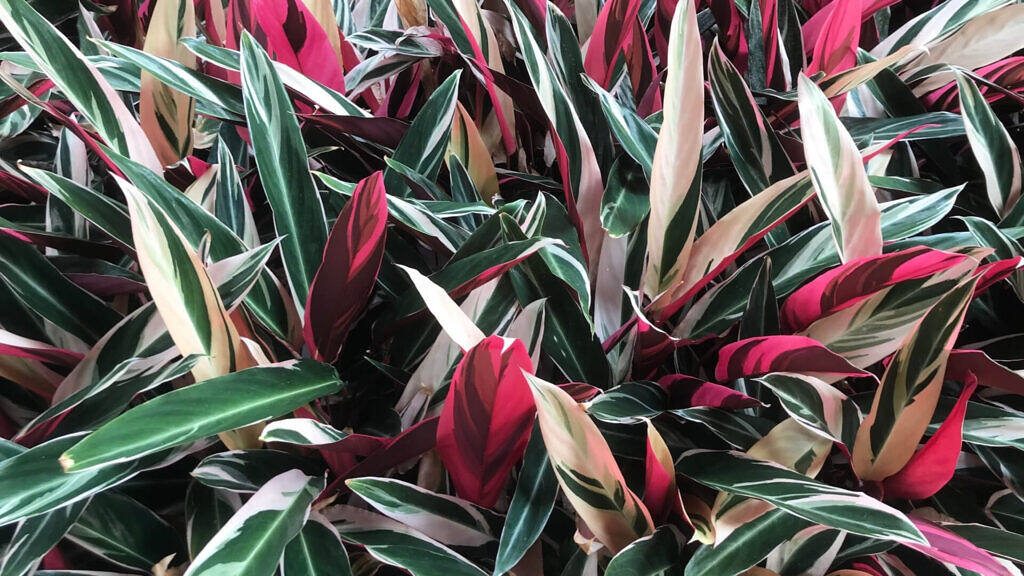
The Stromanthe thalia ‘Triostar’ is a rhizomatous perennial herb that stands out as one of the most colorful foliage plants for filtered light or partial shade. Native to the understory of the Atlantic Forest, it offers a striking color contrast that is hard to ignore: the upper surface of the leaves shows brushstrokes in shades of green, cream, and pink, while the underside reveals a deep burgundy that becomes visible as the plant moves. It is a high-impact choice for anyone looking to fill shaded spaces with color and movement.
Beyond its ornamental appeal, the Stromanthe ‘Triostar’ is known for its dynamic behavior. During the day, the leaves tilt to capture more light; at night, they rise vertically. This biological phenomenon creates a constantly changing plant that seems to come alive in the landscape. In pots or garden beds, it forms dense clumps that remain vigorous year-round, as long as it is protected from direct weather exposure and receives bright light.
Enjoyed this guide? There's more where it came from.
Understanding why plants behave the way they do is what turns guesswork into a thriving garden. That's exactly what we share in the Shrubz newsletter — free, straight to your inbox:
- Seasonal care reminders timed to your gardening calendar
- Propagation and pruning techniques, explained step by step
- Pest and disease alerts — catch problems before they spread
Origin, Habitat, and Etymology
The species is genuinely Brazilian, with a habitat restricted to the Atlantic Forest. Its natural range extends from Rio de Janeiro to Rio Grande do Sul, where it grows sheltered beneath the tree canopy, in places with soil rich in organic matter and constant moisture. The genus name, Stromanthe, comes from the Greek words stroma (mat or bed) and anthos (flower), referring to the way the bracts protect the flowers. The specific epithet thalia honors the botanist Johannes Thal.

Landscape use of Stromanthe ‘Triostar’
Stromanthe ‘Triostar’ is a valuable asset for creating bright focal points in shaded areas of the garden. As a medium-sized groundcover, it fills spaces beneath tree canopies or along side corridors with limited sunlight. In the ground, the ideal spacing to form a continuous mass is 1.6 to 2.3 feet (0.50 to 0.70 meters) between plants. Its growth is moderate, spreading laterally through robust rhizomes, which ensures dense coverage without becoming invasive.
For balanced compositions, combine the plant with species from different layers. It works very well under the protection of the juçara palm (Euterpe edulis), which provides the necessary high shade, or planted in front of dark-green foliage shrubs, such as Chinese evergreen (Aglaonema commutatum), highlighting the pink tones of Stromanthe ‘Triostar’. In tropical-style or contemporary gardens, it breaks up the monotony of green by bringing a warm color palette to ground level.
When grown indoors, Stromanthe ‘Triostar’ is the star of protected balconies and rooms with bright indirect light. Large ceramic or polyethylene pots help retain root moisture and allow the foliage to spread in a sculptural way. It is essential to avoid places with drafts or air conditioning, which dry out the leaf tips and compromise the plant’s appearance.

How to care for Stromanthe ‘Triostar’: growing guide
- Light: Prefers abundant filtered light or partial shade. Direct sun between 10 a.m. and 4 p.m. burns the leaf edges and fades the pink variegation.
- Potting mix: It should be porous and rich in organic matter. An effective potting mix includes topsoil, coarse construction sand, and medium-grade pine bark to ensure drainage and aeration. See the article about potting mix for indoor plants.
- Watering: Keep the potting mix moist, but never soggy. During hot periods, watering should be more frequent. Preferably use rested water or rainwater, as the plant is sensitive to chlorine in municipal water.
- Climate: Grows well in tropical and subtropical climates. It does not tolerate frost or temperatures below 50°F (10°C) for long periods.
- Air humidity: Requires relative humidity above 60%. In dry locations, mist the leaves with water or use humidifiers near the plant. Do not keep it in spaces with regular air conditioning.
- Fertilization: Apply NPK 10-10-10 monthly during spring and summer. Organic fertilizers such as bokashi can be incorporated into the soil every six months.
- Repotting: When grown in pots, repotting is recommended to replace the potting mix every two years.
- Pruning: Only remove dry leaves, cutting the petiole close to the base to keep a clean appearance and prevent fungi.
How to propagate Stromanthe triostar
The most effective method of propagation is by dividing clumps. The best time to carry out this procedure is in early spring, when the plant begins its active growth cycle. Remove the plant from the pot or bed carefully to avoid excessively damaging the roots.
Using a clean knife or your hands, separate the rhizomes, making sure each new section has at least two healthy leaf fans and an established root system. Plant the divisions immediately in moist potting mix and keep them in a shaded, sheltered location until they show signs of new leaves.

Botanical description of Stromanthe thalia
This is a herbaceous plant that reaches 3.3 to 5 feet (1.0 to 1.5 meters) in its natural habitat, although in pots it rarely exceeds 3 feet (0.90 meters). It is a perennial, rhizomatous plant with a herbaceous texture. The root system develops from horizontal rhizomes that store energy and allow the plant to spread laterally.
Support is provided by long, upright petioles emerging from the rhizome. The leaves are alternately arranged in two ranks, oblong-lanceolate in shape, and have an acute tip. They measure between 12 and 18 inches (30 and 45 cm) in length. In the species type, the upper surface is green, but in the ‘Triostar’ cultivar, which is the most popular and best known, it features cream and pink markings. The underside is a deep wine-red.
The inflorescence is a terminal, branched panicle held on a long scape. The blood-red bracts stand out, protecting small white or slightly pink flowers. Blooming occurs from late winter to early spring, although this is rare in indoor cultivation.
Pollination is carried out mainly by hummingbirds and insects adapted to tubular flowers, such as butterflies. The fruit is a small, globose, leathery capsule containing small seeds with a basal aril.
Main varieties and cultivars
- ‘Triostar’: The most popular, with irregular bright pink and cream markings on the upper surface of the leaves.
- ‘Magicstar’: Features dark green leaves with fine white and silver speckles, while keeping the characteristic burgundy underside.
- ‘Charlie’: Has simplified variegation in white and green, with less pink coloration.

Pests, diseases, and solutions
Spider mites are the most common pests, appearing when air humidity is low. They are identified by fine webbing and a dusty appearance on the underside of the leaves. The solution is to increase ambient humidity and wipe the leaves with a damp cloth or potassium soap. Scale insects may appear at the base of the petioles and should be removed manually, with a cotton swab dipped in isopropyl alcohol, or with neem oil in severe cases.
Too much water in the potting mix causes root rot, signaled by yellowing leaves that wilt suddenly. Make sure the pot has efficient drainage holes. Fungal leaf spots can occur if there is too much moisture on the leaves without proper ventilation. Avoid wetting the foliage at the end of the day.
Leaves with burned edges are very common in different species of the Marantaceae family, and are usually caused by potting mix or irrigation water with excess salts. This may happen due to frequent fertilization, lack of flushing of the potting mix, or the use of brackish or hard water, or water with high levels of chlorine and fluoride (tap water).
Interesting facts
Nyctinasty is one of the most interesting traits of Stromanthe triostar, as well as other Marantaceae. Thanks to a joint called a pulvinus, located at the base of the leaf, plants in this family change internal water pressure to move the leaves. At night, they fold upward to conserve heat and moisture, which earned them the nickname prayer plant.
Unlike many indoor ornamental plants, this species is safe around pets. It is classified as non-toxic to dogs and cats, making it an excellent choice for landscaping homes with pets.