I always dreamed of having one of those magazine-worthy gardens: private, sheltered from the wind and from neighbors’ eyes, but without the coldness of a plain gray wall. When I started researching hedges, I discovered that choosing the wrong species can mean years of waiting—and I simply didn’t have that kind of patience. It was through trial (and plenty of error!) that I learned some plants really can close off a space in record time, as long as you know how to prepare them properly from planting.
If you’re at that stage where you want to transform your yard right now, without waiting five years for shade and privacy, this guide is for you. I’ll share the eleven species that impressed me most for their fast growth and dense foliage—as well as the technical secrets that make all the difference between an average hedge and a true living green wall.
What defines a fast-growing hedge?
Before you run out to buy plants, there’s something you need to know: fast growth is not the same thing as dense screening. I’ve seen plants shoot up in height but end up looking bare and leggy at the bottom, leaving gaps that don’t block anything. What you really want is a hedge species that grows quickly and keeps dense foliage all the way from the base.
Growth rate depends on three fundamental pillars:
Climate: Tropical or warm-climate plants grow much faster in hot, humid regions. In cooler or temperate areas, species adapted to mild winters are usually a better choice.
Soil: A soil rich in organic matter and well drained works wonders. Without that, not even the fastest hedge species in the world will help you.
Initial watering: During the first six months, consistent irrigation is non-negotiable. I learned this the hard way, watching my hedge plants struggle in the middle of summer.
As one reader recently commented: “The secret of a fast hedge isn’t just the plant, it’s the watering in the first year.” I couldn’t agree more.
The 11 best species for fast, dense screening
Orange jessamine (Murraya paniculata): the classic sound barrier
Orange jessamine is that hedge plant you see in almost every urban garden—and with good reason. Once established, it can grow up to 3.3 feet (1 metro) per year, and its fragrant flowers are a delightful bonus. In my garden, I use myrtle as a natural barrier against street noise, and it works incredibly well.
But here is the golden tip that few beginner gardeners know: to prevent the myrtle hedge from becoming sparse at the base, you need to start formative pruning early. Even when the plant is still young and small, trim the tips of the branches to encourage lateral branching. This creates a dense structure right from ground level.
Important caution: Before planting orange jessamine (also known as mock orange or orange jasmine), check local regulations. In some citrus-producing regions, its planting may be restricted because the plant can host the insect that transmits citrus greening, a serious citrus disease. Always consult your local agricultural or plant health authority.
Ideal climate: Equatorial, subtropical, tropical
Soil: Rich in organic matter and well-drained
Landscape use: Tall hedges and sound barriers
Black mimosa (Mimosa caesalpiniifoliaPhoto by Nelson Wisnik
If you want explosive growth, black mimosa is unbeatable. We are talking about 6.5 to 10 feet (2 a 3 metros) in less than 18 months. It is the perfect plant for those with a large property who need an immediate screen — or for anyone looking for strong perimeter security.
Why? Because black mimosa has formidable thorns. I have scratched myself badly when pruning without proper gloves. This makes the hedge practically impenetrable, but it also means you should avoid it if you have small children or pets moving around nearby.
Another important detail I learned in practice: “Be careful with black mimosa in urban areas; it grows so much that if you do not prune it every 4 months, it turns into a tree and loses its hedge effect at the bottom, becoming bare-legged.” This remark from a reader perfectly sums up the challenge of this species.
Clusia (Clusia fluminensis): sophisticated and coastal-tough
Clusia is my favorite hedge plant for contemporary gardens. Its thick, glossy leaves have an incredible sculptural look, and it tolerates salty coastal air extremely well, which makes this hedge plant perfect for anyone living near the ocean.
Many people think clusia is slow-growing, but I found the trick: if you prepare the planting hole with plenty of organic matter and keep watering consistently during the first six months, it takes off. In my coastal garden, I watched my clusia plants double in size in less than a year.
Another advantage is its versatility: this hedge plant performs well in both full sun and partial shade. I have tested it in both situations and can confirm it works.
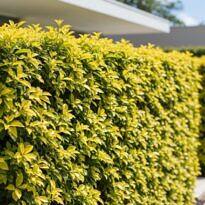
Golden dewdrop is one of the hedge plants that most impresses when it comes to how quickly it fills in. It grows fast and branches intensely with frequent pruning, forming a dense living fence in a short time—especially up to about 5 to 6 1/2 feet (1.5 to 2 meters) tall.
Many people plant it assuming it will stay naturally compact. That is not quite the case. The secret is regular pruning: light, frequent cuts stimulate lateral shoots and prevent the plant from becoming bare at the base. When properly managed, the result is a uniform, luminous block of foliage, thanks to its golden-yellow leaves.
In very cold regions it can struggle a bit, losing some of its color intensity.
In warm, sunny climates, it really reaches its full potential.
Ideal climate: Tropical and warm subtropical
Soil: Well-draining, fertile and enriched with organic matter
Landscape use: Low to medium hedges, defining garden beds and pathways
If you want fast growth and showy blooms at the same time, hibiscus is an excellent hedge choice. It can grow more than 3.3 feet (1 metro) per year when planted in fertile soil and fertilized regularly.
In practice, what I have learned is that hibiscus needs training from an early stage. Without pruning, it tends to grow upright and develop bare gaps at the base. With strategic cuts after each flowering cycle, it thickens, branches out and forms a colorful living wall.
It is a very interesting option for anyone who wants privacy without giving up a vibrant garden. Just keep in mind: the more you prune this hedge, the more it blooms.
Ideal climate: Tropical and warm subtropical
Soil: Fertile, rich in organic matter and well-draining
Landscape use: Flowering hedges for residential gardens
Privet (Ligustrum sinense): classic, durable green hedge
Privet is one of the most traditional hedge plants for those who need a tall, fast and extremely dense hedge. It grows vigorously and responds very well to formative pruning.
In just a few years, it is possible to create a true “living wall.” This hedge species tolerates urban pollution, wind and even harder pruning, which explains its popularity in residential neighborhoods and gated communities.
One important point: growth is so vigorous that maintenance needs to be regular. If neglected, this hedge loses its shape and can grow beyond the desired height.
Ideal climate: Mild temperate and subtropical
Soil: Deep, fertile, and well-drained
Landscape use: Tall green walls and formal hedges
Caliandra (Calliandra brevipes): hardiness and natural screening
Caliandra is an excellent option for anyone looking for a natural-looking, fast-growing hedge. It establishes quickly and forms a dense living fence when maintained with light pruning.
Its pompom-like flowers are an attractive bonus, drawing in pollinators and adding movement and visual interest to the garden. It adapts very well to regions with mild winters, and is more resilient than many strictly tropical species.
Maintenance is simple: pruning after flowering encourages new growth and helps keep the hedge compact.
Ideal climate: Subtropical and high-altitude tropical or mild-winter regions
Soil: Well-drained and moderately fertile
Landscape use: Natural, informal living fences
Podocarpus (Podocarpus macrophyllus): formal elegance and long-lasting structure
Podocarpus is not the fastest-growing hedge plant in its first year, but it makes up for this with consistency and strong structural density. Once established, it forms a tall, compact, and very elegant living fence.
This hedge plant is a frequent choice in formal and contemporary landscape designs. It responds well to geometric pruning and retains an intense green color throughout the year.
If the goal is to create a durable “green wall” with a low replacement rate over the years, podocarpus is an extremely reliable hedge plant.
Ideal climate: Mild subtropical and temperate
Soil: Well-drained and slightly acidic
Landscape use: Tall formal hedges and structural dividers
Cape plumbago (Plumbago auriculata): light and fast-growing for medium hedges
Cape plumbago is an interesting hedge option for those who want relatively quick screening with a lighter, flowering look. It grows vigorously and can reach about 6.5 feet (2 meters) in just a few years, forming a semi-dense hedge when properly trained.
It is important to understand that this hedge plant does not create a completely solid wall like privet or podocarpus. The effect is more open and ornamental. To increase density, space the plants more closely and prune regularly.
In warm climates, this hedge plant can flower almost year-round, bringing a soft blue tone that brightens the garden.
Ideal climate: Tropical and warm subtropical
Soil: Well-drained, tolerant of poorer soils
Landscape use: Medium-height hedges with a light, ornamental effect
Eugenia or Aussie brush cherry (Eugenia sprengelii): ideal for geometric pruning
If you like that formal garden look, with straight lines and crisp pruning, eugenia is hard to beat. It is the hedge plant that best tolerates topiary — those geometric prunings that leave hedges with perfectly rectangular box or wall shapes.
In design projects, eugenia is often used to define pathways and create separations between different areas. Growth is fast, especially if you apply nitrogen-rich fertilizers. Look for NPK 10-10-10 for regular maintenance, or NPK 20-05-20 to enhance the deep green color of the foliage.
Brands such as Forth Jardim, Dimy, or Vitaplan are easy to find.
Ideal climate: Tropical and subtropical
Soil: Kept moist but never waterlogged
Landscape use: Defining pathways or screening walls in narrow spaces
Viburnum (Viburnum suspensum): the green wall for cold climates
For regions with cooler winters, viburnum is one of the best choices for a privacy hedge. It tolerates cold very well, something few hedge species can handle. Its foliage is darker and slightly rough to the touch, creating a natural “green wall” effect that looks very refined and elegant.
I like to use viburnum as a neutral background to highlight flowering plants with bright colors. It doesn’t steal the show, but it creates that perfect frame that makes all the difference in garden design.
Ideal climate: Subtropical and temperate
Soil: Deep and fertile
Landscape use: Neutral backdrop for colorful gardens
Technical secrets for closing your hedge in record time
The trench method vs. individual planting holes
Here is a technique I learned from professional landscape designers that can speed up hedge closure by up to 30%: instead of digging separate holes for each shrub, open a continuous trench along the entire length of the hedge.
Why? Because when you plant in individual holes, the roots meet resistance when they try to expand sideways. With a trench, the whole stretch of soil is prepared and loosened, allowing the roots of neighboring plants to connect quickly. It’s as if they form an underground network that strengthens the entire hedge structure.
How to do it:
Dig a trench about 16 in (40 cm) wide and 16 in (40 cm) deep
Fill it with a mix of topsoil, worm castings, and well-rotted cow manure
Adjust soil pH with dolomitic lime (to reduce acidity)
Add NPK 04-14-08 (ideal for planting, as it stimulates root development)
Plant the shrubs and water thoroughly
Strategic spacing and planting
One of the most common mistakes with a hedge is planting the shrubs 3 ft (1 m) apart.
That might work, but you will wait a lot longer to get a dense hedge closure. For fast closure, the ideal spacing is 3 to 4 plants per linear yard (3 a 4 mudas por metro linear).
I usually plant in a zigzag pattern when I want a thicker, impenetrable hedge, or in a straight line when space is more limited. The zigzag layout creates two alternating rows that weave together as they grow, forming a much denser hedge.
Professional buying and maintenance guide
Starter nutrition and fertilization
When you go to a garden center or agricultural supply store, don’t just ask for “fertilizer.” Be specific. For the initial planting, look for a 4-14-8 NPK fertilizer, which has a higher phosphorus content to stimulate rooting. For ongoing maintenance, use a balanced 10-10-10 NPK.
In addition to chemical fertilizers, invest in soil conditioners:
Worm castings: Rich in nutrients and improves soil structure
Well-composted cattle manure: It must be fully composted (never fresh!) to avoid burning the roots
High-quality potting mix: A ready-made blend that already comes balanced (choose reputable, good-quality products).
Essential tools and safety (PPE)
Investing in the right tools makes all the difference—and can prevent serious accidents. For fast-growing hedges, you will need:
Hand pruning shears: For training and maintenance pruning. I use Tramontina Pro, but Felco is also excellent (although more expensive).
Hedge trimmer: If you have more than 30 linear feet (10 metros lineares) of hedge, it is well worth investing in an electric or battery-powered model. Brands like Stihl, Husqvarna, and Makita are industry benchmarks.
Safety first! When pruning thorny species or tall hedges, it is essential to use:
Heavy-duty leather gloves: Protect against thorns and branches
Safety glasses: Prevent fragments from hitting your eyes
Safety boots: Especially important if you use an electric hedge trimmer
I have seen nasty accidents caused by lack of protective equipment. It’s not worth trying to save money on this.
Frequently asked questions about fast-growing hedges
What is the fastest-growing hedge?
Some of the fastest-growing hedge plants can reach 6 to 10 feet (2 a 3 metros) in less than 18 months under good conditions, forming a dense, effective fast-growing hedge in a relatively short time.
However, it needs frequent pruning so your privacy hedge does not end up tall, bare and “leggy,” and it should not be grown in areas subject to hard frost.
The secret lies in structural pruning from a young age. Trim the tips of the branches while the hedge is still in its early growth stage to stimulate lateral branching. This encourages a dense privacy hedge structure right from the base.
What is the best fertilizer to speed up the growth of a privacy hedge?
Use a balanced granular fertilizer such as 4-14-8 at planting (to stimulate root development) and 10-10-10 for ongoing maintenance. Supplement with earthworm castings and well‑aged manure to improve soil structure and long‑term fertility around your privacy hedge.
On average, how much does a linear yard of privacy hedge cost?
The cost varies according to the species and the size of the plants you buy. On average, considering 3 to 4 plants per yard (3 to 4 plants per meter) and basic soil preparation, the investment usually ranges from about $10 to $30 per linear yard, depending on your local market and the type of privacy hedge you choose.
Which species are more resistant to pests and diseases?
Clusia (Clusia fluminensis) and needle bush (often used as a thorny hedge) are extremely hardy and rarely present serious plant health issues. Scented myrtle, on the other hand, can suffer from scale insects if air circulation is poor. Avoid golden duranta if you want a truly resilient privacy hedge that demands minimal care.
Turn your garden into a private retreat
Choosing the right species for your privacy hedge is like choosing the foundation of a house: it makes all the difference in the final result. If you want maximum security and a barrier that really deters intruders, go for a tall, thorny privacy hedge such as needle bush or similar spiny shrubs. If you prefer a sophisticated, contemporary look, clusia is an excellent option in warm climates. For formal gardens, eugenia is perfect for neatly clipped privacy hedges. And if you live in a colder region, viburnum is one of your best allies.
The success of a privacy hedge does not depend only on the plants, but also on proper soil preparation, generous initial watering, and regular formative pruning. Start planning your privacy hedge now—the best time to plant is usually at the beginning of your local rainy season or in early fall, when the roots will have abundant moisture and mild temperatures to establish quickly.
Keep in mind that every garden is unique, and what works in one yard may need adjustments in another. Observe your climate, soil and exposure, test, make corrections, and learn from the results. That is how you gradually create the lush, private green refuge you have always imagined with a well‑planned privacy hedge.
Raquel Patro is a landscaper and founder of the Shrubz.us. Since 2006, she has been developing specialized content on plants and gardens, as she believes that everyone, whether amateurs or professionals, should have access to quality content. As a geek, she likes books, science fiction and technology.