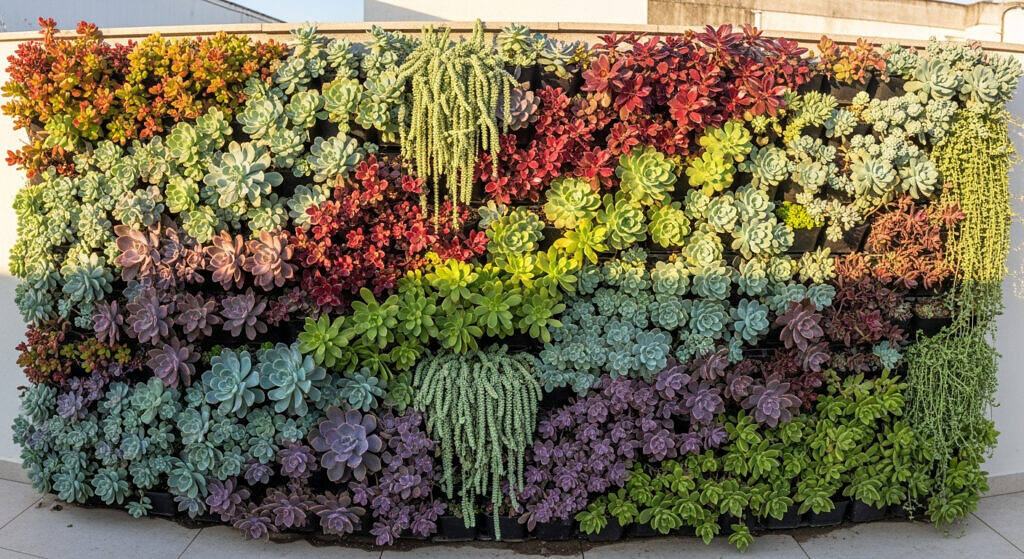
Why choose an outdoor vertical succulent garden
A vertical succulent garden combines three things many people are looking for: low water use, strong visual impact, and relatively simple maintenance. In modular pot systems such as Plastwall, Tecta and similar models, these plants can adapt well to the space, as long as you respect a few important limits: proper light, potting mix volume, efficient drainage, and the total weight of the structure.Succulents are plants adapted to environments with irregular water availability. They store water in their leaves, stems or roots, and they use a type of photosynthesis called CAM metabolism, which allows them to reduce water loss through the leaves. This makes them good candidates for drier, well-ventilated walls, typical of exterior façades.On the other hand, modular pots dry out quickly, heat up more, and receive full sun and wind. If species selection and management are not well planned, the result is: crown rot, sunburn, wilted plants, or plants falling out of the pots. The goal here is precisely to avoid these classic mistakes and create a beautiful, stable, long-lasting vertical succulent garden.
Understanding the modular pots: depth, weight and anchoring
Before choosing the plants, it is essential to understand the physical limitations of the modular system (Plastwall, Tecta, Greenplast and similar brands). In general, they have:
- Pot depth between 6 and 12 in (15 and 30 cm)
- Reduced potting mix volume for each plant
- Lightweight plastic structure that depends on solid anchoring to the wall
- Possibility of installing drip irrigation
These characteristics directly affect species selection and maintenance of the vertical succulent garden.About weight:
- Avoid heavy potting mixes with a lot of garden soil, clay, or dense organic matter.
- A light, well-draining potting mix is essential, both for the health of the succulents and for the safety of the wall.
- Large, woody succulent plants (such as shrub-like forms of Crassula ovata) tend to be too heavy and can throw the panels off balance.
About mounting and support:
- Make sure the wall can safely support the combined weight of structure + moist potting mix + plants.
- Use wall anchors and screws compatible with the type of masonry.
- Avoid installing on hollow or crumbling plaster.
Thinking about all this before rushing out to buy cuttings or plants prevents a lot of trouble—and keeps your wall from “sagging” over time.
Light, wind, and rain: choosing the right spot for your succulent wall
Location determines almost every decision that comes next. Outdoors, the three critical factors are:
- Hours of direct sun (and whether it’s morning sun or afternoon sun)
- Exposure to wind
- Exposure to rain (taking driving rain head-on or more sheltered)
Morning sun (until about 11 a.m.):
- This is the most forgiving condition for most collectible succulents.
- It allows you to grow many colorful species of Echeveria, Graptopetalum and their hybrids, as long as the rest of the day has bright, indirect light.
Afternoon sun (after about 1 p.m.):
- Hotter and harsher, especially on dark-colored walls.
- Prioritize tougher succulent species with thicker, more waxy leaves, which are less likely to burn.
Bright partial shade:
- A spot with very bright light and, at most, filtered sun or one to two hours of weak direct sun.
- Suitable for succulent species with thinner leaves or those that scorch easily.
Rain and wind:
- Fully exposed walls: higher risk of waterlogging and stem rot at the base, especially in the lower panels.
- Very windy walls: the potting mix dries out quickly; the plants suffer more from dehydration and are more likely to topple.
In practice, a good compromise for a succulent wall is a location with morning sun, moderate airflow, and some eave or overhang protection against direct rain—without turning it into a “wind tunnel.”
Potting mix for vertical succulent gardens: light, fast-draining, and stable
The potting mix is the heart of the system. In shallow, vertical containers for succulents, even small management mistakes show up quickly, so it is worth doing this part very carefully.In general, you need a potting mix that is:
- Lightweight (so it doesn’t overload the structure)
- Well-draining (water runs through quickly, without turning into mud)
- Stable (doesn’t break down quickly or turn into “clay” over time)
- Capable of holding some moisture, but without soaking the crown of the plants
An efficient way to think about a vertical garden soil mix is to combine three groups of components:1) Lightweight organic base
- Peat, coconut coir, or a good-quality commercial “cactus and succulent” potting mix.
- These are responsible for holding moderate moisture and nutrients.
2) Drainage and aeration materials
- Coarse washed sand
- Perlite
- Charred rice hulls (widely used because they are light and stable)
3) Small fraction of well-aged organic fertilizer
- Very well-aged, fully stabilized compost, in a small proportion, just to supply baseline nutrients.
For vertical gardens, a potting mix with the following approximate ratio (by volume) usually works well:
- 40–50% lightweight organic base
- 40–50% drainage materials (a blend of sand, charred rice hulls, perlite, etc.)
- Up to 10% richer organic matter (well-aged compost)
What to avoid:
- Garden soil or any soil with a lot of clay (heavy, compacted, waterlogged, and it sticks to the roots).
- Potting mixes with a high content of fresh organic matter, which ferments and heats up.
- Internal drainage layers (pebbles at the bottom of the planter): in shallow modules, this steals root volume. It’s better if the entire volume is filled with a well-structured succulent potting mix.
If you want to go deeper into soil and potting mix properties, it’s worth checking the complete guide for succulent beginners.
Composition of the ideal lightweight potting mix for vertical succulent wall modules: coconut coir, coarse sand, perlite, and charred rice hulls, with a succulent next to it.. Photo by
Step-by-step vertical garden assembly
Once the location and potting mix have been defined, assembling the vertical garden follows a few logical steps.1) Plan the wall layout
- Visualize the wall as a mosaic: areas in full sun, more shaded spots, and sections that receive more rain.
- Reserve the upper modules for hardier species that tolerate more sun and wind.
- Place the more sensitive species, or those that prefer partial shade, in the lower modules or in sections protected by eaves.
2) Prepare the modules
- Install the empty modules on the wall, making sure they are level and securely fastened.
- If you are using drip irrigation, run the tubing behind or above the modules, according to the system design.
3) Fill with potting mix
- Fill each container without compacting the potting mix too much.
- Tap the module gently to help the potting mix settle and eliminate air pockets, but without crushing or compressing the material.
- Leave about 0.4 in (1 cm) free at the rim to make watering easier.
4) Position the transplants
- Rosette-forming plants (such as many Echeveria): set them with the crown slightly above the surface, never buried.
- Trailing plants: tilt them slightly outward or to the side to enhance the cascading effect.
- Do not overcrowd each cavity: in small modules, 1 plant per container is standard; in larger cavities, use 2 to 3 small, low-growing plants.
- Combine trailing or branching plants with rosette-forming plants in the same module to create a fuller effect in the vertical garden.
5) First watering
- Water moderately after planting to settle the potting mix around the roots.
- Avoid waterlogging at the very beginning; freshly disturbed roots are more susceptible to rot.
Watering a vertical garden with succulents: drip or manual?
The great advantage of succulents is precisely their ability to tolerate infrequent watering. In a vertical garden, you can manage irrigation in two main ways.Drip irrigation
- More stable and convenient for those who do not have time for manual watering.
- Allows you to adjust the flow rate by line or zone, preventing waterlogging in more shaded areas.
- It is important to size the drip irrigation system to deliver a small volume at a time, with relatively long intervals.
General recommendations:
- For succulents, short, less frequent irrigation cycles are better than constant drip irrigation.
- If the weather is very hot and dry, the interval becomes shorter; in milder or rainier seasons, it becomes longer.
Manual watering
- Works well on small to medium walls.
- Use a watering can with a fine spout or a hose with a gentle spray nozzle, aiming at the potting mix, not directly at the center of the rosette.
- Let the potting mix dry out well between watering sessions. To the touch, it should feel dry on the surface and slightly dry a few inches (a few centimeters) below.
Signs of overwatering:
- Translucent, soft leaves that detach easily.
- Stem base darkening or “melting.”
Signs of underwatering:
- Wilted, wrinkled leaves, especially the lower ones.
- Plant feels very light when you lift the pot.
To learn more about succulent irrigation care in this type of garden, check out the secrets of watering succulents.In outdoor areas exposed to rain, it is often necessary to water very little during the rainiest season, precisely to avoid excess moisture. Day‑to‑day observation matters more than “fixed rules.”
Light fertilization: nourishing without overdoing it
Succulents generally prefer poor to moderately fertile soils. In shallow modules, excessive fertilization usually leads to leggy growth (etiolation), very watery tissues, and a higher risk of rot.Fertilization principles for outdoor vertical succulent gardens:
- Less is more: it is better to slightly under‑fertilize than to overdo it.
- Prefer more diluted and more widely spaced fertilization schedules.
- Avoid fertilizers that are very high in nitrogen, which stimulate large, weak leaves.
- Avoid using organic fertilizers, which can rot and damage the roots.
Common options:
- Slow‑release granular NPK fertilizer (Osmocote‑type), at a greatly reduced rate, applied to the potting mix, away from the base of the plant.
- Balanced liquid fertilizers, diluted beyond the usual recommendation, applied every 40–60 days during the growing season (spring and part of summer).
- A small amount of very well‑composted organic fertilizer mixed into the potting mix at planting time, without excess.
Avoid:
- Fertilizing in fall and winter (periods when many succulents slow their growth).
- Applying fertilizer directly on the leaves or into the center of rosettes.
List of succulents suitable for outdoor vertical gardens
Now for the part everyone enjoys: choosing the species. Below is a selection of succulents that are widely available on the market, adapt well to shallow containers, and perform well on exterior walls when properly placed. If you want to go deeper into plant selection, read the article 60 trailing succulents for vertical gardens.
For full sun or very strong morning sun
Ideal for the upper rows, which are more exposed to sun and wind.
- Graptopetalum paraguayense (Ghost Plant): very hardy, excellent for soft cascades; tolerates full sun, wind, and a certain irregularity in watering.
- Graptoveria hybrids (e.g., ‘Fred Ives’): colorful rosettes that tolerate intense sun once well acclimated.
- More rustic species and cultivars of Echeveria (with thick, waxy, bluish or grayish leaves): excellent for a look of well-defined rosettes.
- Sedum nussbaumerianum (Coppertone Stonecrop): elongated leaves that turn golden/orange in strong sun; great for borders and a trailing effect.
- Sedum rubrotinctum (jelly bean plant): small, rounded leaves that take on a reddish tone in the sun; works well in shallow pots.
- Portulacaria afra (Elephant Bush) (mini forms and variegated varieties): as long as it is pruned to stay low, it forms dense, very resilient clumps.
For morning sun and bright light the rest of the day
Good for the middle sections of the vertical garden, with softer sunlight and partial protection.
- More ornamental varieties of Echeveria (pink, purple, bicolored), which look beautiful in gentle sun.
- Crassula ovata (Jade Plant) in compact varieties (such as dwarf types), kept pruned so they do not become too heavy.
- Crassula perforata (string of buttons): segmented, trailing stems, excellent for borders.
- Senecio serpens (Blue Chalksticks): great as a groundcover in wider planting modules.
- Senecio radicans (String of Bananas) or similar trailing types, as long as they receive enough light to avoid etiolation.
For bright partial shade or very filtered sun
Ideal for the lower modules of the vertical garden, under eaves or on east-facing walls with little direct exposure.
- Haworthia spp.: small rosettes, with stripes or dots; they prefer filtered light, excellent for protected niches in a vertical succulent garden.
- Gasteria spp.: thick, resilient leaves, they like partial shade; they perform well in shallow pots.
- Some compact forms of Sansevieria (Snake Plant) (such as dwarf types): use with caution regarding weight, but they tolerate partial shade very well.
- Certain crassulas with thinner, greener leaves, as long as they are not kept in the dark – they need bright, indirect light.
Trailing species perfect for the lower edges
To create that cascading effect without overloading the structure:
- Graptopetalum paraguayense (already mentioned, but worth reinforcing: it is almost a “wild card plant” for vertical succulent gardens).
- Sedum morganianum (burro’s tail): its stems break easily and need careful handling, but it works well as long as the wind is not extreme.
- Dischidia and other more delicate species can be used in protected niches of the vertical succulent garden, provided the microclimate is not extremely dry.
Species that require caution in shallow and vertical pots
They are not forbidden, but they demand extra attention in a vertical succulent garden:
- Heavy, shrubby succulents: they can topple the pot or put excessive strain on the structure.
- Large columnar cacti: deep roots and considerable weight.
- Species that are very sensitive to direct rain, with very thin, highly succulent leaves: on exposed walls, they tend to rot.
Whenever possible, research the plant’s mature size and its geographic origin in reliable sources, such as the succulent guide for beginners or academic publications, to understand whether it is suitable for a small, vertical space.
Spacing, pruning, and renewing transplants
A common temptation is to “overfill” each module to achieve a lush effect immediately after installation. The result, a few months later, is competition for light and space, with plants overlapping, stretching, or rotting due to poor air circulation in the vertical succulent garden.Initial spacing:
- In small cells (about 4 x 4 in / 10 x 10 cm): 1 plug per pot.
- In slightly larger cells: up to 2 or 3 small plants, as long as they are low-growing and slow-growing.
- Remove dry leaves at the base of the rosettes, preventing the buildup of dead matter that can retain moisture and fungi.
- Cut back overly stretched (etiolated) stems and use the tips as cuttings, replanting them wherever there are gaps in the vertical garden panel.
- Control the size of shrubby species with light, regular pruning, maintaining balanced weight on the vertical garden structure.
Renewing plants:
- On vertical garden panels that receive a lot of sun and wind, it is normal for some succulents to lose vigor over time.
- Plan for minor annual or semiannual maintenance to replace very exhausted plants, redo part of the compositions, and fill in bare spots.
Common problems: rot, sunburn, and leaf drop
Even with all the proper care, some problems are almost inevitable at some point in a vertical garden. The important thing is to recognize them early and know how to adjust your management.Rot (crown and root rot)Most frequent causes:
- Heavy, poorly drained potting mix.
- Excessive watering, especially during rainy periods.
- Installation in an area with shade and constant humidity.
What to do:
- Drastically reduce watering frequency.
- Replace the potting mix with a more free-draining blend if the problem is widespread throughout the vertical garden.
- Remove affected parts and replant from healthy cuttings.
To prevent rot and other common diseases, it is very helpful to understand the essential care for succulents.SunburnNewly purchased plants that come from shaded greenhouses burn easily when placed directly in the intense sun of a façade or exposed vertical garden. Acclimation is essential: a gradual adaptation to strong light over 2–3 weeks before permanently fixing them to the exterior wall.Signs of sunburn:
- Dry brown spots on the leaves, especially on the most exposed areas.
- Sudden discoloration of entire parts of the plant.
Leaf dropIn succulents such as Graptopetalum and some Sedum, it is normal for a few leaves to be shed at the base.But excessive leaf drop can indicate:
- Post‑transplant shock.
- Overwatering (tissues become soft and detach).
- Light deficiency (plants stretching, losing leaves at the base).
Adjusting light and watering almost always solves or at least stabilizes the situation.
Pests and diseases in succulent walls
Vertical gardens tend to create their own microclimate: plenty of air circulation in front, but sometimes little ventilation behind the modules. In succulents, the most common pests are:
- Mealybugs (white cottony clusters in leaf axils and roots).
- Aphids on new growth.
- Slugs and snails on more humid, shaded walls.
Preventive measures:
- Avoid excess nitrogen fertilizer, which makes tissues very tender.
- Maintain good front ventilation and do not overcrowd each pot.
- Inspect the back of the modules and the joints between them regularly.
In cases of light infestation, it is often possible to control it manually (removing the pests) or with specific solutions labeled for ornamental use, always following the label and local regulations. To read about ecological control, see these recipes for pest and fungus control.
Practical summary for a healthy vertical succulent garden
Once you understand how a vertical succulent garden works, it stops looking like a “delicate panel” and becomes a simple system: well‑chosen light, flawless drainage, and a bit of self‑control with watering. That is what keeps the succulent wall beautiful not just for weeks, but for entire seasons, with the plants fitting together better each month, filling gaps at the right pace and becoming more resilient over time — just the way a succulent prefers, without rush and without excess.The best starting point is to begin small and with intention. Choose a section of wall that gets bright light (preferably softer sun), assemble one module or a narrow strip of the panel with a few reliable succulent species, and observe how that microenvironment behaves: how long the potting mix takes to dry, how the wind hits that spot, whether rain reaches it too much. In a vertical succulent garden, this “first trial” is priceless, because it reveals the fine‑tuning that no text can guess for you.From there, the process becomes almost automatic: you expand the succulent panel more confidently, repeat what worked, and avoid the classic mistakes that make a succulent give up on life — especially waterlogging disguised as care.If you were waiting for a sign to start, here it is: set up your first vertical garden module this week, using a light, well-draining potting mix, and let the plants show you that a well-planned vertical garden requires less maintenance than it seems and is far more rewarding than any picture you see on the internet promises.