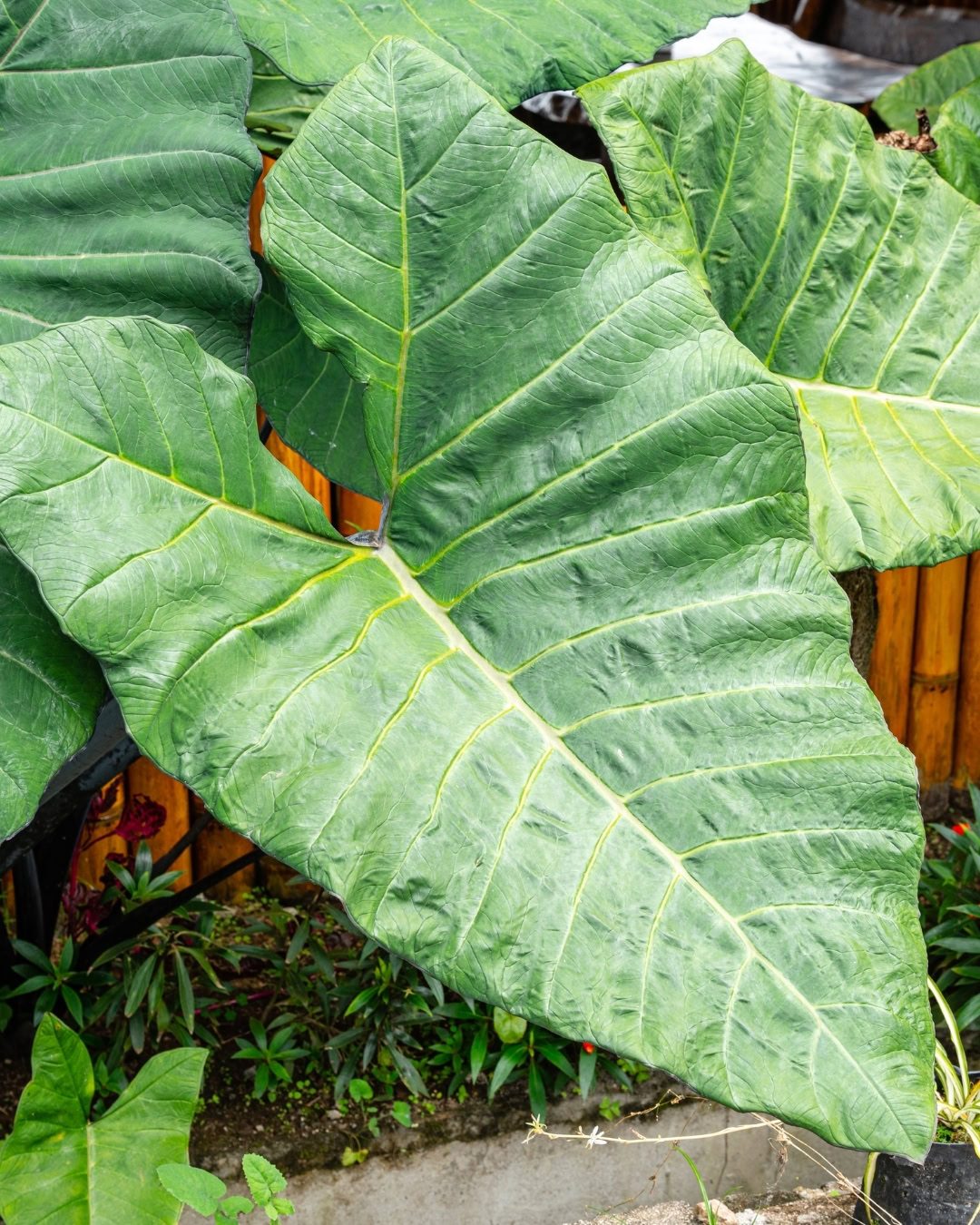
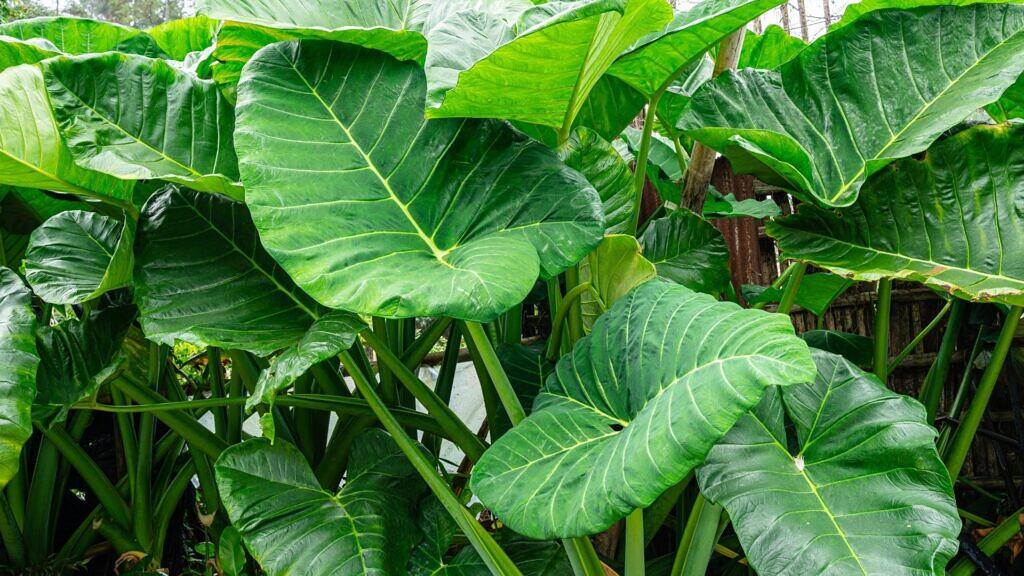
Giant Taro (Alocasia macrorrhizos) is a monumental herbaceous plant, celebrated in landscape design for its ability to transform ordinary spaces into lush tropical areas. With its colossal leaves, this species is not just a filler plant, but a true star that brings a unique texture to garden beds. Its presence evokes the mystical atmosphere of humid forests, making it a favorite choice for architects and gardeners seeking the impact of the urban jungle style on a macro scale.
Although it is often confused with other species in the Colocasia genus, Alocasia macrorrhizos has a noble structural distinction: its leaves point proudly toward the sky, like lush emerald-green flags. It is a plant that demands space and respect, growing vigorously when it finds ideal conditions of moisture and warmth.
Origin, habitat and etymology
Alocasia macrorrhizos traces its roots to the depths of the humid tropical forests of Southeast Asia and the islands of the Indo-Malayan region in the Pacific. In its habitat, it thrives in understory environments, where sunlight is filtered through the canopy of giant trees, and along fertile banks of waterways. In these regions, relative humidity is consistently high and the soil is rich in organic matter from decomposing leaf litter, conditions the plant tries to replicate even when grown in urban gardens.
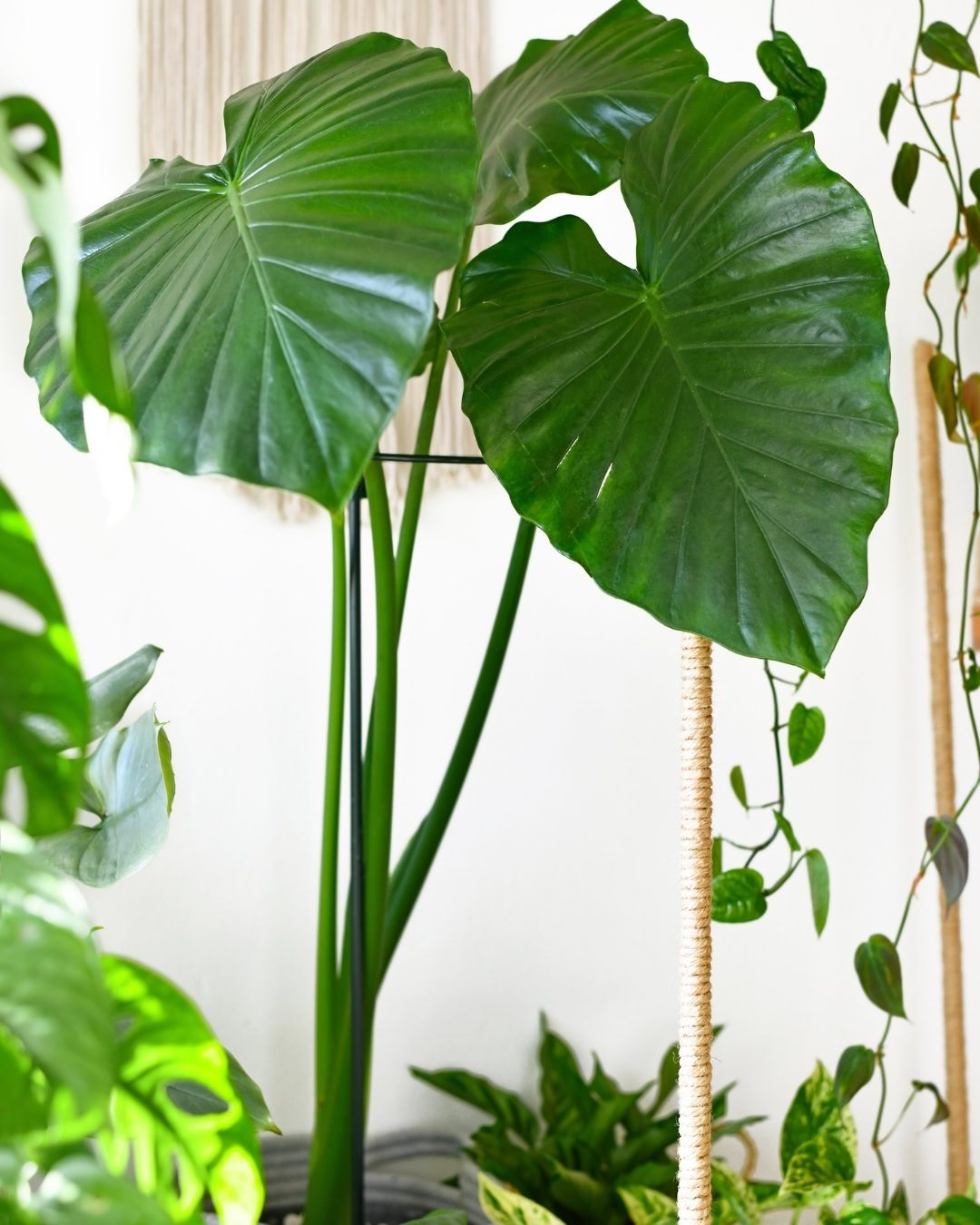
The genus name Alocasia arose as a derivation of the name of another very close genus, Colocasia. The specific epithet macrorrhizos is a combination of two Greek terms: makros, meaning “large” or “long,” and rhiza, which translates as “root.” This is a clear reference to its “pachycaul” (thick-stemmed) and elongated rhizome, which functions as a reservoir of nutrients and water, allowing the plant to sustain its gigantic proportions.
Landscape use of Giant Taro
In landscape design, Giant Taro is used primarily to create immediate visual and structural impact. It works as a focal plant, ideal for anchoring corners of shaded gardens or serving as a backdrop in tropical-style beds. Because of its fast growth and dense foliage, it is often used to create “living walls” or visual barriers that provide privacy without the rigidity of masonry walls. In large-scale projects, planting in groups or massings creates a continuous green effect that fills the middle and upper layers of the garden, easily reaching between 10 and 16 feet tall.
The recommended spacing for planting is 5 to 8 feet between each specimen. This distance is crucial not only to allow the leaves to spread without restriction, but also to ensure air circulation between the petioles (leaf stalks), which helps prevent fungal problems. Giant Taro pairs beautifully with plants that offer contrasting textures and colors, such as Philodendron bipinnatifidum or Canna indica, whose vibrant flowers create an interesting visual dialogue with the bright green of Alocasia. For groundcover beneath its shade, using Asparagus densiflorus offers a fine, delicate contrast against the broad, leathery leaves of Giant Taro.
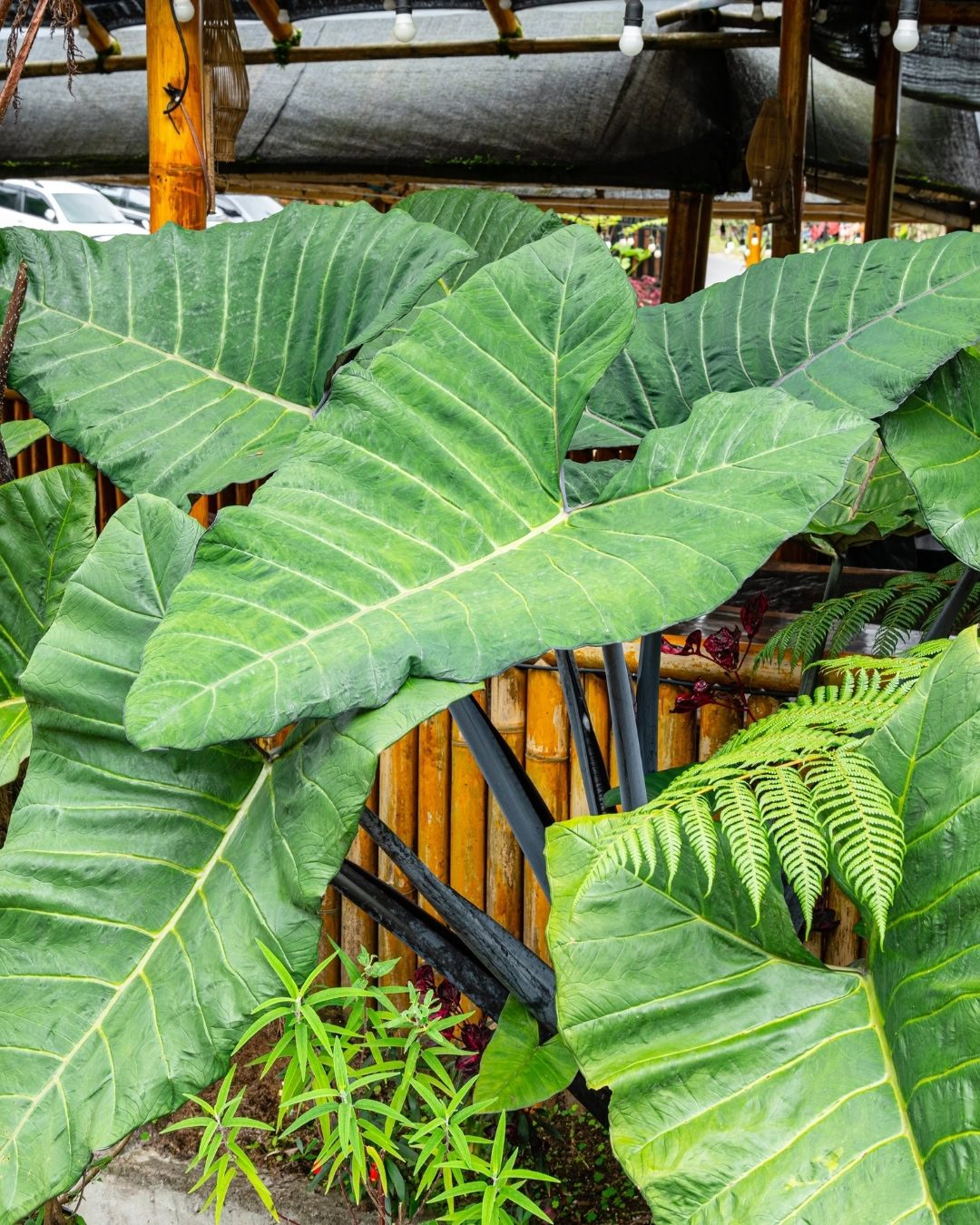
Alocasia macrorrhizos is also versatile in large containers (minimum 13 gallons), making it a standout feature on balconies, patios, and living rooms with high ceilings and abundant natural light. In tropical or contemporary garden styles, it is a true all-rounder. Although its flowers are not the main attraction in arrangements, the foliage is highly valued in themed event decor, though it requires constant hydration after cutting so it does not wilt quickly.
How to care for Giant Taro: Growing guide
- Light: Prefers filtered light or partial shade, mimicking the forest understory. In regions with high relative humidity (above 70%), it tolerates full sun, which results in a more compact habit and stiffer petioles. However, in dry climates, direct exposure to strong sun can cause necrotic burns on the leaf margins.
- Soil and Substrate: The soil should be deep, rich in organic matter (worm castings or organic compost), and have excellent moisture retention without being overly clayey. The ideal pH should be slightly acidic to neutral (5.5 to 7.0). In pots, use a potting mix that combines topsoil, coconut fiber, and a little coarse sand to ensure drainage.
- Watering: Giant Taro is a thirsty plant. During the hottest months of spring and summer, watering should be frequent and deep, about 3 to 4 times a week, keeping the soil consistently moist to the touch, but never soggy enough to deprive the roots of oxygen. In winter, the frequency should be drastically reduced.
- Humidity: Essential for successful growing. In indoor spaces or dry climates, mist the leaves daily or use humidifiers. Leaves with dry tips are the first sign of low ambient humidity.
- Fertilizing: Because it is a fast-growing, large plant, it is demanding when it comes to nutrients. Use a balanced formula such as NPK 10-10-10 or, preferably, NPK 20-10-20 (with a higher nitrogen and potassium content) monthly during the growing period. Adding micronutrients, especially magnesium and iron, helps keep the foliage a vibrant green and prevents chlorosis.
- Pruning: Do only cleanup pruning. When a lower leaf naturally starts to yellow (senescence), cut the petiole close to the base using a sterilized tool. This keeps the plant from wasting energy on dead tissue and improves its appearance.
How to propagate Giant Taro
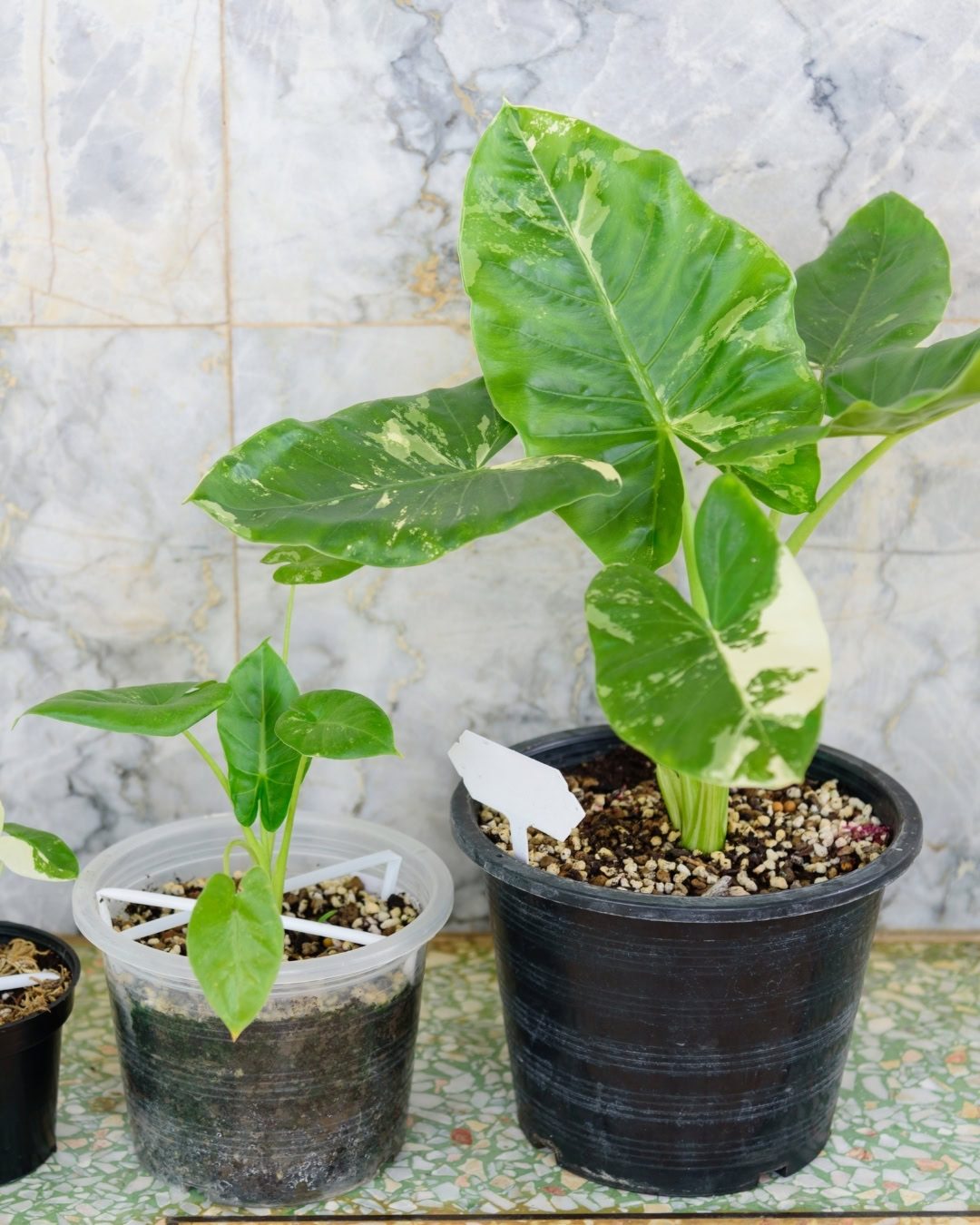
The simplest and most effective way to propagate Alocasia macrorrhizos is by dividing rhizomes or separating side shoots. During spring, it is common to see “pups” emerging at the base of the mother plant. To propagate, carefully remove the soil around these shoots and, with a sharp, clean knife, separate the shoot, making sure it comes with a portion of rhizome and some of its own roots. Plant immediately in a pot with moist substrate and keep it in a sheltered spot out of strong sun until the new leaf begins to develop.
Another method is using stem sections. If the plant has become very tall and the stem (aerial rhizome) is exposed and long, you can cut it into 4 to 6 in (10 to 15 cm) sections. Lay these sections horizontally over a bed of moist sand or a light substrate, covering them partially. Keep the moisture constant and, in a few weeks, the adventitious buds will begin to sprout.
Botanical Description of Alocasia macrorrhizos
Alocasia macrorrhizos is a perennial herb with a pachycaulous growth habit, characterized by a succulent, thick, upright stem that stores water and starch. The plant can reach impressive heights of 118 to 197 in (300 to 500 cm). Its leaves are arranged spirally at the top of the stem; the blade is sagittate-ovate (arrowhead to oval shape) and has a leathery, waxy texture, being completely glabrous (hairless). The leaves are colossal, ranging from 39 to 79 in (100 to 200 cm) long, with rounded basal lobes and slightly wavy margins. The venation is a technical detail of its own: the central vein is extremely prominent, with 9 to 12 pairs of primary lateral veins that stand out strongly on the abaxial (lower) surface.
The petiole is robust, cylindrical, and succulent, and can reach 4.9 ft (1.5 meters) in length, with an invaginated base that clasps the central stem. As a monoecious plant in the Araceae family, its inflorescence consists of a spadix protected by a greenish-yellow, lightly scented spathe, measuring between 6 and 10 in (15 and 25 cm). The female flowers are located at the base of the spadix, separated from the male flowers at the top by a sterile zone. After pollination, dense ellipsoid berries form and change from green to bright red when ripe, attracting wild birds. The roots are fibrous, arising from the vigorous central rhizome.
Main varieties and cultivars
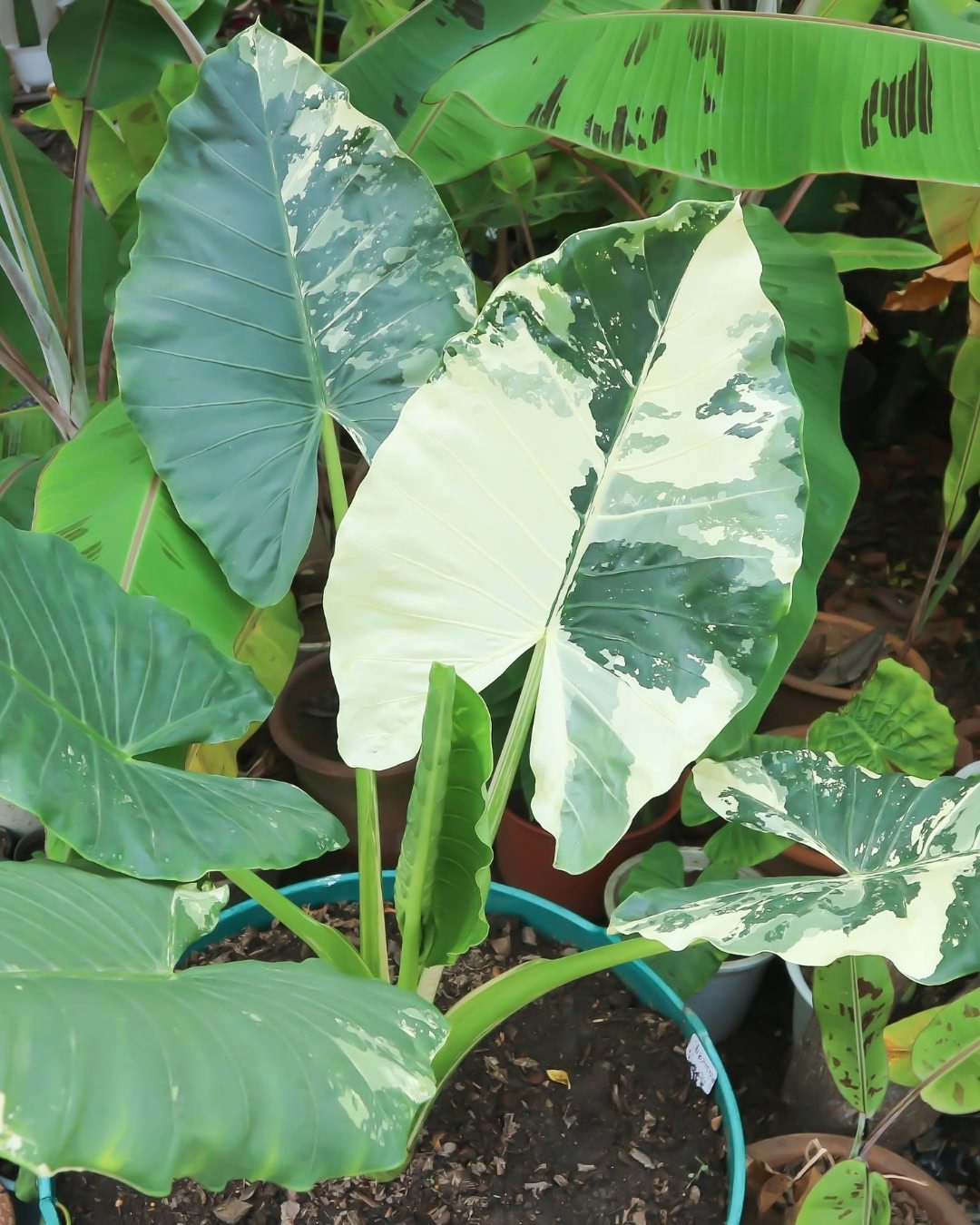
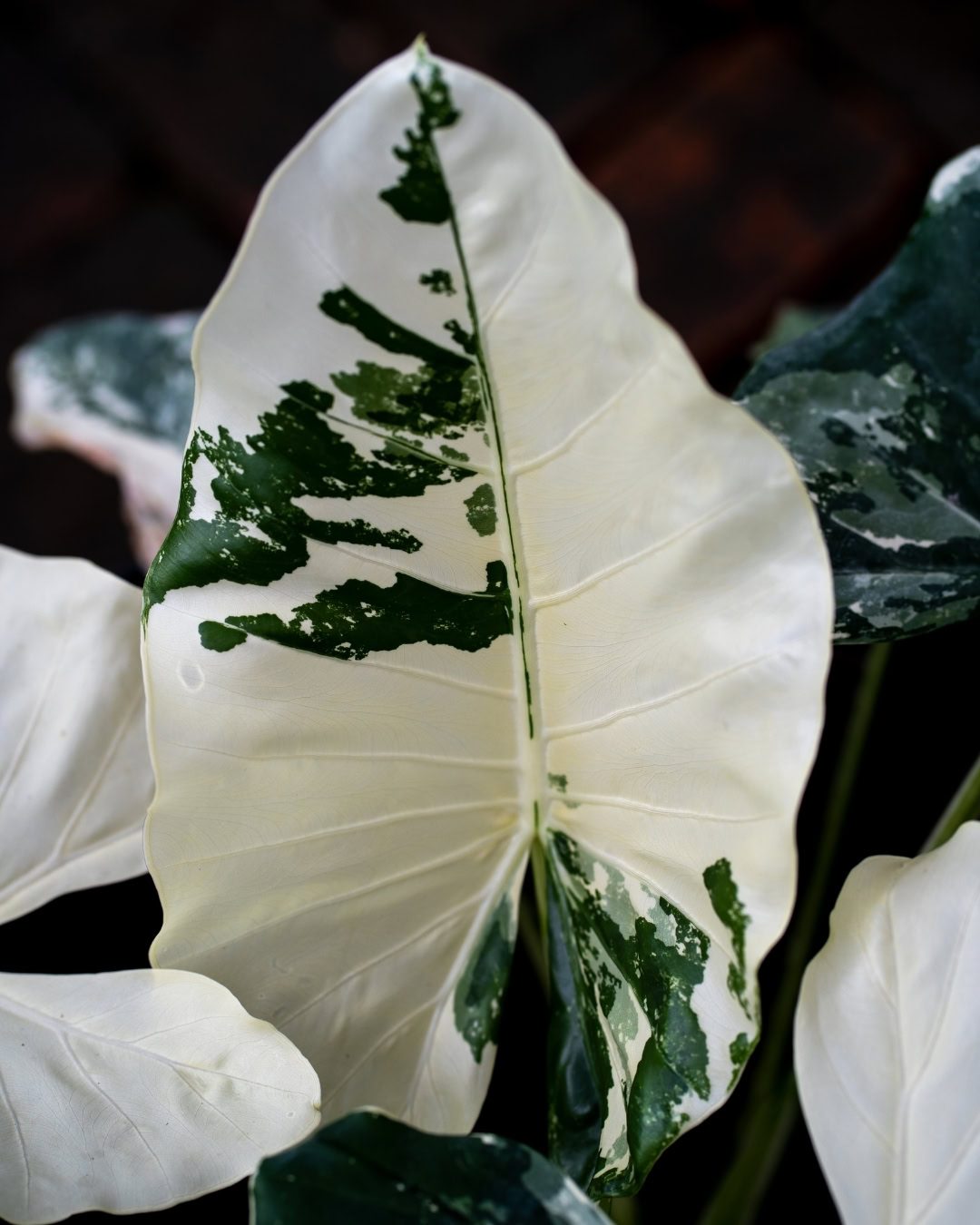
- ‘Variegata’: Without a doubt the most coveted by collectors. It has irregular sectors of pure white or cream contrasting with green. It needs more light than the plain form to avoid losing its variegation, but it is more sensitive to direct sun.
- ‘Lutea’ (Golden Elephant Ear): An exotic variety where the petioles and main veins show a vibrant golden-yellow tone, creating a sunlit contrast with the lime-green blade.
- ‘Borneo Giant’: The giant among giants.
Under ideal moisture and nutrition conditions, this selection produces leaves that easily exceed 6 feet in individual length, so it is suited only to large properties. - ‘Black Stem’: It is characterized by petioles in a nearly black deep purple tone, which gives the plant a dramatic, modern elegance.
Pests, diseases, and solutions
The main pest that attacks Giant Taro in low-humidity conditions is the two-spotted spider mite (Tetranychus spp). They settle on the undersides of the leaves, causing a bronzed or dusty appearance. The solution involves increasing ambient humidity and applying neem oil or potassium soap. Scale insects can also appear at the base of the petioles; in light infestations, these should be removed manually with a soft brush and isopropyl alcohol.
Root rot caused by fungi such as Pythium and Phytophthora is the most serious problem, usually resulting from compacted soil and overwatering. If the plant starts to lean or the leaves suddenly turn yellow, check the roots; if they are dark and soft, stop watering and try repotting into dry soil. Bacterial leaf spots caused by Xanthomonas can appear if there is too much moisture on the leaves without ventilation. The solution is to cut off the affected leaves and improve air circulation around the plant.
Interesting facts
Alocasia macrorrhizos has a contradictory relationship with human food. Although it is an aroid and classified as a toxic plant because of the presence of calcium oxalate crystals (which cause severe irritation, glottal edema, and intense pain if eaten raw), it is considered a nonconventional food plant in various cultures of Southeast Asia and the Pacific. In those regions, the rhizomes and leaves are eaten, but only after rigorous processing involving prolonged cooking or fermentation, processes that neutralize the toxicity of the crystals.
In Asia, the plant also has traditional medicinal uses. The chopped rhizome is sometimes applied topically to relieve skin inflammation and insect bites, although this practice is not recommended for laypeople because of the high risk of contact dermatitis for sensitive skin. There is also an interesting technical detail: the phenomenon of guttation. It is common to see “dew drops” on the tips of Alocasia leaves in the morning; this is not rain, but the plant expelling excess water and mineral salts through special pores called hydathodes, a sign that the plant’s water metabolism is functioning at full capacity.