
Some gardens seem to gain more depth as soon as purple and lilac flowers come into bloom. These shades soothe the eye, create visual distance, and make yellow, gold, and silvery foliage stand out. Between a small African violet in the living room and a jacaranda tree in full bloom, there are options for containers, flower beds, walls, ponds, and larger landscapes. And purple doesn’t belong only in the garden: it’s also one of the most popular colors for weddings. That’s why, later on, I’ll also share the best purple flowers for bouquets, arrangements, and wedding and event decor, with ready-made color palettes and each flower’s season.
I recommend starting with the space you have and the amount of sun it gets, not just the flower color. A cool-climate plant placed in intense heat may survive for a while, but it won’t deliver the bloom display you were hoping for.
Why use purple and lilac flowers in landscaping?
Purple, violet, and lilac are cool colors: they seem to recede in the visual field. In a narrow planting bed, that helps create a sense of depth. In seating areas, lavender, mauve, and violet tones make the design feel calmer and more restful.
Purple is also an easy color to combine in the garden: it pairs beautifully with yellow, white, silver, and neighboring shades on the color wheel. After the list, I’ll show the combinations I use most often in landscape designs.
Purple ground covers, annuals, and herbaceous plants for beds and containers
1. Verbena (Verbena hybrida)

Low-growing and reaching 6 to 12 in (15 to 30 cm), verbena loves full sun and blooms in spring and summer. It works well in borders, window boxes, and mass plantings. The key factor is drainage: use fertile, very well-drained soil, since the roots struggle in soggy conditions.
2. Torenia (Torenia fournieri)

Torenia, also called wishbone flower, grows 8 to 12 in (20 to 30 cm) tall. It prefers partial shade or morning sun and handles heat and humidity well. Its blooms combine deep violet, a yellow throat, and lilac-edged petals.
3. Pansy (Viola × wittrockiana)

Growing 6 to 8 in (15 to 20 cm) tall, pansies bloom in fall and winter. Their velvety flowers may be deep purple, lilac, or bicolored. They’re a great choice for colder areas; in intense heat, they quickly decline.
4. Sweet violet (Viola odorata)

A relative of the pansy, sweet violet forms low carpets 4 to 6 in (10 to 15 cm) tall and spreads by stolons, stems that run along the soil surface and root as they go. It prefers partial shade and cool soil rich in organic matter. From late winter into spring, it produces small violet flowers with a sweet fragrance. The flowers are edible and work well in salads and baking.
5. Garden petunia (Petunia × hybrida)

Trailing or mounding, petunias reach 8 to 16 in (20 to 40 cm) and need full sun. In mild-winter climates, they bloom from fall into early spring. To keep them covered in flowers, feed regularly with a bloom fertilizer higher in potassium.
Enjoyed this guide? There's more where it came from.
Understanding why plants behave the way they do is what turns guesswork into a thriving garden. That's exactly what we share in the Shrubz newsletter — free, straight to your inbox:
- Seasonal care reminders timed to your gardening calendar
- Propagation and pruning techniques, explained step by step
- Pest and disease alerts — catch problems before they spread
6. Calibrachoa or million bells (Calibrachoa hybrida)

Million bells has a trailing habit, grows 6 to 10 in (15 to 25 cm) tall, and carries smaller but very dense blooms. It looks especially good in hanging baskets in full sun and can flower nearly year-round where hard freezes are uncommon. It also handles heavy rain and wind better than standard petunias.
7. China aster (Callistephus chinensis)

Also called annual aster, this is a 12 to 28 in (30 to 70 cm) annual for full sun and mild weather. Sown in spring, it blooms from summer into fall, with double flower heads in purple, violet, or lilac. It’s excellent as a cut flower and lasts well in a vase. Avoid planting it in the same bed year after year, since soilborne fungi can cause wilt.
8. Globe amaranth (Gomphrena globosa)

This annual reaches 24 in (60 cm) and blooms from spring through late summer. Its rounded purple-magenta flower heads have a papery texture and stay attractive even after drying. It’s a great choice for cutting gardens and dried arrangements.
9. Mealycup sage (Salvia farinacea)

Growing 16 to 24 in (40 to 60 cm) tall, mealycup sage forms upright clumps in full sun. Its indigo-purple flower spikes, with velvety calyces, appear from spring through fall.
It’s one of the most interesting plants for bringing bees and butterflies into the garden. See more options in plants that attract butterflies and hummingbirds.
10. Trailing tibouchina (Heterocentron elegans)

In the same family as princess flower, this ground cover grows just 2 to 6 in (5 to 15 cm) tall and has reddish stems that root wherever they touch the soil. It carpets beds with tiny leaves and magenta-purple four-petaled blooms, especially in summer and fall. It grows in full sun or partial shade as long as the soil stays moist. It is not frost-tolerant.
11. Dwarf ruellia (Ruellia simplex)

Growing 8 to 12 in (20 to 30 cm) tall, dwarf ruellia blooms in spring and summer. It handles moist soil and also tolerates short dry spells. Its tubular lilac-purple flowers open daily in full sun or partial shade.
12. Angelonia (Angelonia angustifolia)

Often called summer snapdragon, angelonia forms upright clumps 12 to 24 in (30 to 60 cm) tall, with spikes of purple and lilac flowers from spring through fall. Unlike many purple flowers, it thrives in heat and full sun, tolerates dry periods, and keeps blooming without deadheading.
13. Lisianthus (Eustoma grandiflorum)

At 20 to 32 in (50 to 80 cm) tall, lisianthus has blooms that resemble roses or tulips, in deep purple, violet, and lilac, often with lighter edges. It’s one of the longest-lasting cut flowers for arrangements. In the garden, it needs full sun, well-drained soil, and cool nights. Because starting from seed is slow and delicate, it’s best to buy transplants.
14. Statice (Limonium sinuatum)

This annual grows 16 to 24 in (40 to 60 cm) tall and produces winged stems topped with clusters of papery violet-purple calyces that hold their color for months after drying. It likes full sun and sandy soil, and it tolerates wind and salt spray, making it a great choice for coastal gardens and dried arrangements.
15. Canterbury bells (Campanula medium)

A biennial reaching 24 to 36 in (60 to 90 cm), Canterbury bells sends up stems covered with large lilac or violet bells in its second year, blooming in spring. It’s a cool-climate plant typical of cottage gardens and does well in full sun or partial shade with fertile, well-drained soil. It’s also widely grown in containers.
16. Balloon flower (Platycodon grandiflorus)

This perennial grows 16 to 24 in (40 to 60 cm) tall and has inflated buds like little balloons that open into bluish-violet stars with darker veining. It blooms in summer in full sun or partial shade and prefers mild weather. It dies back in winter and returns in spring, so mark the spot to avoid damaging the roots.
17. Foxglove (Digitalis purpurea)

A biennial, foxglove sends up 3.3 to 5 ft (1 to 1.5 m) spikes in its second year, covered with purple tubular flowers speckled inside. It blooms in spring and early summer and prefers partial shade, cool weather, and consistently moist, rich soil. All parts of the plant are toxic because they contain cardiac glycosides, so grow it away from children and pets.
Shrubs with purple and lilac flowers for garden structure
18. French lavender (Lavandula dentata)

French lavender grows 24 to 36 in (60 to 90 cm) tall and needs at least six hours of sun a day. It has gray, toothed foliage and lilac flower spikes. For most warm-climate gardens, it’s one of the best lavender choices: plant it in sandy or alkaline soil with impeccable drainage.
19. Spanish lavender (Lavandula stoechas)

Growing 16 to 24 in (40 to 60 cm) tall, Spanish lavender is easy to recognize by its “rabbit ear” bracts—purple tufts topping the short, dark flower spikes. Its color is a richer purple than that of many other lavenders, and it blooms from spring into summer. It handles dry heat well but struggles in humidity, so plant it in full sun in a raised bed or container with excellent drainage.
20. Orelha-de-onça (Pleroma heteromallum)

A native shrub, 3.3 to 6 ft (1 to 1.8 m) tall, for full sun.
Blooms from summer into fall with upright panicles of vivid purple flowers. The green, velvety leaves have pronounced veins and attract native pollinators.
21. Mexican bush sage (Salvia leucantha)

Also known as velvet sage, this shrub grows 32 to 48 in (0.8 to 1.2 m) tall and thrives in full sun. From fall into spring, it sends up long, arching spikes covered in velvety purple calyces. In the typical form, small white corollas emerge from those calyces; in the cultivar ‘Midnight’, the flowers are fully purple. Once established, it tolerates drought and attracts hummingbirds. It can be cut back to the ground after flowering to refresh the clump.
22. Golden dewdrop (Duranta erecta)

Duranta can reach 10 ft (3 m) tall and produces dangling clusters of purple flowers edged in white, followed by orange berries. If you want blooms, avoid shearing it into a square topiary, since pruning removes the branches that would form flower buds.
23. Yesterday-today-and-tomorrow (Brunfelsia uniflora)

Yesterday-today-and-tomorrow blooms from late winter into spring and can grow 5 to 8 ft (1.5 to 2.5 m) tall. Each flower opens deep purple, turns lilac on the second day, and becomes white on the third. The fragrance is intense, and the color shift gives the shrub an ever-changing look.
24. Sweet pea shrub (Polygala myrtifolia)

A rounded shrub growing 3 to 6 ft (1 to 1.8 m) tall for full sun. It blooms from fall into spring in mild tropical and subtropical climates. The purple and lilac flowers resemble tiny butterflies, with a whitish tuft at the center.
25. Amethyst flower (Plectranthus saccatus)

A South African subshrub growing 24 in to 3 ft (60 cm to 1 m), amethyst flower is one of the few plants with purple and lilac flowers that performs well in shade. It prefers partial shade or filtered light, under trees or near walls. In late summer and fall, it produces large lilac-blue flowers with a pouch-shaped lower lip. It has slightly fleshy leaves and adapts well to container growing.
26. Heliotrope (Heliotropium arborescens)

A subshrub growing 16 to 35 in (40 to 90 cm) tall, heliotrope forms flattened clusters of tiny deep purple flowers with a vanilla fragrance that becomes stronger in the late afternoon. It blooms from spring through fall in full sun or partial shade and does especially well in containers near patios and seating areas. This plant is toxic if ingested and contains alkaloids harmful to people and pets.
27. Butterfly bush (Buddleja davidii)

Growing up to 10 ft (3 m), butterfly bush prefers full sun and blooms in spring and summer in mild climates. Its lilac to deep purple conical flower clusters are fragrant and attract lepidopterans, including butterflies. In some parts of the US, this plant can self-seed aggressively, so check local guidance before planting.
28. Philippine violet (Barleria cristata)

Compact at 32 to 48 in (80 cm to 1.2 m), Barleria blooms in fall and winter. Its funnel-shaped lilac flowers appear when many garden beds have already lost their color. It works well in low hedges and informal borders.
29. Blue potato bush (Lycianthes rantonnetii)

Blue potato bush grows 5 to 6.5 ft (1.5 to 2 m) tall and blooms from spring through fall. The violet-purple flowers have a bright yellow center. It can also be trained as a small tree with a single trunk.
30. Purple angel’s trumpet (Datura metel)

Shrubby and 3 to 5 ft (1 to 1.5 m) tall, this plant prefers full sun and blooms from spring through fall. The double trumpet flowers have overlapping layers, purple on the outside and cream inside, and release their fragrance at dusk. All parts of the plant are toxic if ingested, so keep it away from children and pets.
Purple and lilac flowering vines for walls and pergolas
31. Queen’s wreath (Petrea volubilis)

A woody vine that can climb up to 20 ft (6 m) in full sun. In late winter and early spring, it produces hanging clusters. After the purple flowers drop, the pale lilac sepals, the structures that surround the flower, remain for weeks.
32. Maypop (Passiflora incarnata)

Vigorous and suitable for sun or partial shade, maypop blooms in spring and summer.
The corona, the cluster of filaments at the center of the flower, blends purple, lilac, and white. It attracts Heliconius butterflies.
33. Blue sky vine (Thunbergia grandiflora)

This vigorous vine quickly covers large pergolas. It blooms in spring and summer with cascading clusters of lilac-blue tubular flowers. It needs plenty of room and sturdy support. See other Thunbergia species too.
34. Garlic vine (Mansoa alliacea)

Native to the Amazon, garlic vine blooms in spring and fall. Its flower clusters shift from violet-purple to lilac. When crushed, the leaves release a garlic scent, which explains its common name.
35. Clematis (Clematis × hybrida)

Clematis is a climbing vine that clings to supports with its leaf stalks, which curl like tendrils. From spring into summer, it opens large star-shaped flowers with four to six pointed sepals and prominent stamens. It needs a cold winter to perform well. The golden rule is to keep the top growth in sun and the roots shaded: mulch around the base or use low-growing companion plants, and provide fertile, cool, well-drained soil.
36. Chinese wisteria (Wisteria sinensis)

Chinese wisteria needs winter chill. Its long, fragrant lilac flower clusters appear in late winter before the leaves emerge. This is a large vine best suited to strong, durable structures.
Bulbs and rhizomatous plants with purple and lilac flowers
37. Hyacinth (Hyacinthus orientalis)

At 8 to 12 in (20 to 30 cm) tall, hyacinth produces dense, highly fragrant flower spikes in late winter to early spring. The bulb needs cold to bloom. Outside colder regions, store the bulbs in the refrigerator crisper drawer for six to eight weeks before planting in fall. Wear gloves when handling the bulbs, as they can irritate the skin.
38. Bearded iris (Iris germanica)

Growing 24 to 31 in (60 to 80 cm) tall, bearded iris blooms in spring and prefers areas with a distinct winter season. To prevent rot, the rhizome, the thick stem that grows at soil level, should remain slightly exposed.
39. Walking iris (Neomarica caerulea)

This species reaches 4 ft (1.2 m) tall and tolerates moisture well. Its bluish-purple flowers last only one day, but they appear in succession for weeks through spring and summer.
40. Society garlic (Tulbaghia violacea)

At 12 to 16 in (30 to 40 cm) tall, society garlic produces small lilac umbels, clusters of flowers that emerge from the same point, for much of the year. The leaves have a mild garlic scent and may help repel garden pests.
41. Gladiolus (Gladiolus × hortulanus)

Gladiolus grows 31 to 47 in (80 to 120 cm) tall and needs full sun. It blooms 70 to 90 days after planting. Make successive plantings in spring and summer to enjoy lilac or deep violet flower spikes at different times.
42. Baboon flower (Babiana stricta)

One of the truest purple and lilac flowers among bulb plants, baboon flower forms clumps 8 to 12 in (20 to 30 cm) tall, with pleated, hairy leaves. In late winter and early spring, it sends up stems with intense violet-purple blooms. It prefers full sun and sandy soil. Plant the corms in fall about 4 in (10 cm) deep, and reduce watering when the foliage starts to yellow.
Trees with purple and lilac flowers for large spaces
43. Jacaranda (Jacaranda mimosifolia)

A tree reaching 26 to 49 ft (8 to 15 m) tall for full sun. In spring, it drops its leaves and covers the canopy with lilac-blue bell-shaped flowers. It is best suited to parks and wide sidewalks.
44. Glory bush (Pleroma granulosum)

Native to Brazil’s Atlantic Forest, glory bush can reach 39 ft (12 m).
It has a heavy bloom from February through April, followed by a lighter flush in spring. The five-petaled purple flowers stand out beautifully, and the roots are not aggressive around sidewalks.
45. Princess tree (Paulownia tomentosa)

A very fast-growing tree, reaching 26 to 49 ft (8 to 15 m) with a broad canopy. In late winter to early spring, before the leaves emerge, it becomes covered in upright panicles of trumpet-shaped lilac-violet flowers with a light fragrance. It prefers mild to cool climates, full sun, and deep, well-drained soil. Because it produces abundant seed and can spread, plant it only in managed areas and away from natural woodlands.
Purple and lilac flowers for containers, balconies, and ponds
46. African violet (Saintpaulia ionantha)

Compact at 4 to 6 in (10 to 15 cm), African violet thrives in bright, indirect light, with no direct sun on the leaves. It can bloom year-round indoors in a climate-controlled space. Avoid wetting the foliage, since moisture encourages fungal spotting. Learn more about African violet care.
47. Ground orchid (Spathoglottis unguiculata)

A terrestrial orchid growing 16 to 24 in (40 to 60 cm) tall, this ground orchid does well in beds and containers in full sun to partial shade. In warm climates, it blooms nearly year-round, sending up upright stems of grape-purple flowers that open in sequence. Use a rich, light, well-drained potting mix and keep it consistently slightly moist.
48. Vanda and Ascocenda (Vanda sp. and Vanda × Ascocentrum)

Few orchids offer purple and lilac flowers as striking as vandas. Their large, flat blooms, often marked with a darker netlike pattern across the petals, range from bluish violet to deep purple and last for weeks on the stem. Ascocendas are hybrids of Vanda and Ascocentrum; they are more compact, bloom more freely, and carry the same intense color. Both are epiphytes with thick aerial roots. Grow them in slatted baskets or hanging supports without potting mix, with bright filtered light, warmth, and high humidity. On hot days, mist or soak the roots daily and fertilize frequently at low strength.
49. Bamboo orchid (Arundina graminifolia)

A terrestrial orchid reaching 3 to 6.5 ft (1 to 2 m), with slender stems that resemble bamboo. In warm climates, it blooms almost year-round, producing lilac flowers with a deep purple lip, similar to small cattleyas. Unlike most orchids, it prefers full sun and can be planted in garden beds in rich, well-drained soil.
50. Water hyacinth (Eichhornia crassipes)

Water hyacinth floats in ponds and water gardens in full sun. In spring and summer, it sends up lilac flower spikes with a blue and yellow marking on the upper petal. It can help filter water, but it multiplies very quickly: grow it only in closed ponds, thin it regularly, and never discard excess plants into rivers or streams, where it is invasive.
Smart ways to combine purple in landscape design
A single purple flower can go unnoticed. What makes purple shine is the right company. These are the combinations that work best, from the boldest contrast to the most serene.
Purple and yellow: the boldest contrast
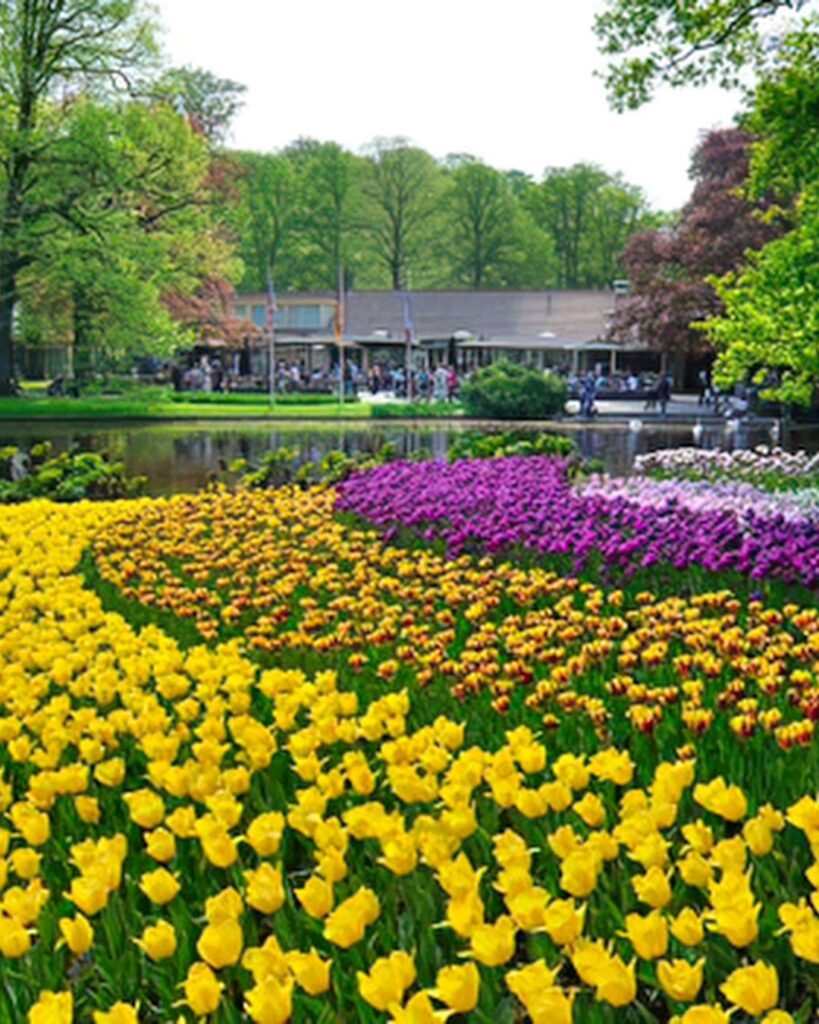
Yellow and purple are complementary colors, opposite each other on the color wheel, so each one intensifies the other. It’s the most energetic and cheerful pairing: blue salvia with Tagetes or Coreopsis, lavender with calendula, or on a larger scale, jacaranda planted near yellow trumpet tree. Use yellow as an accent and in smaller proportion so purple remains the star. To choose companion plants, see our plants with yellow flowers.
Purple and white: elegance and light
White brightens dark tones and gives purple an airy feel, since purple on its own can look heavy in shady areas. It’s a classic, elegant combination that also works especially well at night, when white reflects the limited available light. Try purple queen with gardenias, wisteria with jasmine, or a bed of alternating purple and white verbena.
Purple and silver: calm and sophistication
Gray and silver foliage, such as Cineraria maritima and lamb’s ear, makes purple and lilac flowers stand out without competing for attention. It’s the foundation of Mediterranean-style gardens, with lavender, salvias, and other dry-climate plants.
Gradient in violet tones
For a serene, sophisticated effect, layer purple tones: lilac, violet, purple, and plum, from the lightest shades in front to the darkest in back. Dark-foliaged plants, such as purple heart, add even more depth. Learn more about how to use color in the garden.
Purple flowers for weddings and events: bouquets, arrangements, and decor
Purple is one of the most versatile colors for weddings. It can range from the delicate lilac of a garden ceremony to the deep purple of an evening reception, bringing elegance without relying on an all-white palette. For events, though, the choice depends less on the garden and more on three factors: what your florist has available for the date, how long the flowers hold up out of water, and the overall decor palette.
Best purple flowers for a bridal bouquet
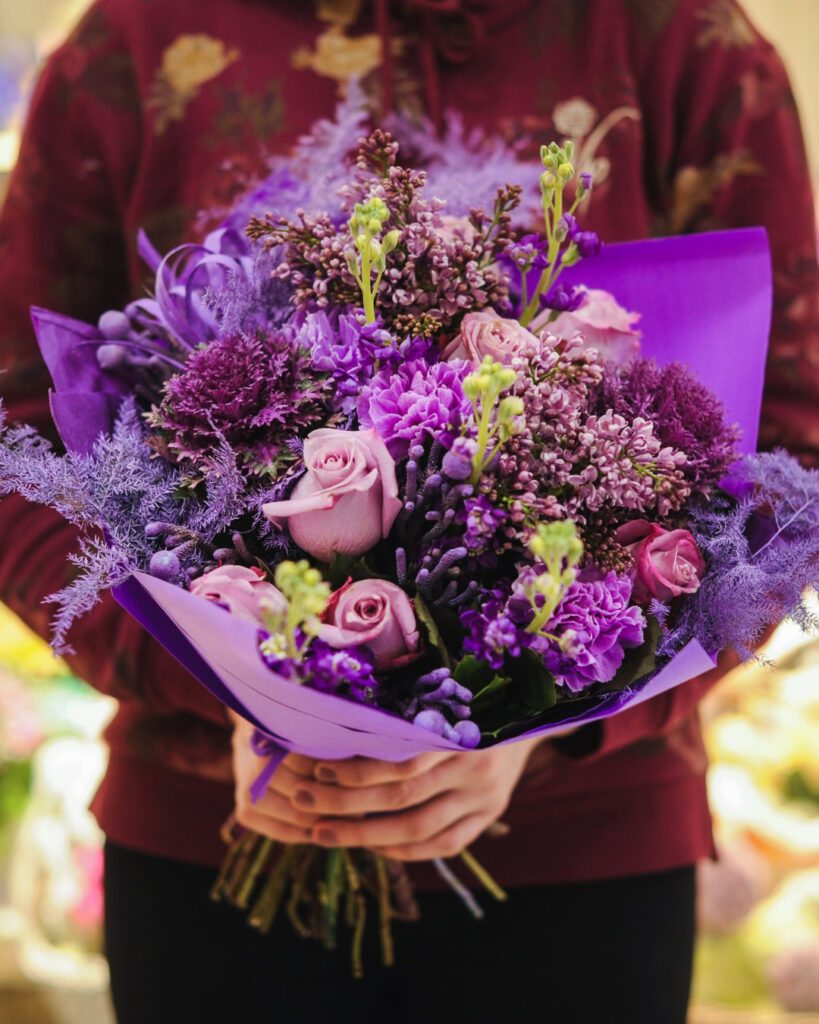
- Lisianthus: the star of purple bouquets. Its petals are as delicate as a rose’s, it’s available year-round, and it lasts about two weeks in a vase. Shades range from lilac to deep purple, including bicolor-edged blooms.
- Vanda and Phalaenopsis orchids: perfect for cascading bouquets and brides who want a sophisticated look. Vandas offer the richest purple tones, and both hold up well through hours of ceremony.
- Lilac roses: bring the classic bouquet shape in a soft lavender tone that feels romantic and timeless.
- Purple tulips: elegant and modern, they look beautiful in minimalist bouquets tied with ribbon alone.
- Lavender: ideal for fragrant, garden-style bouquets. After the celebration, it can be dried and kept as a keepsake.
- Statice and globe amaranth: excellent as fillers, adding volume and texture while staying attractive even without water.
Purple flowers for table arrangements and decor
In arrangements, volume matters just as much as color. Purple gladiolus and delphiniums add height to altar and entry arrangements, while lisianthus, asters, and statice fill low centerpieces that won’t get in the way of conversation. For a garden-inspired touch, use small pots of lavender or African violets on the tables; afterward, they can double as favors for guests to take home.
Wedding palettes with purple flowers
- Classic: purple, white, and green. White brightens purple and keeps the arrangement feeling light, making it a great choice for daytime ceremonies.
- Romantic: lilac, dusty rose, and champagne. Lilac lisianthus with pale roses creates delicate, timeless bouquets.
- Garden style: lavender, eucalyptus, and straw tones. A lovely fit for outdoor weddings and intimate celebrations.
- Bold: deep purple, burgundy, and wine. Ideal for evening parties and fall or winter weddings.
- Vibrant: purple with yellow or gold. A cheerful, luminous contrast that works especially well for spring and summer celebrations.
Which purple flowers handle heat and hours out of water
For outdoor weddings or summer events, choose flowers with a firmer texture. Statice, globe amaranth, and lavender hardly wilt at all because they naturally have drier structures. Lisianthus and orchids also hold up well. Tulips, anemones, and hydrangeas, on the other hand, dehydrate quickly in the heat, so if they’re included in the bouquet, ask the florist to keep them in water until the last possible moment.
Purple flowers by season
With greenhouse production, many cut flowers are available year-round, but pricing and quality are usually better in season. Use the table as a starting point and confirm availability with your florist, since it varies by region.
| Season | Featured purple and lilac flowers |
|---|---|
| Spring | Lavender, iris, hyacinth, gladiolus, lisianthus, orchids |
| Summer | Lisianthus, gladiolus, asters, globe amaranth, statice |
| Fall | Asters, lisianthus, statice, orchids, tulips |
| Winter | Tulips, anemones, pansies, orchids, lisianthus |
Tips for getting purple right at your event
Purple shifts a lot depending on the lighting. Very dark shades tend to disappear in nighttime photos, so it helps to mix in lilac or white blooms to give the bouquet more definition. When ordering, show your florist reference photos instead of simply asking for “purple,” since lilac, violet, lavender, and deep purple can look very different. And if you want the color to carry a message, remember that purple and lilac flowers often symbolize admiration, respect, and elegance, as explained below.
The meaning of purple flowers
Purple has always been a rare color in nature and historically expensive for people to produce. That rarity explains much of the meaning purple flowers still carry today.
What do purple flowers mean?
Purple symbolizes nobility, dignity, and admiration. In ancient times, purple dye extracted from mollusks was so costly that it was reserved for kings and emperors. That’s why purple flowers express respect and recognition. Softer lilac tones suggest delicacy, enchantment, and first love.
What is the spiritual meaning of purple flowers?
In spiritual symbolism, purple is the color of intuition, introspection, and transformation. In the Christian tradition, it marks Lent, a season of reflection. In holistic practices, violet is associated with the crown chakra and a connection to the sacred, and purple flowers often appear on altars and in meditation spaces.
When should you give purple flowers?
Purple flowers are a great choice for honoring someone you admire, celebrating achievements and graduations, or showing affection without the overtly romantic message of red roses. Lisianthus, Vanda orchids, and African violets are among the most popular choices for gifts. In some settings, darker purple can also be associated with mourning and remembrance, so it’s worth considering the occasion.
Essential care tips to intensify color
Strong color starts with choosing the right plant for your climate and available light. Blue salvia, for example, only develops richly colored flower spikes in full sun, while African violet can scorch if its leaves get direct sun.
- Provide good drainage: lavender, verbena, and petunias do not tolerate soggy roots.
- Respect cold requirements: pansies, butterfly bush, and wisteria need cooler conditions to bloom well.
- Choose the cultivar for color: in plants like lisianthus, hyacinth, clematis, and petunia, the exact shade of purple depends on the cultivar.
Check the plant tag, or buy it when it’s already in bloom. - Fertilize based on the plant’s needs: petunias respond well to regular potassium-rich feeding, which helps support continuous blooming.
Common mistakes when growing purple and lilac flowers
The mistake I see most often is planting English lavender, Lavandula angustifolia, in hot, humid conditions. It’s prone to root fungi and can rot quickly. For that kind of climate, choose French lavender instead.
Another common mistake is planting hyacinth bulbs in a warm climate without chilling them first in the refrigerator. Without that cold period, the plant may sprout, but the flower spikes will be short, sparse, or may not appear at all.
Also avoid pruning golden dewdrop or yesterday-today-and-tomorrow right before new growth begins. When you cut the tips of the branches, you remove the apical buds—the small growing points where flower buds would have formed.
Frequently asked questions about purple flowers
What are some purple flowers?
Among the best-known purple and lilac flowers are lavender, African violet, pansy, lisianthus, verbena, petunia, hyacinth, iris, wisteria, and clematis. Among flowering trees, princess flower and jacaranda are standout choices. For containers, Babiana and Vanda and grape orchids offer especially rich purple tones.
What is the most famous purple flower?
Lavender is probably the world’s most famous purple flower, known for the blooming fields of Provence and its fragrance in oils, sachets, and cosmetics. In the houseplant category, African violet is one of the most widely grown purple flowering plants indoors. Among trees, princess flower is especially admired for its purple bloom.
Which purple flowers are good for bouquets?
Choose flowers with sturdy stems and good vase life, such as lisianthus, statice, aster, gladiolus, iris, lavender, and Vanda orchids. Aster and lisianthus last especially well after cutting, while statice and globe amaranth can also be dried for permanent arrangements. For fragrant bouquets, pair lavender with hyacinth.
Which purple flowers are best for weddings?
The purple and lilac flowers most often used in weddings include lisianthus, Vanda and Phalaenopsis orchids, lilac roses, purple tulips, and lavender. For fuller arrangements, florists often add gladiolus, asters, and statice. Choose based on the season and your wedding color palette, and confirm availability with your florist.
Which purple flowers last longest in bouquets and out of water?
Statice, globe amaranth, and lavender are among the toughest choices because they barely wilt and can even be dried afterward. Lisianthus and orchids also hold up well through several hours of a ceremony. Tulips, anemones, and hydrangeas are more heat-sensitive and should stay in water until the last possible moment.
What colors pair well with purple in wedding decor?
Purple pairs beautifully with white and green for a classic look, with dusty rose and champagne for a romantic style, and with eucalyptus and straw tones for a rustic feel. For evening events, it looks especially elegant with burgundy and wine shades. Yellow and gold create a cheerful contrast that’s perfect for spring.
Which purple flowers should you plant in the garden?
Choose based on sunlight and available space. In sunny beds, grow verbena, angelonia, blue salvia, and globe amaranth. In part shade, Persian shield and torenia bloom well. For structure, use shrubs such as lavender, yesterday-today-and-tomorrow, and sweet pea shrub. For walls and pergolas, try blue thunbergia and bridal veil. In larger spaces, princess flower and jacaranda make a big impact.
What are the darkest purple flowers?
The darkest purple flowers include pansies in nearly black shades, hyacinth ‘Woodstock’, clematis ‘Etoile Violette’, Mexican bush sage ‘Midnight’, and deep purple Vanda orchids. If you want to go beyond purple, also see the black flowers.
Which orchid has purple flowers?
Vandas and Ascocendas have some of the most distinctive purple flowers among orchids, often with dark veining across the petals. The grape orchid, a terrestrial type, has grape-purple blooms and flowers nearly year-round. Bamboo orchid also produces lilac-purple flowers and can be planted in sunny garden beds.
A garden in violet tones starts with one choice
You don’t need to plant 50 species to create a beautiful garden. Choose one ground cover, one shrub, and one focal plant that all thrive in the same amount of sun. A simple combination could start with purple verbena, French lavender, and Persian shield, all suited to full sun.
Pay attention to your space, respect your climate, and let each bloom do its job. Over time, your garden will develop layers of color, fragrance, and movement through every season.