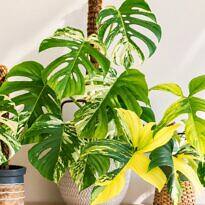
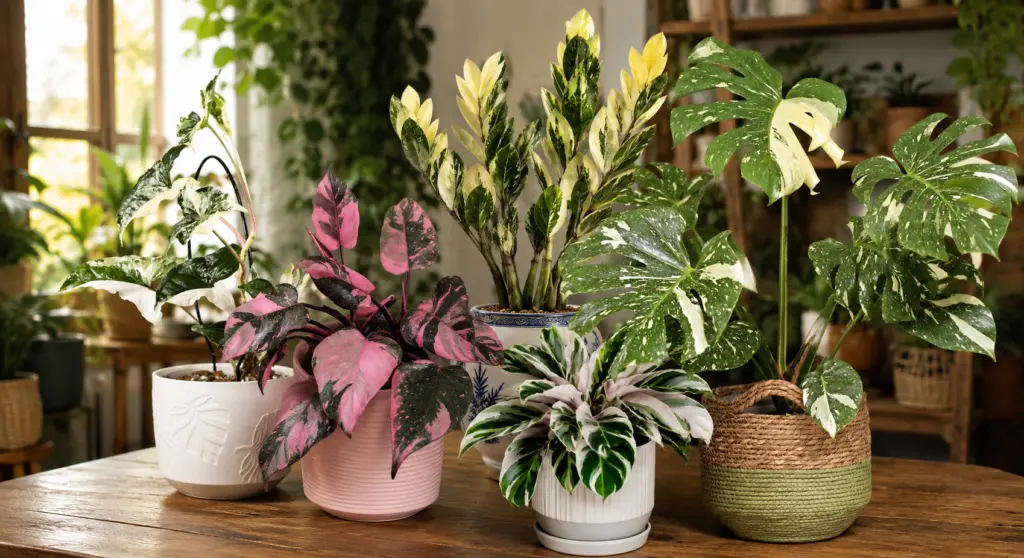
In 2021, a single variegated Monstera deliciosa leaf sold for the equivalent of several thousand dollars at an online auction in New Zealand. One leaf. No roots, no stem, and absolutely no guarantee it would ever grow. I followed that craze closely and watched plenty of smart collectors buy expensive cuttings, successfully root them, and then helplessly see the new leaves come in completely green.
That’s exactly why this topic matters. The market for rare variegated plants blends real botany with pure speculation, and the difference between a smart buy and an expensive disappointment usually comes down to one detail the seller leaves out of the listing: what kind of variegation that plant actually has. If you don’t understand that, you’re basically buying a lottery ticket with a Latin name.
So let’s do this differently. First, I’ll explain why some variegated plants hold their pattern for life while others revert within a few months. Then I’ll walk through seven rare variegated plants that are genuinely worth the investment, organized from the safest and most accessible to the most challenging. And at the end, I’ll cover the most common scams in the market, including one that fooled collectors around the world.
Not all variegation is the same—and that’s what determines a fair price

Variegation is the presence of areas with little or no chlorophyll (the green pigment in plants) in the leaves. So far, so good. What almost nobody explains is that there are completely different mechanisms behind this phenomenon, and each one behaves differently in cultivation. Knowing how to tell them apart is what separates a collector from an impulse buyer.
- Chimeric (or sectoral) variegation: the plant has two cell lines living side by side in the same tissue, one with functional chloroplasts and one without. This is the case with Monstera Albo, Pink Princess, and Albo syngonium. It’s unstable: every new leaf is a surprise, and the plant may revert to green or produce an albino stem with no chlorophyll at all. You also can’t propagate new plants from seed.
- Mosaic variegation or stable genetic variegation: the pattern is encoded more predictably and repeats with consistency. Monstera ‘Thai Constellation’ is the classic example, which is why it’s considered a safer purchase than Monstera ‘Albo’, even though both are Monstera deliciosa.
- Transient or juvenile variegation: the leaf emerges pale and darkens with age. This isn’t variegation in the strict sense—it’s maturation. ZZ Plant ‘Chameleon’ fits here, and a lot of people buy it thinking they’re getting something else.
- Reflective variegation: this doesn’t involve a lack of chlorophyll, but rather air pockets between the epidermis and mesophyll that reflect light and create a silvery effect. That’s the case with Scindapsus pictus. Because there’s no loss of chlorophyll, these plants grow just as well as their green counterparts.
- Viral or induced variegation: caused by viruses or chemical treatment. It exists, it’s sold, and it’s almost always bad news.

Keep that framework in mind, because it explains everything that comes next. A chimera means you should buy by looking at the stem and growth points, not the leaf. Mosaic variegation lets you buy with more confidence. And transient variegation should not be priced like a true rarity.
There’s also a second factor that almost nobody talks about: the whiter the plant, the more fragile it usually is. Areas without chlorophyll can’t photosynthesize, which means they only consume the sugars produced by the green parts. A nearly all-white cutting looks amazing in photos but is biologically struggling in a pot. I almost always prefer a plant with sixty to seventy percent green: it grows, supports itself, and still gives me new leaves to work with. If you want to go deeper into why these plants revert, I wrote a full article on variegated plant reversion.
Enjoyed this guide? There's more where it came from.
Understanding why plants behave the way they do is what turns guesswork into a thriving garden. That's exactly what we share in the Shrubz newsletter — free, straight to your inbox:
- Seasonal care reminders timed to your gardening calendar
- Propagation and pruning techniques, explained step by step
- Pest and disease alerts — catch problems before they spread
7 rare variegated plants worth the investment
I organized this list like a staircase. The first few are the ones I’d recommend to anyone just getting into collecting, with plenty of room for error (and generally easier price points). The last ones require a controlled environment, a practiced hand, and some tolerance for frustration.
If you skip steps, you’ll probably pay a lot more to learn what the previous plant could have taught you for less.
1. N’Joy Pothos (Epipremnum aureum ‘N’Joy’)

I’m starting with this one precisely because it’s the least rare on the list—and that’s a compliment. N’Joy is a selected sport from pothos ‘Marble Queen’, with smaller leaves and a crisp white-and-green pattern that looks almost hand-painted. No random speckling here: the color appears in clearly defined blocks, which gives it a graphic, contemporary look that fits beautifully in more minimalist interiors (though it works just as well in an Urban Jungle setup too!).
N’Joy’s biggest strength is that it holds its pattern with a consistency unstable chimeras just don’t have. Root a cutting with a variegated node and, in most cases, you’ll get variegated leaves. That completely changes the risk equation. It’s forgiving, too: it handles medium indirect light, the occasional missed watering, and the dry air of an air-conditioned apartment.
It’s worth the investment because it’s the only plant on this list you can realistically propagate into a whole collection. One well-chosen starter plant can turn into five within a year. For growing, give it bright indirect light, water when the top 1 inch (3 cm) of the potting mix dries out, and avoid letting it sit in standing water—the longtime enemy of every pothos. When shopping, look for a full, bushy plant with multiple vines and a true balance of green and white.
2. Variegated ZZ Plant (and the Chameleon Mix-Up)

Here I need to be very direct, because I see confusion in almost every listing. ZZ Chameleon and a truly variegated ZZ plant are not the same thing.
Chameleon, also sold as ZZ Chameleon, pushes new growth in golden yellow or lime green that gradually darkens until it matches the rest of the plant. It’s beautiful, interesting, and creates a real contrast effect within the clump. But that variegation is temporary, tied to leaf maturity. If you bought it expecting permanent cream markings, you’ll be disappointed once the new leaf matures.
A truly variegated ZZ plant, often labeled ‘Variegata’, shows cream, white, or marbled sectors that remain on mature leaves. That one is a true chimera, much rarer, slower growing, and considerably more expensive. It’s worth asking the seller for photos of mature leaves, not just fresh new growth.
That said, both are worth the investment for one shared reason: they’re among the very few ornamental foliage plants with lighter coloring that tolerate indoor conditions without any drama. ZZ plants store water in their rhizomes and petioles, which makes them almost forget-proof. Place them in a very bright spot out of direct sun, water only when the potting mix has dried out completely, and be suspicious of any soft leaf at the base—that usually points to rhizome rot, not thirst.
3. Albo Variegatum Arrowhead Vine (Syngonium podophyllum ‘Albo Variegatum’)

In my opinion, this is the best entry point into true chimeric variegation among rare variegated plants. You get all the behavior of an unstable chimera, with irregular white sectors and leaf-to-leaf unpredictability, but in a genus that grows fast, roots easily, and costs a fraction of a Monstera Albo.
In other words: this is where you learn to read a variegated plant without putting your budget at risk. Will you make mistakes? Absolutely. Will you see one vine reverting to green while another comes out too white and collapses? Also yes. And you’ll learn, in practice, how to prune above a node with balanced variegation to steer future growth. That’s exactly the same skill you’ll use later on a plant that costs four figures.
The arrow-shaped leaves, marbled white over green, look great in a hanging pot, on a shelf, or trained up a moss pole or support for a more upright habit and larger leaves. It prefers bright indirect light, fertile well-drained potting mix, and regular watering without waterlogging. When buying, the most important criterion is not a pretty leaf—it’s having multiple nodes with visible signs of variegation on the stem. A cutting with one lone white leaf or an all-green stem is money wasted.
4. Monstera Thai Constellation (Monstera deliciosa ‘Thai Constellation’)

Thai Constellation is the most elegant example of how science undercut speculation. It originated through tissue culture in Thailand, and its mosaic variegation—with cream speckles scattered across the green like a constellation—is genetically far more stable than Monstera Albo.
In practical terms, that means two things. First, it rarely reverts, which makes it the safest variegated Monstera for anyone who doesn’t want to depend on luck. Second, because it’s propagated in tissue culture rather than by small-scale stem cuttings, supply has increased dramatically and the price has dropped steadily in recent years. It’s no longer a speculative trophy plant and has become what it always should have been: an exceptional ornamental houseplant.
In the home, it’s a true focal point. Large, fenestrated leaves with sculptural presence don’t belong squeezed between a dozen tiny plants. It deserves a floor pot, a coco coir or moss pole, and a very bright spot near a window with filtered light. Use a chunky, well-aerated potting mix based on pine bark, perlite, and coco coir, water moderately, and maintain decent ambient humidity. If you can only own one of the rare variegated plants in your life, this is probably the one.
5. Philodendron Pink Princess (Philodendron erubescens ‘Pink Princess’)

Pink Princess was the breakout star of the rare variegated plants bubble, and like every star, it’s now in a more mature second act. The nearly black leaves splashed with pink are still among the most striking effects an indoor foliage plant can offer. What has changed is the price, which has come down significantly as supply has increased.
It’s an unstable chimera, so your buying criteria need to be ruthless here. Don’t buy the leaf. Buy the stem. Check whether the internodes show alternating pinkish or reddish striping with green. That’s the sign that variegation is present in the growth tissue and has a real chance of continuing. One gorgeous leaf on a cutting with a uniformly dark green stem usually means the plant will revert.
There’s also the opposite extreme: the all-pink leaf. It’s stunning, and it’s a trap. With no chlorophyll at all, it can’t support itself, drains energy from the plant, and eventually dries up. Experienced collectors prune leaves like that to encourage a more balanced bud to break. As for care, it wants bright indirect light, a support pole, a fast-draining mix, and consistent moisture without staying soggy. Insufficient light is the main reason it loses contrast.
6. Calathea White Fusion (Goeppertia lietzei ‘White Fusion’)

If the earlier entries are statement plants, White Fusion is a plant to admire up close. The leaves blend green, white, and cream in an almost watercolor pattern, with pink and lilac tones on the undersides that show subtly when the light hits them just right. There’s nothing loud about it, and that’s exactly the appeal.
Here, the price isn’t financial: it’s in the care. This is the most demanding plant on the list so far, and it doesn’t forgive mistakes. It wants high humidity, steady indirect light, a potting mix that stays lightly moist without becoming waterlogged, and good-quality water. Water that’s too hard or too high in chlorine or fluoride can mark the leaves. Air conditioning, direct drafts, and inconsistent watering can produce crispy tips in a matter of days.
That’s why it’s not a great first rare plant. It’s a much better second or third choice for someone who has already grown prayer plants and more common calatheas and understands their own indoor microclimate. In an apartment or home with good indirect light, away from drafts, with a humidifier nearby, it can be incredibly rewarding. When shopping, tolerate minor edge blemishes, which are normal in this group, but avoid plants with extensive scorch or a yellowing leaf center.
7. Monstera adansonii Variegata

I’m ending this tier with what I consider the most collectible of them all. Monstera adansonii is already interesting on its own, with those perforated leaves and climbing habit. In variegated form, the natural holes in the leaf combine with white sectors and marbling to create a level of visual complexity that no other plant on this list can match.
It’s also the riskiest. Unstable chimeric variegation, smaller leaves that leave less room to balance green and white, slower growth in very pale plants, and sensitivity to dry air all add up. Some specimens can sit still for months, produce an albino leaf, and stall out completely. This is not a plant for anyone who wants quick results.
It wants bright indirect light, high humidity, a very airy potting mix, and above all, a support pole. Trained vertically, it matures and produces larger, more fenestrated leaves with that classic Swiss cheese vine look; left to trail, it tends to stay juvenile much longer.
And because it’s one of the most frequently faked plants in the online marketplace, verify the source with extra care.
Other rare variegated plants worth keeping on your radar
This list could easily be much longer, and a few plants just barely missed the cut. Monstera Albo, often sold as ‘Albo Borsigiana,’ is still one of the ultimate collector wish-list plants, with white variegation that’s far more dramatic than Thai Constellation. It just didn’t make the main list because it’s too unstable to recommend as a safe investment. It’s also worth noting that the name “Borsigiana” is used very loosely in the trade and shouldn’t be treated as a guarantee of botanical taxonomy.
Philodendron ‘White Princess’ and ‘White Wizard’ are great options for anyone who likes the idea of Pink Princess but prefers white over pink, and they’re usually a bit more vigorous. Meanwhile, Stromanthe ‘Triostar’ (Stromanthe thalia) isn’t exactly rare, but it delivers the same green, cream, and pink effect as White Fusion with much better durability, making it a smart substitute for gardeners in drier climates.
Among collectors looking beyond the latest trends, variegated hoyas, variegated peperomias, and Monstera standleyana Albo-variegata are gaining attention. And Philodendron ‘Caramel Marble’, with its green, cream, and caramel-toned leaves, remains a true trophy plant in a very narrow niche, with a price tag that reflects how scarce it still is on the market.

The most common scams in the rare variegated plants market
Where prices are high and knowledge is uneven, fraud follows. These are the scams I see most often:
- Monstera Albo seeds. They do not exist. Chimeric variegation is not reliably passed on by seed, and listings promising this are selling ordinary Monstera deliciosa seeds or random species seeds, often artificially dyed. It’s the biggest scam in this niche.
- Chemically induced plants. The best-known case is “Philodendron Pink Congo,” which became a global sensation around 2019 for its fully pink leaves. The color came from ethylene treatment, and every plant reverted permanently and irreversibly to green within a few months. A lot of people paid rare-plant prices for a common philodendron.
- Painted or dyed plants. Less sophisticated, but still common at plant shows and online marketplaces. Rub a damp finger over a discreet area and see whether any pigment comes off.
- Reference photos. A listing shows a spectacular mature plant, then ships a one-leaf cutting. With variegated plants, every specimen is unique, so ask for a photo of the exact plant that will be shipped, ideally recent and without color editing.
- A cutting without a variegated node. The classic scam. They sell the pretty leaf, but the genetic material that will produce future growth is completely green.
How to evaluate a starter plant before paying premium prices
Before I commit to any purchase, I mentally run through the same checklist every time. It has saved me a lot of money:
- Look at the stem before the leaf. In chimeras, the stem and buds tell you the future; the leaf only tells you the past.
- Count the nodes. More variegated nodes mean better odds of recovery if one stem reverts.
- Check the roots. Ask for a photo of the roots or how long the plant has been in its current pot. A freshly cut piece on an expensive plant is unnecessary risk.
- Evaluate the amount of green. Around thirty to fifty percent light-colored tissue is usually the sweet spot between beauty and vigor.
- Check for pests. Mealybugs and spider mites love variegated tissue because it’s more tender. Inspect the undersides of the leaves and the leaf axils.
- Match the plant to your conditions. If your home is dark, don’t start with White Fusion. If you forget to water, ZZ plant is your friend. The best rare plant is the one that survives your real routine, not the routine you wish you had.
Is there a right time to buy?
Yes, and it’s surprisingly predictable. Nearly every rare variegated plant follows a similar curve: it appears in tiny numbers, hits an absurd price fueled by social media, enters tissue culture or large-scale nursery propagation, and then drops fast. The best time to buy is right after that drop, when the plant is finally affordable but hasn’t yet become commonplace.
That’s exactly what happened with Thai Constellation, and it’s happening now with Pink Princess. People who bought at the peak paid for temporary scarcity; people who bought later paid for lasting beauty. In this market, patience is often worth more than budget.
And I’ll close with the most important advice I have on this topic: plants are not financial assets. They may rise or fall in price as supply changes, but the real return from rare variegated plants has never been monetary. It’s the new leaf that finally unfurls after three months of waiting, showing exactly the pattern you hoped for. It’s the cutting you rooted and shared with someone else. It’s that slightly silly and completely legitimate satisfaction of knowing you pulled it off.
Choose one of the plants on this list that matches the light you actually have right now, not the light you imagine you have. Start with N’Joy pothos or arrowhead vine if you’re a beginner, give it the support and bright light it needs, and watch the next three leaves closely. You’ll learn more about variegation in those ninety days than from any article, including this one.