Plants for fairy gardens: what really works in containers
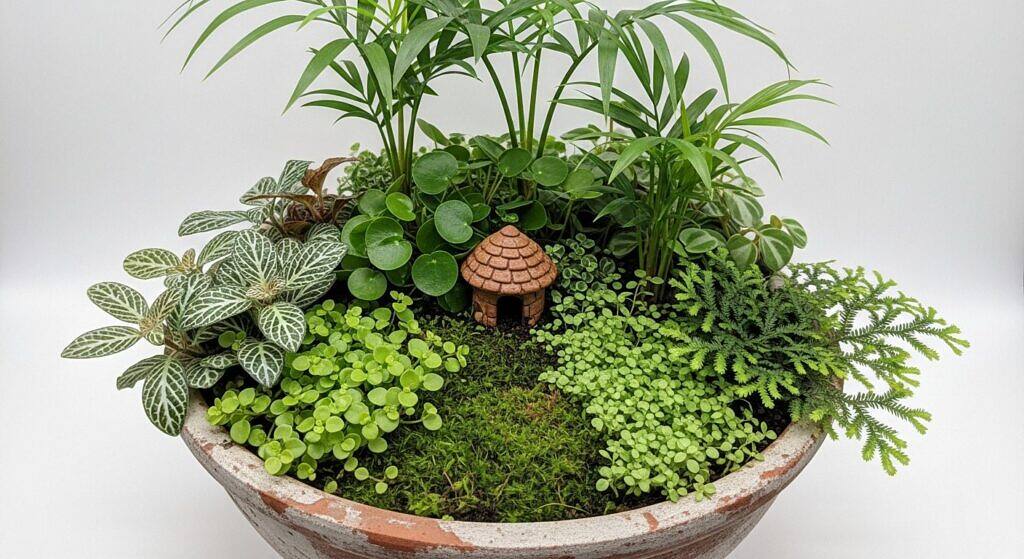
A successful fairy garden in a pot or open terrarium doesn’t depend only on tiny houses, bridges, and accessories. What truly makes the magic work are the right plants for fairy gardens: naturally compact in size, with controlled growth, delicate foliage, and good tolerance to pruning, all thriving in bright filtered light.
In this guide, the goal is not to teach the step-by-step assembly, but to offer a curated list of 22 reliable options for fairy gardens in open containers, along with technical criteria to help you combine species without creating a botanical “Frankenstein” that’s impossible to maintain.

Essential criteria for choosing plants for fairy gardens
Before looking at the list, it’s important to understand why not every “cute” plant is suitable for living in tight quarters in a pot or open terrarium.
Mini size and slow growth: the first filter
A fairy garden works through the illusion of scale. Any plant that grows too fast or turns into a “monster” in just a few months will dominate the container, smother its neighbors, and force you to redo everything.
For pots and open terrariums, prioritize plants for fairy gardens that:
- have a naturally low profile (without needing frequent, drastic pruning);
- show slow to moderate growth in bright, indirect light conditions;
- tolerate thinning and light pruning well without “disfiguring” the plant.
One important point: “tiny leaves” is not the same thing as “restrained growth”. Ficus pumila and ivies (Hedera helix), for example, have great scale in the juvenile phase, but can quickly invade the scene if you give them too much freedom. The same goes for Callisia repens, which fills in fast and usually needs regular pinching to keep it from turning into a dominant carpet.
Small leaves and delicate texture: the miniature look
Plants for fairy gardens with small leaves create the feeling of reduced scale: our eyes read them as trees, lawns, and shrubs in miniature form. This fine-textured effect is central to the composition.
Very broad leaves tend to “break the magic” of the scene, unless you intentionally want to create the effect of a “giant tree” inside the micro garden.
In most cases, delicate textures (such as Biophytum sensitivum, maidenhair ferns and fine groundcovers) work best as the visual base layer. Species that eventually grow into full “houseplants” (such as Chamaedorea elegans) can also be used in a terrarium, but usually in larger containers and with a realistic expectation of ongoing care and eventual repotting.
Bright filtered light: luminous without scorching
The terrarium plants selected here prefer bright, indirect light. In practice, this means placing the terrarium close to well-lit windows (east- or west-facing) or on covered porches and patios, where the foliage is not exposed to harsh, direct sun.
Direct sun through glass can heat the leaf surface too much and cause scorching. On the other hand, lack of light leads to etiolation: long, weak stems, widely spaced leaves, and the miniature look of the terrarium is lost.
Another key aspect of terrarium care: this list includes two general “climates” of cultivation. Plants for more humid terrariums (such as Fittonia, Soleirolia, maidenhair ferns, selaginellas, nertera and miniature African violets) usually prefer bright filtered light, but without extremely dry air. Drier, more exposed terrarium setups (with plants like Crassula ovata, Orostachys boehmeri and Lotus berthelotii) typically require even more light and a potting mix that dries out more quickly.
If you want to explore natural light in more depth for terrarium plants, it helps to review basic concepts of solar radiation in resources such as the sunlight page.
Humidity, open terrariums and the risk of rot
Here we come to an important difference between open and closed terrariums. In open containers, there is more air circulation and the relative humidity tends to stay closer to the surrounding room conditions. This is excellent for preventing fungal issues and rot, but it demands more attention to watering.
Tropical terrarium plants with fine foliage (such as fittonias, maidenhair ferns, selaginellas and Soleirolia) generally prefer a slightly moist potting mix with excellent drainage. Waterlogging the container is a recipe for root rot; on the other hand, allowing the system to dry out completely for long periods makes this group collapse, develop crispy brown tips or lose vigor.
In drier, more exposed terrarium setups, the typical risk is the opposite: too much water and compacted potting mix. Succulents and rosette-forming plants (such as Crassula, Orostachys and more mineral, rock-garden-style compositions) need very sharp drainage and widely spaced watering to keep terrarium plants healthy and prevent rot.
In this situation, misting as if you were creating a “rainforest floor” is usually the fastest way to ruin your fairy garden project.
Compatibility between species: similar water, light and pruning needs
Mixing plants with incompatible requirements is a common mistake in a fairy garden. A classic example is trying to combine succulents (which prefer more light and a potting mix that dries out quickly) with tropical shade plants that like consistently moist soil in the same container: inevitably, one group will suffer.
In practice, it helps to think in terms of two groups:
- Moist group (bright, filtered light and slightly moist potting mix): Fittonia, Soleirolia, maidenhair ferns, selaginellas, Nertera, miniature African violets and many other small groundcovers that mimic woodland conditions.
- Drier, more exposed group (more light and faster drying): Crassula ovata, Orostachys boehmeri, Lotus berthelotii, Cryptanthus bivittatus and combinations in a more mineral, fast‑draining potting mix.
When assembling your fairy garden, keep together only plants that:
- enjoy the same type of light (bright, filtered light without harsh, direct midday sun);
- have similar water and air‑humidity needs;
- tolerate the same style of pruning and fertilizing.
Safety for children and pets
If your fairy garden will be within reach of young children or pets, be extra cautious: many ornamental plants can be toxic if ingested or irritating if the sap comes into contact with eyes, mouth or other mucous membranes.
As a practical rule, treat the fairy garden as a decorative item kept out of reach, and check each plant species before buying it—especially if you plan to use plants such as Ficus pumila, Hedera helix and various succulents, whose risk level can vary a lot depending on the animal, its habit of chewing leaves, and the amount ingested.
For households with pets, consult a reliable guide to poisonous plants from a local veterinary association or poison control center. This will help you both when choosing plants for your fairy garden and when deciding how to handle and position them to reduce the risk of toxic accidents.
If your goal is a whimsical fairy garden, handled by children or placed within reach of curious cats and dogs, choose plant species known for being safer and more touch-friendly, such as nerve plants (Fittonia), artillery ferns (Pilea) and small‑leaf peperomias, Soleirolia soleirolii, and young plants of Chamaedorea elegans.
22 Plants for Container Fairy Gardens
Below is a selection of 22 options, including species and varieties suitable for fairy gardens in pots and open terrariums, all chosen for bright indirect light, compact growth and realistic maintenance levels.
I organized the list by their role in the scene: groundcover/“lawn,” miniature shrubs, tiny trees, trailing plants, color highlights and drier mini gardens.
Miniature groundcovers and “lawns”

- Baby’s Tears (Soleirolia soleirolii) – used in a carpet style. It is one of the best “lawns” for a fairy garden: dense, very fine and perfectly in scale. It prefers potting mix that stays slightly moist (not soggy) and softly filtered light. In an open terrarium fairy garden, it needs light but frequent watering and occasional trimming to keep it from swallowing neighboring plants.
- Artillery Fern (Pilea microphylla) – also called artillery plant in some regions. It creates the look of a low hedge or a slightly taller lawn, with tiny leaves. Growth is moderate to fast when the fairy garden conditions suit it, but it tolerates pinching and pruning without complaint. It performs best in bright diffuse light; in low light it loses density and becomes more leggy.
- Clubmoss / Selaginella (Selaginella kraussiana) – a groundcover that looks like a mix between moss and a tiny fern. It creates a damp‑forest texture that instantly makes the fairy garden scene look more convincing.
It prefers consistently moist potting mix and will suffer if the potting mix dries out completely (open terrariums demand a keen eye and more frequent watering).

Miniature shrubs and clumping plants
- Maidenhair fern (Adiantum raddianum) – the classic maidenhair fern to bring lightness and that soft, woodland-floor feel to a fairy garden. In a pot or open terrarium, consistency is the key: do not let the potting mix dry out completely and do not keep it waterlogged for days. It prefers bright, filtered light and good air circulation (stagnant air combined with excessive humidity usually spells trouble).
- Dwarf Boston fern (Nephrolepis exaltata, dwarf cultivars) – in compact forms it is excellent for creating a clump that looks like a delicate shrub in a fairy garden. It works well at the back of the container, adding height and volume without turning into a full-size living-room fern (as long as you prune regularly and provide bright, indirect light).
- Lace fern (Nephrolepis cordifolia ‘Duffii’) – one of the easiest ferns to “miniaturize” for a fairy garden design: small fronds, a fluffy look, and great scale. It likes slightly moist potting mix and filtered light. It is not a super fast grower, but it is not slow either: with good conditions, it fills in space steadily and reliably.

Miniature “trees” for the back of the container

- Mini tree (Biophytum sensitivum) – it looks like a tiny toy palm and even has that sensitive-plant movement that draws attention in a fairy garden.
In fairy gardens, it works as a delicate focal point at the back of the container. It prefers bright filtered light and consistently even moisture; if the potting mix dries out too much, it wilts and loses vigor.
- Parlor palm (Chamaedorea elegans) – when young, it looks like a miniature woodland. It is excellent for adding height and depth to the scene, but it needs realistic expectations: over time it wants to turn into a full-sized palm. Use it in larger containers, keep it in bright indirect light, and manage growth with regular pruning (and if your fairy garden is very small, accept that one day you will probably have to retire it from the terrarium).
Trailing, vining, and edging plants

- Baby’s tears (Callisia repens) – excellent along edges, small slopes, and “hillsides” in the fairy garden. It grows from moderate to fast under good conditions, so pinching and trimming become part of the hobby (the upside: it responds very well and fills bare spots quickly).
- String of turtles (Peperomia prostrata) – a delicate trailing plant with tiny leaves and a subtle pattern. In an open terrarium, it does best with excellent drainage and moderate watering (it tolerates slight dryness better than overwatering). It is great for simulating vines or vegetation cascading down rocks and driftwood in a fairy garden.
- Round leaf peperomia (Peperomia rotundifolia) – with its round little leaves and relatively compact growth when it receives enough filtered light, it is one of the best choices for a living border in a fairy garden: it creates volume without looking coarse. If it starts stretching and dropping leaves, it is usually a sign of insufficient bright, diffused light.
- Dwarf creeping fig (Ficus pumila) – a classic climbing plant for creating “walls” and vertical backdrops in an open terrarium. The juvenile leaves are small and beautiful for miniature landscaping in fairy gardens. The critical point is its vigor.
It needs frequent pruning and clearly defined boundaries; otherwise, it will take over the entire container like a self-appointed building manager.

- Dwarf English ivy (Hedera helix) – delivers that classic “castle vine” look with excellent visual impact. In a fairy garden, the key is to keep it in its juvenile phase with strict, regular pruning. In very humid, poorly ventilated spaces it can become more vulnerable to fungal issues; in an open terrarium with bright, indirect light it performs well (but you should always keep pruning shears handy).
Color accents and contrast in the fairy garden

- Nerve plant (Fittonia albivenis) – ready-made color on a miniature scale: bright (or pinkish/red, depending on the variety) veins that work like ornamental garden beds without relying on blooms. It prefers consistently moist potting mix and filtered light; when the air is dry, it shows stress quickly (which is actually helpful: it’s a leafy watering alarm for your fairy garden).
- Polka dot plant (Hypoestes phyllostachya) – a great choice for a “colorful shrub” effect even without flowers. In small containers, it stays more compact with regular pinching (if you let it go, it gets leggy and loses its charm). It’s ideal for highlighting entrances, pathways, and the “cottage” area of a fairy garden.
- Purple waffle plant (Hemigraphis alternata) – brings deep purple tones and striking texture for strong contrast. In a fairy garden, it works well as a “shade thicket” or a focal point to create depth and a moody backdrop.
- Nertera (Nertera granadensis) – almost like a special effect: a compact groundcover and, in good conditions, colorful beads that look like tiny “fruits” in the scene. It prefers bright filtered light, evenly moist potting mix (without waterlogging) and usually does best in cooler, mild climates. It is more temperamental than baby’s tears and polka dot plant, but when it works, it truly earns its place.
- Miniature African violet (Streptocarpus ionanthus, syn. Saintpaulia ionantha) – produces flowers in a scale that is perfect for an open terrarium. The key is to avoid soggy conditions and not keep the crown constantly wet; watering directly onto the potting mix, with bright indirect light and gentle air circulation, helps keep the plant compact and free‑flowering.
It prefers consistently moist conditions; in potting mix that dries out too much, it loses vigor and ornamental value.

Drier, more exposed miniature gardens

-
- Jade plant (Crassula ovata) – works only in a drier, very bright fairy garden design. In a fairy garden, use young plants and formative pruning so it keeps the look of a miniature tree. In a humid terrarium it tends to struggle (and rot), so here the ideal is an open setup, very gritty, mineral potting mix and infrequent watering.
- Orostachys (Orostachys boehmeri) – a succulent with a compact, delicate rosette, excellent for simulating “rock beds” and arid areas in the fairy garden. It needs plenty of light (bright indirect light or gentle direct sun, depending on the location) and an extremely fast‑draining potting mix.
Water sparingly and infrequently: this plant would rather be forgotten than overpampered. - Earth star (Cryptanthus bivittatus) – a rosette-forming plant that’s excellent for contrast and structure in a fairy garden. It tolerates drier conditions than many moisture-loving terrarium plants, as long as it receives bright, indirect light. It performs best in an open container with excellent drainage; it does not need to sit constantly in water to look attractive.
- Parrot’s beak (Lotus berthelotii) – ideal for a fairy garden in a brighter spot, with a sharply draining potting mix and moderate watering. It is a trailing plant and creates a very striking silvery effect, but it does not do well in the constant humidity of a closed or very wet terrarium. Think of it in an exposed, bright, well‑ventilated pot instead of a humid terrarium environment.

Notice that this list mixes different species and different design uses of the same plants. This is intentional: in small containers, the trick for a successful fairy garden is to make the most of the aesthetic potential of each species, varying placement, planting density, and pruning to create very different scenes with a small, compatible set of plants.
Plants that seem ideal, but demand more care in a fairy garden
Not everything sold as a “terrarium plant” will actually behave well in an open terrarium or a decorative pot in filtered light. Some species can work in a fairy garden — but only when their care routine truly matches the plant’s real needs, instead of the expectation of “self‑maintaining decor.”
Out-of-control growth: the case of Tradescantia
Tradescantia zebrina (often called inch plant or wandering dude) grows far too quickly for the scale of a fairy garden. In just a few weeks, it tends to cover the entire container, smothering delicate groundcovers and “swallowing” fairy houses, paths, and other miniature decorative elements. It works extremely well in its own hanging containers, but it is not a good partner for miniature fairy garden compositions that need to stay readable and visually stable for months.
Maidenhair ferns in open terrariums: beautiful, but for more advanced gardeners

The maidenhair fern (Adiantum spp.) is one of the most beautiful plants for creating that miniature “forest feel” in a fairy garden terrarium: delicate fronds, airy texture, and a look that pairs perfectly with fairy gardens. The point is that, in open terrariums, this fairy garden terrarium favorite demands more refined care than most of the other plants on the list.
Maidenhair ferns prefer consistently moist potting mix, air that is not too dry, and good protection against rapid drying (wind, strong filtered sun, rooms with constant air conditioning). This does not mean they are “impossible” — it means they are plants for gardeners who already master the basics of a fairy garden terrarium: correct drainage, a watering schedule adjusted to the home’s microclimate, and, if necessary, strategies to stabilize moisture (such as a light mulch layer over the potting mix, containers that do not dry out completely in a single day, and placement away from drafts). For more experienced gardeners, the maidenhair fern can be the star of the scene. For beginners, it often turns into an undeserved disappointment.
Succulents and cacti: excellent, but only in dry-care fairy gardens
Succulents and cacti are excellent for miniature compositions — just with a different kind of fairy garden terrarium logic: much brighter light, very mineral potting mix, and widely spaced watering. So the issue is not “using succulents,” but trying to mix them with typical humid-terrarium plants, such as nerve plants, selaginellas, maidenhair ferns, and groundcovers that need the potting mix to stay lightly and consistently moist.
In the same container, usually one side loses: either the tropicals suffer from lack of moisture, or the succulents rot because the potting mix never really dries out. If the idea is to work with jade plants, echeverias, cacti, and other succulents, the best approach is to set up a fairy garden terrarium designed specifically for dry care: a more exposed container, more intense light, sandy/mineral potting mix, and much more widely spaced watering. Compatibility improves dramatically — and ongoing care becomes far more predictable.
Realistic maintenance in containers and open terrariums
Even with the right plant list, a fairy garden terrarium in a container or open terrarium needs a simple routine to stay “magical” for many months. The goal is to keep the whole composition stable: moisture in balance, good filtered light, and pruning to preserve the miniature scale of the fairy garden terrarium.
Watering: little water, but on a regular schedule (with exceptions for the driest terrariums)
Most of the species on this list prefer a slightly moist potting mix, never waterlogged. In practice, it works better to water small amounts more frequently than to “flush” the container and leave standing water. In an open terrarium, moisture is lost faster; for that reason, consistency matters more than heavy watering.
A spray bottle can help, but it is more efficient when the water actually reaches the potting mix (and not just the leaves). Watch for easy signs: fittonias usually wilt when they get too dry; selaginellas and maidenhair ferns lose vigor when humidity fluctuates too much.
The species in the drier, exposed terrarium category (such as Crassula ovata, Orostachys boehmeri and, in general, arrangements with Lotus berthelotii) require the opposite approach: infrequent watering and a more mineral, sharply draining potting mix. Mixing succulents with moisture‑loving woodland plants in the same terrarium usually fails because their care requirements conflict.
Light: near a window, away from strong direct sun
Keep your fairy garden terrarium in a bright spot where you could comfortably read during the day without switching on artificial lights, but with no strong direct sun during the hottest hours. Close to bright windows with sheer curtains, covered porches, and skylights with diffused light usually work well.
The more miniature and compact the plant, the more it depends on good bright, indirect light so it does not stretch and lose its scale. Biophytum sensitivum, fittonias, Pilea microphylla, and trailing peperomias tend to look their best when they receive strong, filtered, and stable light. Species from the drier group (such as jade plants and stonecrop‑style succulents) tolerate (and often require) more light, as long as you control excessive heat.
Pruning and thinning: the secret to keeping everything in scale
To preserve the miniature look of a fairy garden terrarium, pruning is an ally, not an enemy. Trimming groundcovers that invade “paths,” cutting back the tips of trailing plants, and thinning very dense clumps refreshes the look and reduces competition for light and nutrients.
Species such as Soleirolia soleirolii, Pilea microphylla, Ficus pumila, Callisia repens, Peperomia prostrata, and Peperomia rotundifolia tolerate pinching and light pruning very well.
With Hedera helix and Ficus pumila, pruning shears are not optional: without regular control, they will quickly take over the container.
Renewal and spot replacement

Even with proper care, it is normal that, over the months, a plant may lose vigor, become unbalanced, or simply stop fitting into the layout you want. Fairy gardens are living compositions: part of the process is replacing a little plant here, replanting some groundcover there, and redesigning a corner when needed.
In practice, it helps a lot to keep some “wildcard plants” on hand for quick replacements: small starts of Pilea microphylla, Callisia repens, and trailing peperomias are easy to replant and quickly fill bare spots in a fairy garden. For more humid, shaded areas in your fairy garden, keeping a reserve of Soleirolia and small clumps of Selaginella also makes it easier to fine‑tune the scene without having to dismantle the entire setting.
A tiny garden, a whole world
A fairy garden is not just cute decoration: it is a way to create presence using living things, both at a human scale and at an imaginary scale. When you arrange a pot with miniature paths, clearings, and tiny “groves,” you are doing something ancient—almost ritualistic: giving shape to a place that invites the mind to slow down.
And there is an important detail: unlike a ready‑made ornament, a fairy garden grows. It is alive, it changes, it calls for adjustments, it demands small decisions. That is part of the charm of a fairy garden. It is as if the scene reminds you, every day, that beauty is not a permanent state—it is a well‑tended process.
If you like a more spiritual touch, think of your fairy garden as a household nature altar: a space where life becomes visible. You do not need to “believe in fairies” to feel the effect. Just look closely for a few minutes: the texture of the leaves, the way the light filters through, the quiet of slow growth.
The invitation is simple: start small. Choose a container, build a well‑drained base, decide on a landscape idea for your fairy garden (misty forest, woodland clearing, hillside, drier rock garden), and put together a first version without worrying about perfection. Then let time do the rest: you will refine the contours, trim what grows too much, swap out a plant here, add a small stone there. Your fairy garden does not need to be born finished—it just needs to be born.
When you’re ready to take the first step, go ahead and create a simple “mini glade” in a container today: a low-growing groundcover to carpet the soil, a taller clump-forming plant toward the back, and a trailing variety to spill over the rim. The rest is all in the details… and that’s exactly where the real magic happens.