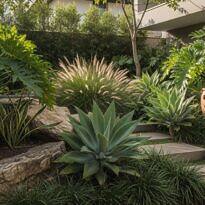

When I visited a client’s garden for the first time and saw the steep bank at the back of the property, I immediately understood the scale of the problem. With every heavy rain, more soil washed down, opening deep grooves that looked like scars in the ground. It was the kind of situation that, if not treated quickly, would turn into a major project — and a much more expensive one. That was when it became clear how the right slope plants can be the smartest solution: they stabilize the hillside, reduce maintenance, and even turn a “problem area” into an attractive part of the landscape.
If you are facing this challenge as well, there is good news: nature provides incredible tools to hold soil in place and control erosion. Even better, many of these slope plants are easy to find in garden centers and nurseries.
Plants for slopes: the natural solution to turn steep areas into safe gardens
Working with slopes is not just an aesthetic issue — it is a safety issue. I learned this the hard way, watching part of that garden literally slide downhill after a summer storm. The right plants act as true natural engineers, creating a living structure that protects the soil.
The secret lies in two fronts: surface protection and deep anchoring. Dense foliage works like a green umbrella, softening the impact of raindrops and preventing the soil from breaking apart. The roots, in turn, function as an invisible mesh, literally “stitching together” the soil layers and preventing landslides.
In the garden, I saw with my own eyes the difference slope plants can make. Where there used to be channels and bare soil, there is now a vibrant green carpet that not only holds the ground in place, but also drastically reduces the speed of rainwater, allowing it to infiltrate instead of dragging sediments away.
The role of soil bioengineering: how plants help control erosion
I used to think that any plant would work to cover a bank. Or worse, that I would always have to build a retaining wall to hold a slope. I was completely wrong. Soil bioengineering is a fascinating field that explains exactly why some species are champions at slope stabilization while others can barely stay in place.
It all starts with the so-called “interception effect.” Plants for slopes that provide dense groundcover act as natural brakes for water, reducing the speed of surface runoff. The slower the water flows, the more time it has to soak into the soil instead of washing it away.
But it does not stop there. The roots of slope plants play a crucial structural role.
Species with deep root systems—such as vetiver grass, which can reach an impressive 10 ft (3 m) deep—act as true living anchors. It is as if each plant were a natural stake driven into the slope.
One strategy I learned and strongly recommend for slope stabilization is mixed planting: combine shallow-rooted grasses with deep-rooted shrubs. Avoid monoculture. Grasses and other herbaceous plants prevent sheet erosion (that thin layer of soil that is washed away with every rainfall), while shrubs hold the deeper structure, reducing the risk of major landslides. Depending on the size and steepness of the slope, it is also worth including trees with very deep roots.
1. Vetiver grass (Chrysopogon zizanioides): the king of slope stabilization with deep roots

If there is an MVP among plants for slopes, it is vetiver grass. Its roots can reach depths of about 10 ft (3 m), creating an anchoring system that very few species can match. It tolerates full sun, periods of drought, and poor soils—it is the definition of a hardy and efficient slope stabilization plant.
A key technique is to plant it in contour hedgerows, following the natural level curves of the terrain. This creates living barriers that slow down runoff. By spacing clumps about 6–8 in (15–20 cm) apart, in roughly six months they will form an impressive barrier. To also cover the surface between the lines—and achieve a more uniform visual effect from the beginning—combine vetiver grass with a low groundcover such as perennial peanut or blue daze. On narrow slopes, occasional light pruning helps keep growth in check. The end result is a highly efficient, attractive, and long-lasting slope stabilization system.
2. Perennial peanut (Arachis repens): dense cover and natural soil enrichment

Perennial peanut is one of the favorite groundcovers for sunny slopes—and for good reason. In addition to fixing nitrogen in the soil, it forms such a dense mat that it virtually eliminates surface erosion on stabilized slopes exposed to full sun.
The small yellow flowers still add charm to the landscape, turning simple erosion control into attractive landscaping.
The secret to success is straightforward: thorough initial soil preparation and a period of hand weeding until the groundcover forms a complete mat. This establishment phase is worth the effort—once peanut grass closes, it smothers any weeds and requires minimal maintenance. Because it does not tolerate constant foot traffic, the ideal recommendation is for slopes without regular movement of people or animals, where its erosion-control function can fully express itself. In well-drained, sunny locations, it is practically ideal.
3. Emerald zoysia (Zoysia japonica): the durable grass carpet for sunny slopes

Emerald zoysia is a classic for a reason: it works. It forms a very dense turfgrass carpet, with a surprisingly strong root system for an ornamental lawn grass. It is the right choice when the client wants a slope that is attractive, stable, and has the appearance of a well-maintained garden. The key is to ensure full sun—in that condition, emerald zoysia is an absolute champion.
For maintenance, a balanced granular fertilizer such as 10-10-10 NPK every 3 months keeps the turfgrass vigorous and dense. On slopes with moderate incline, periodic trimming with a string trimmer or brush cutter is simple and quick. On very steep banks where maintenance would be difficult, it is worth considering combining emerald zoysia with low-growing groundcovers that do not require mowing. In full sun with proper management, emerald zoysia delivers a visual and functional result that is hard to surpass.
4. Bahiagrass (Paspalum notatum): maximum toughness for poor soils and large areas

When the budget is tight and the area is large, bahiagrass is the turfgrass professional’s best ally. It is extremely hardy, has strong roots, and colonizes the site with impressive efficiency.
It adapts well to both full sun and partial shade, which makes it even more versatile. It tolerates poor soils, occasional foot traffic, and even periods of neglect.
For farms, large properties, roadsides, and industrial areas—where the main goal is slope stabilization rather than a refined garden look—there is hardly a better choice in terms of cost-effectiveness. To secure the ground cover more quickly on embankments with more intense erosion, applying mulch or straw as a protective layer over the soil during the first few months speeds up the process. Simple, inexpensive, and efficient: this grass delivers exactly what it promises on a slope.
5. Wedelia (Sphagneticola trilobata): fast growth and strong hold in coastal areas

Wedelia grows so vigorously it seems made for problematic slopes. It literally grips the soil, rooting at every node that touches the ground. It adapts to full sun and partial shade, withstands salt spray and strong winds that defeat many other species—making it especially valuable in coastal areas.
On very steep slopes, it forms impressive green curtains in a remarkably short time. To make the most of this vigor without losing control, clearly define the planting limits with curbs, edging, or maintenance strips, and carry out regular pruning to keep it contained. Used this way—with clear intent and boundaries—wedelia provides one of the fastest and most efficient ground covers available for slope stabilization.
6. Blue daze (Evolvulus glomeratus): ornamental beauty and resilience in hot climates

When someone needs a slope that is both attractive and functional in a hot climate, blue daze (Evolvulus glomeratus) is an excellent choice. It flowers year-round with delicate blue blooms, covers the soil efficiently, and has a surprisingly strong root system for a plant that looks so delicate. A true sun lover, it thrives in full sun—the more light it receives, the more flowers it produces and the more vigorous it becomes.
Blue daze tolerates drought well once established, which makes it ideal for slopes with free drainage and full sun exposure. For slopes subject to heavy runoff, it performs best when combined with a strip of ornamental grasses or vetiver to act as a barrier: the grasses absorb the impact of the water while blue daze is responsible for the visual finish and ground coverage on the slope.
The result is a slope that protects the soil and still enchants everyone who passes by.
7. Spider plant (Chlorophytum comosum): water storage and protection for partial shade

Spider plant is an ideal ground cover solution for partially shaded to shaded slopes, especially beneath trees where other plants tend to decline. Its tuberous roots store water like small reservoirs, allowing the plant to survive dry spells that would wipe out many other ground covers. It grows vigorously, and the baby plantlets that form on the stolons make propagation very easy.
For the best results, plant it on more stable, shaded slopes, with a generous layer of mulch to retain moisture and protect the roots. This combination creates an ideal environment for spider plant to establish quickly and form a dense ground cover. On slopes with trees where other ground covers repeatedly fail to take hold, spider plant is often the answer—reliable, attractive, and extremely low-maintenance.
8. English ivy (Hedera helix): the classic solution for shaded ground cover

For fully shaded to partially shaded slopes, English ivy is practically unbeatable. It covers the soil with impressive density, creating a dark green carpet with a refined, classic look. The aerial roots that develop along the stems form multiple anchoring points, making it excellent for helping to stabilize soil on slopes.
On open slopes without nearby tree trunks, English ivy performs at its best—away from vertical supports, it focuses its energy on horizontal coverage. Periodic edging and trimming keep growth within the desired area and ensure good air circulation, preventing problematic moisture buildup. With this simple care, English ivy provides a dense, attractive, long-lasting ground cover in places where very few other plants grow well.
Russelia (Russelia equisetiformis): cascading effect for rocky slopes and retaining walls

Coral fountain has a unique look: arching, pendulous stems that create a stunning green waterfall effect on rocky slopes and retaining walls. Its red tubular flowers attract hummingbirds — an amazing bonus in the landscape. This ground cover handles heat, full sun, and poor, dry soils, making it one of the toughest, most resilient options for challenging sites.
It performs beautifully when planted in pockets between rocks or on mixed slopes, especially when combined with a low, spreading ground cover that closes the soil between clumps. This combination — coral fountain for the cascading, architectural effect, plus a ground cover for soil coverage — delivers a result that is both highly functional and very ornamental. In climates with occasional frost, a hard renewal pruning after winter encourages vigorous new growth in spring.
10. Trailing lantana (Lantana montevidensis): wind resistance and pollinator magnet

Trailing lantana is a true workhorse. This ground cover withstands very strong winds and degraded, poor soils, and still blooms profusely in full sun, attracting butterflies and bees with clusters of purple, pink, and white flowers. On exposed slopes, coastal areas, and open rural-style sites, it offers exceptional value and performance.
Its vigorous growth habit, though less aggressive than wedelia, is easy to manage with periodic edge pruning. Treating trailing lantana as a mass-planting ground cover — with clearly defined boundaries and regular maintenance — is the key to taking full advantage of its potential with no unwanted surprises. For projects near natural areas or native vegetation, checking its behavior and status locally ensures responsible use. This ground cover generously rewards careful, well-planned planting.
11.
Arrowhead vine (Syngonium podophyllum): aggressive groundcover for moist, shaded slopes

For moist, shaded slopes—near springs, drainage areas, or under dense tree canopies—Syngonium podophyllum is one of the most efficient groundcovers available. Its aggressive growth habit covers any open space in record time, the broad leaves create a bold visual mass, and the tendency to root at the nodes provides very effective natural anchoring.
Its ideal conditions are exactly what many other slopes do not offer: shade and consistent moisture. This makes Syngonium podophyllum almost irreplaceable in specific situations where few species will thrive. To keep growth under control, clearly define the planting area and carry out regular edging and containment pruning. When used intentionally in these moist, shaded environments, this groundcover delivers fast, robust results that are difficult to achieve with most other species.
12. Greater periwinkle (Vinca major): extra stability through rooting stems

Greater periwinkle has an intelligent mechanism: it develops roots at the nodes of the stems that touch the soil, creating multiple anchoring points. This greatly increases its ability to stabilize a slope. The purple or white flowers add a distinct ornamental appeal. It performs best in part shade and light, gentle sun—conditions that are very common on residential slopes with some surrounding vegetation.
On slopes with changing light exposure—partly shaded by trees and partly in bright, indirect light—greater periwinkle adapts easily, making it especially versatile. Periodic edge pruning keeps growth tidy and prevents it from spreading into adjacent planting beds. With well-defined boundaries and simple maintenance, this groundcover provides a dense, flowering cover with excellent holding and stabilizing capacity.
13.
Rock cotoneaster (Cotoneaster horizontalis): woody groundcover for dry, rocky slopes

Rock cotoneaster seems made for rocky slopes: herringbone-branching stems, horizontal growth, and an ability to nestle into stone crevices that helps reduce the impact of rainfall on the soil. It is an excellent choice for alpine- or dry-style gardens, in full sun to partial shade.
Staggered planting of young rock cotoneaster, with light staking during the first few months to guide the branches toward the ground, speeds up coverage and maximizes micro-anchoring. In compositions with boulders, small retaining steps, and mineral mulches, rock cotoneaster creates a very controlled, long‑lasting look. For projects near naturalized or protected areas, it is important to check how the species behaves locally before specifying it on a large scale.
14. Saw palmetto (Serenoa repens): structure for slopes and circulation edges

Saw palmetto is a low palm with rigid fronds that combines strong structure and visual impact with high toughness. It tolerates full sun as well as partial shade, has excellent drought tolerance once established, and also works as a natural physical barrier — the sharply toothed leaves discourage shortcuts and foot traffic.
Ideal as an anchor plant at strategic points on the slope, saw palmetto gives architecture and rhythm to the design while stabilizing higher‑stress areas. It pairs very well with mineral mulches (gravel, pebbles, bark) and with groundcovers around it to close the soil. The first year calls for patience and consistent establishment watering, but once well rooted it becomes almost self‑sufficient — a long‑lived, living structure that enhances any low‑maintenance landscape.
15.
Parrot’s beak (Lotus berthelotii): a cascading orange groundcover that thrives in poor soil

Lotus berthelotii is one of the most elegant choices for rocky banks, low retaining walls, and edges. This parrot’s beak creates a highly ornamental trailing effect, protects the soil with its low, spreading growth, and helps reduce the impact of heavy rain. It demands full sun and excellent drainage—conditions in which this parrot’s beak literally shines, especially when it blooms in that vibrant orange.
Amending the soil with coarse sand or fine gravel and using a mineral mulch around the young plants provides ideal conditions from the start, preventing waterlogging and compaction. On slopes that are exposed to strong runoff, pairing parrot’s beak with a barrier grass in the upper rows helps shield young plants while they establish. With proper management, this parrot’s beak offers incredible visual impact while also performing very well as a groundcover and soil-protection plant.
16. Creeping princess flower (Heterocentron elegans): steady purple flowers for part‑shade slopes

Creeping princess flower is a very refined solution for anyone who wants a slope that doesn’t look like a purely structural retaining feature. It forms a dense groundcover with frequent purple blossoms and a delicate appearance that elevates any residential landscape. This parrot’s beak relative performs best in bright shade to light partial sun—exactly the conditions found on many home slopes with nearby trees and buildings.
Planting smaller, more numerous starts speeds up coverage and prevents bare patches. Like any groundcover, it needs weeding and a bit of training in the early phase—but once established, it largely maintains itself. In spots that are more exposed to intense sun, combining it with a tougher companion species gives the slope greater stability without sacrificing ornamental charm. It is a plant that turns a simple slope into a garden.
17.
White African iris (Dietes grandiflora): a robust clump that reinforces slopes with structure and beauty

Dietes grandiflora is far more useful than most people realize. Its sword‑shaped foliage gives strong visual structure, and the clump develops a dense root system that holds the soil very efficiently. It tolerates full sun to partial shade without stress and keeps an attractive appearance year‑round — exactly what urban slopes and embankments need.
Using it in mass plantings — not as isolated specimens — is the key to taking full advantage of its potential for slope stabilization. Repeating clumps along the embankment creates a living grid of anchorage. To close the gaps between plants and ensure full soil coverage from the beginning, a low groundcover (such as perennial peanut or purple heart) completes the system perfectly. Dividing older clumps to multiply planting material is easy and economical — this white African iris responds very well.
18. Brazilian joyweed (Alternanthera brasiliana): color and dense mass for tropical slopes

Alternanthera brasiliana delivers two things slopes love: fast growth and dense biomass. Used as a low shrubby groundcover, it covers the soil efficiently and adds vibrant color (purple, burgundy, dark green) without having to wait for flowering. It performs very well from full sun to partial shade.
Pinching back the tips from the beginning encourages branching and speeds up coverage. On large slopes, planting it in alternating bands with ornamental grasses or clumping perennials improves water control and overall stability. Once established as a living mat, this Brazilian joyweed significantly reduces surface erosion and requires little maintenance. It is one of the fastest and most colorful slope groundcovers available for tropical and subtropical climates.
19.
Norantea (Norantea brasiliensis): a native species with strong botanical impact for naturalistic compositions

Norantea brasiliensis is a true curator’s plant: it is not the typical corner-garden-center choice, but it is exactly the right one for naturalistic slope designs with moist conditions and surrounding vegetation. It prefers dappled light to partial shade with good moisture—conditions typical of woodland edges and transitions to denser plantings.
On slopes, the Norantea shrub works as a woody, semi-climbing layer‑2 element: it adds volume, visually connects the slope to taller vegetation, and creates that botanical‑garden look sought in naturalistic landscape projects. To achieve this, provide a path for it to grow—stakes, fencing, logs—and combine it with low, ground-hugging cover plants that close the soil. Testing Norantea on a smaller scale before specifying it for large areas helps ensure confidence in the final result.
20. Creeping juniper (Juniperus horizontalis): the woody carpet that hugs the slope and does not let go

Creeping juniper (Juniperus horizontalis) is the right choice for those who want a woody groundcover with a controlled, long‑lasting look. This Norantea companion plant creeps, forms a dense cushion, and stitches the slope together with branches that stay close to the soil—excellent for reducing erosion caused by the impact of rainfall. It requires full sun and has good drought tolerance once established.
Its tidy, permanent appearance is especially appealing in projects with a dry, minimalist aesthetic—stone, gravel, and low irrigation. To cover a slope quickly with creeping juniper, plant more young plants than the minimum spacing would suggest: faster coverage reduces maintenance and improves soil stabilization. A mineral mulch around the new plants protects the soil during establishment and enhances the overall look of the Norantea landscape design from day one.
21.
Weeping lovegrass (Eragrostis curvula): lightness, movement and stability on large slopes

Weeping lovegrass is a classic choice for large embankments and slopes: fibrous roots that anchor the soil effectively, a naturalistic look with graceful movement in the wind, and high drought tolerance in full sun. For roadsides, long banks and extensive areas where lawn would be expensive and fragile, weeping lovegrass is one of the most efficient and economical solutions.
Planting in bands perpendicular to the contour lines maximizes erosion control and creates a rhythmic, intentional visual effect. Cutting back the foliage right after planting stimulates root growth and thickens the clump. For projects near native vegetation, prioritize equivalent native grass species whenever possible — there are regional grasses with similar performance that fit better in ecological restoration and conservation contexts.
22. Pampas grass (Cortaderia selloana): scale, sculptural effect and a serious root system

When the slope is large and the project calls for visual impact, pampas grass delivers like few other plants. Massive clumps, ornamental plumes and a strong fibrous root system combine beauty and function at scale. It requires full sun and tolerates drought and strong winds very well.
Used as structure rather than filler — in strategic groups with open space between them — pampas grass organizes the landscape of extensive slopes with elegance. Groundcovers and lower ornamental grasses fill the spaces between the clumps, ensuring complete soil coverage. Managing the inflorescences before seed dispersal, especially in areas near native plant communities, is an important practice to keep the use of this spectacular species responsible and under control.
23.
Lemongrass (Cymbopogon nardus): aromatic, hardy clump grass, excellent for erosion-control strips

Lemongrass is extremely versatile on slopes: it forms dense clumps with fibrous roots, offers high resilience, and still provides the bonus of a pleasant fragrance released by wind or rain. It requires full sun and has good drought tolerance. It works very well as an erosion‑control plant — slowing down water flow and holding soil particles in place with great efficiency.
Using lemongrass in lines that run across the contour, similar to vetiver, is the most effective strategy. Its look is more functional garden than strict engineering, fitting well into landscape designs that aim for a natural, integrated result. Periodic cutting rejuvenates the clump and keeps it compact. Supplemental watering during the first month after planting, especially on very dry slopes, ensures quick rooting and a safer, more vigorous start.
24. Calliandra (Calliandra tweedii): a shrub that stabilizes slopes and delivers pom‑pom blooms

Calliandra is an excellent choice when you want substantial shrub volume on a slope with strong visual impact. Its woody framework, good root anchorage, and abundant flowering that attracts pollinators make it a plant that goes far beyond simple soil stabilization. It prefers full sun, but will tolerate light partial shade with good brightness.
Used as a structural shrub — at strategic points to stabilize and provide medium height, while groundcovers close the surface — it turns a bare slope into true landscape design. Formative pruning from an early stage, encouraging branching downward and sideways, creates a low, well‑distributed mass that is much more efficient for erosion control. Properly preparing the planting hole, loosening compacted soil, is the initial investment that ensures full development of the species.
25.
Cambarazinho (Lantana camara): the survivor that blooms in chaos

Lantana camara is outstanding on embankments because it withstands tough conditions, flowers profusely in full sun, attracts pollinators, and quickly covers disturbed or degraded areas. For roadsides, rural and highway slopes, coastal regions, and locations that call for a low‑maintenance species that establishes easily, it is hard to find a better cost‑effective option.
Planted in groups and maintained with regular pruning — including removing volunteer seedlings along the edges — lantana provides bulk, color, and slope stabilization with very little effort. This edge pruning is simple and makes all the difference in keeping the landscape looking organized over time. In areas close to sensitive native vegetation, giving preference to equivalent native shrub species is the most sustainable choice.
26. Clusia (Clusia fluminensis): robust shrubby mass for exposed slopes

Clusia fluminensis is the right choice when a slope needs a tough, almost armored shrub: thick foliage, excellent response to pruning, clean appearance, and strong resistance to wind and salt spray. Once established, it no longer requires frequent irrigation. It prefers full sun to light shade with good brightness, ensuring a dense, uniform cover.
Planting clusia in bands or blocks — rather than as isolated specimens — is the key to effective erosion control and containment. A groundcover (such as perennial peanut, Alternanthera, or purple wandering Jew) between the young shrubs covers the soil from the start and eliminates the window for erosion. With good drainage ensured — a basic requirement for any well‑built slope — clusia provides long‑lasting visual and structural coverage, with the look of a finished, professionally designed project.
27.
Trailing asparagus fern (Asparagus densiflorus): physical barrier and hardiness on sloped terrain

Trailing asparagus fern combines toughness with an extra layer of functionality: the small thorns along its stems create a natural physical barrier that discourages unauthorized access to embankments and steep slopes. It performs very well in partial shade, keeping its foliage vibrant and vigorous year-round. The small red berries attract birds, adding movement and interest to the planting.
It is a versatile choice for shaded slopes where both erosion control and a visual and physical barrier are desired. Periodic pruning keeps the clumps at a manageable size and makes access for maintenance along the edges easier. In projects adjacent to naturalized or conservation areas, managing fruiting with pruning before the berries mature is a simple practice that helps ensure responsible use of this trailing asparagus fern.
28. Japanese jasmine (Jasminum mesnyi): flowering cascade and soil binding on slopes

Japanese jasmine is one of those shrubs that behave almost like a groundcover when they encounter a retaining slope. Its long, arching branches lean onto the ground, root easily wherever they touch the soil (natural layering), and form a dense, binding mass that helps reduce surface runoff and protect the upper soil layer from rain impact. In full sun it delivers its best performance: vigorous growth and a profusion of bright yellow flowers at the end of winter and beginning of spring, when many other plants are just starting to wake up.
On slopes, Japanese jasmine works extremely well as a cascading groundcover: you can plant it along the top edge and let it spill down to “clothe” the bank, or in staggered rows along the slope to achieve quicker coverage. Maintenance is straightforward and strategic: prune right after flowering to stimulate branching, thicken the cover, and keep its growth disciplined. In sites near naturalized landscapes or sensitive habitats, use this trailing asparagus fern and Japanese jasmine responsibly: maintain clear boundaries with regular pruning and prevent stems from rooting beyond the designed area—excellent for stabilizing the slope, but undesirable if the plants begin to spread as though the entire landscape were theirs.
How to plan planting on slopes and ensure strong root establishment
Planting on a slope is different from planting on level ground. Gravity works against you, and every detail matters. I learned this in the field, making a few mistakes that make me laugh today — but at the time, they kept me up at night.
On a slope, the most efficient and visually balanced design is to work with layers and repetition, not with isolated plants. Depending on the garden style, I start with at least three plant species: a low groundcover to close the soil surface, an ornamental grass or clumping plant in bands that follow the contour lines to slow down runoff, and one structural shrub in groups to give form and a finished look. Some design styles call for more species (which is better for the slope), such as cottage, rustic, or tropical gardens, while more contemporary, Asian-inspired, and minimalist gardens work better with fewer species. Example for full sun:
- a low groundcover as a living carpet,
- vetiver grass in bands running across the face of the slope, and
- a compact evergreen shrub in clusters (3–5 plants) at key points.
First step: analyze the degree of slope. For slopes up to 30° (about 58%), direct planting generally works well. Between 30° and 45° (about 58–100%), you will need supporting techniques. Above 45° (about 100%), strongly consider using geotextile erosion-control blankets or even consulting a specialized agronomist or landscape engineer.
The technique I use most often for slope planting is contour planting. Imagine horizontal lines running across the slope — you plant along these lines, never straight up and down. This creates natural barriers that slow water flow and distribute moisture more evenly.
When spacing plants, be generous from the beginning. It is tempting to save money on young plants, but planting too far apart leaves soil exposed, which is exactly what we want to avoid on a slope. For ornamental grasses, I space them about 6–8 in (15–20 cm) apart. For herbaceous groundcovers, 8–12 in (20–30 cm) apart. For low, spreading shrubs, 16–20 in (40–50 cm) apart.
One very effective trick: plant on cloudy days or in late afternoon. Intense sun in the first few hours after planting can stress young plants and compromise root establishment on a slope. If you have no choice and must plant in full sun, provide temporary shade with 50% shade cloth.
Soil preparation, fertilization, and the use of geotextile blankets to prevent erosion
Soil preparation on slopes is a delicate art. You cannot simply till the soil with a rototiller as you would in a flat vegetable garden — that can further destabilize the bank.
What I do is a light surface cleanup, removing only taller weeds and loose stones.
Then I use a rake to create small depressions where I’ll place the young plants. These shallow “basins” help retain water during the first few weeks.
For establishment fertilization, my choice is always single superphosphate or thermophosphate. Look for these names at farm supply stores or larger garden centers. Phosphorus is essential for root development, which is exactly what we need on a slope.
I use about 3.5 oz (100 g) per 10.8 sq ft (1 m²), lightly mixed into the soil of each planting hole. After 30 days, I apply a top-dressing with 10-10-10 NPK, about 1.8 oz (50 g) per 10.8 sq ft (1 m²), spread between the plants.
Another point that makes a huge difference (and that many people ignore) is mulching. After planting, I always apply a 2 to 3 in (5 to 8 cm) layer of organic mulch—pine bark, wood chips, shredded straw, or even finely chopped dry leaves.
On a slope, mulch is not just “a nice finishing touch”: it cushions the impact of rain (reducing that splashing effect that breaks down the soil surface), reduces evaporation in the first weeks (when young plants still have shallow roots), and slows weed germination, which reduces the need for weeding—and weeding a steep slope is an extreme sport nobody asked for.
In areas with a lot of surface runoff, I prefer heavier mulch (wood chips) and, if necessary, I secure it with light mesh or jute on top, so it doesn’t turn into “traveling mulch” in the first heavy rain.
Now, about geotextile blankets: they are real lifesavers on problematic slopes. The most common types are nonwoven synthetic fabric (often sold under brands like Bidim) and coir fiber blankets (more sustainable and biodegradable).
The function of the blanket is to hold the soil in place while the roots are not yet developed. It’s a temporary solution that buys time for the plants to create their own stabilizing root system. On very steep slopes, or those with a history of slippage, I consider them non‑negotiable.
Installation is simple: unroll the blanket from top to bottom, fixing it with U-shaped galvanized wire staples every 20 in (50 cm). Then make X-shaped cuts wherever you’re going to plant. Coir fiber blankets have the advantage of decomposing naturally in 2–3 years, just when the plants are fully established.
Essential care: proper irrigation and safe maintenance on slopes
Irrigation on slopes is where many people slip up—literally and figuratively. The classic mistake is using conventional sprinklers that throw water with too much pressure. I’ve seen this cause actual washouts in newly planted areas.
The solution that has worked for me is drip irrigation.
I install drip lines following the contour lines, with emitters every 8–12 inches (20–30 cm). The water is released slowly, soaking into the soil without causing erosion. If drip irrigation is not feasible, use micro‑sprinklers with reduced flow.
In the first 4–6 weeks, irrigate daily during the coolest hours. After the plants have established, you can gradually reduce watering until they rely solely on rainfall—except during prolonged droughts.
One crucial point that many people underestimate is personal safety on steep slopes. I have worked on banks and embankments that gave me chills, especially after heavy rains. Some rules I follow religiously:
- Never work on wet or slippery slopes—wait for the soil to dry
- Wear boots with non‑slip soles, not regular sneakers
- On slopes steeper than about 45°, use a safety rope secured to a solid anchor point
- Always work with someone nearby who can call for help if needed
- Carry tools in a pouch or tool belt, never in your hands while climbing
It may sound excessive, but I have seen minor accidents that could have been easily avoided with these basic precautions. Safety on slopes comes first, always.
As for maintenance, in the first few months, hand‑weeding on the slope will be your constant companion. It is tiring, but it is essential for effective erosion control. Once the groundcover closes in completely, it will naturally smother most weeds, drastically reducing the work.
I do maintenance pruning every 3–4 months on the most vigorous species, just to keep them under control and encourage denser growth. And every 6 months, a light application of a balanced fertilizer such as 10‑10‑10 NPK keeps everything lush, green, and healthy.

Frequently asked questions about erosion control with plants on slopes and banks
How long does it take for a planted slope to become fully stabilized?
In my experience, a well‑planned slope for erosion control starts to show stabilization in 3–4 months, but full containment usually takes 8–12 months. That is how long the roots need to create a deep, resistant network. Patience is essential.
Can I mix different species on the same slope?
You not only can, you absolutely should. Plant diversity is the most efficient erosion control strategy. Combine grasses (with shallow roots) with low, spreading shrubs or groundcovers (with deeper roots). This combination provides multi‑layered protection. On main slopes, I like to pair a low, mat‑forming groundcover with a trailing shrub such as lantana—beautiful and highly effective for erosion control.
Is it absolutely necessary to use geotextile fabric?
It’s not mandatory on gentle slopes with stable soil. But in problematic situations — slopes steeper than 30° (about 58%), a history of erosion, or very sandy soil — I strongly recommend it. It’s an upfront investment that can prevent much greater losses later on.
How can I control invasive plants before planting?
For pre‑planting cleanup, you have two options: hand weeding (labor‑intensive but safe) or controlled use of a systemic herbicide. If you choose a chemical option, look for glyphosate‑based products at garden centers and apply them at least 15 days before planting. Ideally, consult a licensed agronomist or landscape professional to avoid problems. Another technique I use is smothering with black plastic sheeting for 30–45 days — it works well in small areas.
What is the best time of year to plant?
I always prefer the beginning of the rainy season or the wetter part of the year. This gives the slope plants time to establish with abundant natural water, reducing irrigation costs and increasing survival rates. Avoid planting during peak summer heat or the coldest part of winter in your region.
Do sod rolls or turf squares work well on slopes?
They do, but they require proper technique. Turf pieces need to be secured with pins or bamboo stakes, especially on steeper slopes. The cost is higher, but the visual result is immediate. I use this solution a lot in residential projects where the client wants quick results and has the budget for it.
The balance between beauty and safety in slope landscaping
Turning a problematic slope into a safe, attractive landscape is one of the most rewarding experiences I’ve had as a landscape designer. Seeing a bank that once kept me up at night turn into a vibrant green hillside is simply magical.
The secret is to respect nature and work with it, not against it. The slope plants I’ve shared with you are true partners in this process — each with its own unique characteristics, but all with the shared purpose of protecting the soil.
Remember: there is no instant solution. Stabilizing a slope is a process that requires patience, planning, and consistent maintenance in the first few months. But the end result is worth every drop of sweat you invest.
Start small if necessary. Choose the slope plants that best suit your site, climate, and budget. Prioritize native species. Prepare the soil well, plant carefully, irrigate correctly, and be patient.
In just a few months, you’ll look at that slope and feel an immense sense of pride — after all, you didn’t just solve a problem, you created life where there was once only erosion.
Now it’s up to you. How about starting today to plan the transformation of your slope? Your hillside garden — and the environment — will thank you.