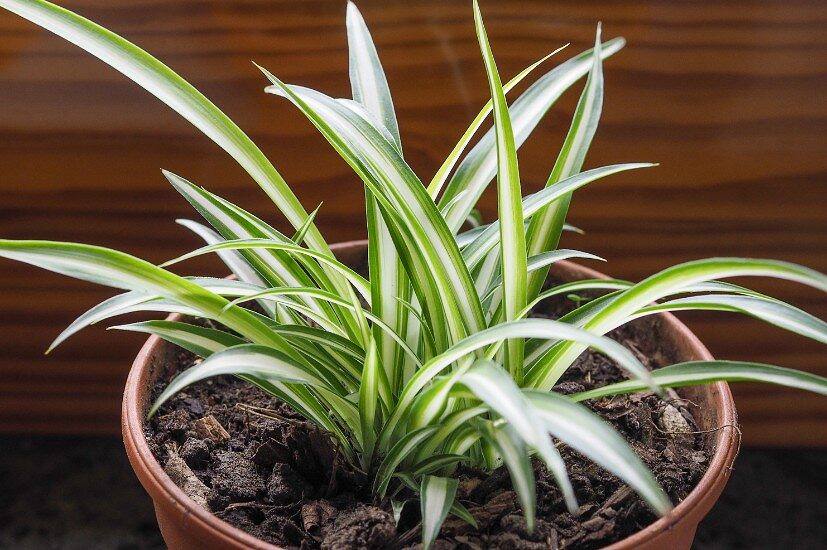
Spider Plant (Chlorophytum comosum), also known as spider ivy, is a perennial, stolon-forming herbaceous plant that stands out as one of the most widely grown and valued plants in residential landscapes. With its foliage arranged in dense, arching rosettes, it produces long trailing stems that carry small plantlets ready to root. This trait gives the plant a lush, cascading look, making it ideal for hanging baskets or as a light, dynamic ground cover. Its toughness and ability to adapt to different light levels have made it an indispensable classic for indoor growing.
Far beyond its ornamental beauty, this species has earned wide appreciation for its extraordinary ability to survive with minimal care. It tolerates missed waterings thanks to its root system, which is modified to store water, making it a perfect choice for beginner gardeners. In the plant market, it moves easily between classic outdoor use and decorating indoor spaces in bright, indirect light, proving that the simplicity of its care is the secret to its lasting popularity.
Origin, habitat and etymology
This species is native to the tropical and subtropical forests of southern Africa, with natural occurrence in South African provinces such as KwaZulu-Natal, Limpopo, Mpumalanga, and Eastern Cape. In its habitat, it grows as an understory plant, thriving in soil rich in leaf litter (the layer of dry leaves and organic matter that covers the forest floor) beneath the canopy of trees that filter direct sunlight. This moist, shaded, highly porous-soil environment shaped the plant’s resilience in indoor settings.

The genus name, Chlorophytum, comes from the combination of the Greek words chloros, meaning light green or greenish, and phyton, which translates as plant, describing the always fresh color of its leaves. The specific epithet comosum comes from Latin and means hairy, tufted, or with tufts, a direct reference to the plantlets that develop at the tips of the trailing stems and resemble small floating green tufts. In older botanical literature, it has also been recorded under synonyms such as Anthericum comosum and Chlorophytum sternbergianum.
Landscape use of Spider Plant
In landscaping, Spider Plant offers remarkable versatility, working both as a light ground cover for partially shaded beds and as an edging plant to define paths, outline planting masses, or soften the base of walls, steps, and trees. Its arching leaves create a low, fresh, luminous mass, especially in variegated cultivars, which help brighten part-shade areas without the visual weight of denser foliage. To form a uniform green carpet, spacing of 0.25 m by 0.25 m to 0.30 m by 0.30 m between plants is recommended. Growth is usually fast in fully green forms and moderate in striped varieties, which have less chlorophyll, the pigment responsible for capturing light and producing the energy needed for growth.
In outdoor compositions, Spider Plant works very well as a transition plant: it fills gaps, covers the soil, and finishes the base of larger species without competing with them visually. It can be used beneath the canopy of medium-sized trees, such as Quaresmeira (Pleroma granulosum), where it forms a light ground cover that brightens the shaded area. It also creates an elegant contrast in front of broad-leaved, deeply cut shrubs, such as Xanadu Philodendron (Thaumatophyllum xanadu), highlighting the difference between fine and tropical textures. At the base of walls covered with Creeping Fig (Ficus pumila), it softens the transition between the vertical plane and the ground, creating a more natural and less rigid finish.

The plant fits easily into tropical, contemporary, low-maintenance, and more naturalistic garden designs. Although simple, it is far from boring: its appeal lies in the movement of the leaves, the lightness of its form, and its ability to visually weave together different elements of the garden. In larger plantings, it can replace more demanding ground covers in part-shade areas; in small gardens, it helps create a sense of abundance without making the space feel heavy. It is an especially useful choice for anyone who wants a green, full, well-balanced garden without relying only on large, dramatic plants.
In balconies and indoor spaces, Spider Plant has taken on new prominence with the urban jungle aesthetic. In hanging pots, bowls, high shelves, and wall-mounted supports, its reproductive stems with tiny plantlets drape freely, forming a living cascade of leaves and new growth. This effect is highly valued indoors because it adds movement, vertical interest, and a relaxed feel to the decor, working well alongside pothos, ferns, peperomias, prayer plants, and philodendrons. Instead of taking up only floor space, the plant lets you make use of overhead space, something especially valuable in apartments and compact rooms.
Indoors, the ideal placement is in spots with abundant, filtered natural light, such as near bright windows, covered balconies, or rooms that stay consistently bright throughout the day. It tolerates some shade, but it should not be treated as a low-light corner plant: the less light it gets, the slower it will grow and the less vigorous the new shoots will be. In indoor vertical gardens, the fine texture of its leaves helps break up the rigidity of support structures and adds movement to the green wall. On consoles, shelves, and countertops, Spider Plant works as a “bridge” plant, visually linking furniture, walls, and other foliage with a light, homey, unpretentious look.

How to care for Spider Plant: growing guide
- Light: Prefers partial shade or bright, indirect light. It can tolerate full sun if acclimated gradually and kept evenly moist, but its leaves may scorch during the hottest hours of the day. Variegated types need more light to keep their colors vivid.
- Soil mix: Should be light, sandy loam in texture, rich in organic matter, and with excellent drainage. A good potting mix consists of 50% garden soil, 25% well-aged organic compost, and 25% washed medium river sand to prevent water buildup.
- Watering: Keep the soil moderately moist during spring and summer, reducing frequency in fall and winter. Let the surface layer of soil dry out between waterings. The plant tolerates short dry spells thanks to its water-storing roots, but prolonged soggy conditions will rot the root system.
- Climate: Grows best in tropical, subtropical, and warm temperate climates, with ideal temperatures between 64°F and 75°F (18°C and 24°C). Growth stops below 50°F (10°C), and it does not tolerate hard frosts or temperatures below freezing.
- Air humidity: Prefers relative humidity above 50%. In very dry indoor spaces or under air conditioning, leaf tips may dry out. Mist the leaves lightly with water in the morning to help reduce the problem.
- Fertilizing: Apply a balanced mineral fertilizer such as controlled-release NPK 10-10-10 mixed into the soil at the start of spring. Alternatively, use a liquid foliar fertilizer diluted to half strength every 30 days during the active growing months.
- Pruning: Do only cleanup pruning to remove dry, old, or damaged leaves at the base of the rosette. Dry tips can be trimmed with sharp scissors at a slanted angle, imitating the leaf’s natural pointed shape.
- Sensitivity to fluoride and chlorine: The plant accumulates fluoride and chlorine in the leaf tips, which causes burn and dark dry spots. To avoid this damage, water Spider Plant with rainwater, filtered water, or let tap water sit in an open bucket for 24 hours before using it in the pot.

How to propagate Spider Plant
Propagation by adventitious plantlets (the small clones that appear on the trailing stems) is the simplest and most efficient way to multiply Spider Plant. Select the offsets that already have small nodes or visible aerial roots at the base of their rosette. Remove the small plantlet by cutting the stem that connects it to the mother plant with clean scissors. Plant the offset directly in a small pot with moist soil and keep it in a shaded, protected spot until the roots anchor firmly in the soil, which takes about two weeks. Another option is to place the base of the plantlet in a glass of water for 7 to 10 days to encourage root growth before planting it permanently.
Division of clumps is recommended to rejuvenate very dense mature plants in late winter or early spring. Remove the plant from the pot carefully and shake off the excess soil to expose the base of the rhizome (the short stem that grows close to the soil surface). Using a sharp, sterilized blade, cut the base vertically, making sure each new section has at least one healthy leaf rosette and a well-developed cluster of tuberous roots. Replant the divisions immediately into their final pots, using a light potting mix and watering generously for the first few days to encourage root recovery.
At commercial scale and for the mass production of disease-free plantlets, laboratory micropropagation is used. This process grows fragments of plant tissue in sterile culture medium under controlled light and temperature conditions, allowing the production of thousands of identical clones in a short time.

Botanical description of Chlorophytum comosum
Spider Plant is a perennial herbaceous plant with a compact habit, whose leaf rosette reaches between 0.20 and 0.40 meters in height and 0.30 to 0.60 meters in diameter. Its trailing stems, however, can extend from 0.75 to 1.00 meter in length when the plant enters an active reproductive phase. The overall texture of the plant is flexible and soft to the touch.
The root system is fibrous (also commonly known as a hairlike root system), characteristic of plants in the class Liliopsida (the monocots, a group that includes species with parallel-veined leaves). Its roots are modified into tuberous, fleshy structures that are white to yellowish in color. These structures function as specialized storage organs that accumulate water and complex carbohydrates called fructans, giving the species excellent resilience against short dry periods.
The true stem is extremely reduced to a short, thick rhizome located at ground level, from which the leaves emerge directly in a dense basal rosette arrangement. The aerial stems are modified into stolons (thin, flexible stems with horizontal or trailing growth), cylindrical and green or yellowish, which carry the flowers and the new clone plantlets at their nodes. These stolons show negative phototropism, growing actively toward the ground (away from direct light) to make it easier for the new shoots to root away from the mother plant.
The leaves have a rosette phyllotaxy and a leaf blade that is linear-lanceolate to ensiform (sword-shaped). They measure 20 to 45 centimeters long by 0.5 to 2.0 centimeters wide, with an acute to attenuate tip, smooth entire margins, a herbaceous texture, and a completely glabrous surface (without hairs). The venation is parallel-veined, typical of its botanical class. Its leaves show gentle circadian nyctinastic movements, subtly changing the curvature and angle of the leaves between day and night to optimize transpiration and moisture retention.

The inflorescence develops at the tip of the stolons in the form of a simple raceme or a weakly branched loose panicle. The small flowers are gathered in fascicles (small groups of 1 to 6 flowers) spaced along the stem, which can reach up to 80 centimeters in length, interspersed with small membranous bracts. Flowering occurs continuously from early spring through late summer, although in warm, humid climates it may persist throughout the year.
The flower is small, measuring between 1.0 and 1.5 centimeters in diameter, with actinomorphic symmetry (radial, divided into several equal parts like a star), trimerous and hypogynous (with the ovary positioned above the other floral parts). The perianth (the set of petals and sepals) is made up of 6 free white tepals, with a slight greenish line on the outer surface. The androecium has 6 free stamens with yellow anthers, and the gynoecium has a superior, trilocular ovary. There are no nectar guides visible to the human eye; they can be detected only under ultraviolet radiation by pollinating insects.
Pollination is entomophilous, carried out by small flies, hymenopterans, and bees, and self-pollination is also common. The fruit is a leathery dehiscent capsule (which opens on its own to release the seeds) with a triquetrous shape (with three well-defined angles), measuring 5 to 8 millimeters in diameter, green when young and brown at maturity.
The seeds are small, flattened, disc-shaped to kidney-shaped, deep black, and rough in texture, dispersing by gravity near the mother plant.

Spider Plant types: green, variegated, Bonnie, and other cultivars
The Chlorophytum comosum has several cultivars that stand out in the ornamental plant market, differing mainly in leaf color pattern, size, and growth habit. The main Spider Plant types available include:
- Chlorophytum comosum ‘Vittatum’: One of the most popular cultivars, characterized by a creamy white central stripe running lengthwise along the green leaves. This variegation is stable and remains even in moderate light conditions. Also known as “Variegatum” in some markets, although botanically they are distinct.
- Chlorophytum comosum ‘Variegatum’: Features leaves with white or cream margins and a green center, in the reverse pattern of ‘Vittatum’. It requires stronger light to keep the variegation clearly defined.
- Chlorophytum comosum ‘Bonnie’ (also called ‘Curly Spider’): Characterized by wavy or curled leaves, creating a distinctive visual effect. It is available both in fully green form and in variegated versions.
- Chlorophytum comosum ‘Ocean’: A more compact cultivar, with shorter and broader leaves and white variegation. Ideal for smaller spaces or for arrangements in smaller pots.
- Chlorophytum comosum ‘Lemon’: Features leaves with lemon-yellow variegation, providing a softer contrast compared with white-variegated varieties.
- Chlorophytum comosum ‘Mandaianum’: More compact and upright, with slightly broader leaves and prominent central variegation, it is often confused with ‘Vittatum’ but is distinguished by its less arching growth habit.
- Chlorophytum comosum ‘Picturatum’: Similar to ‘Vittatum’, but with a wider and whiter central stripe, creating a visual effect where the green appears to be the variegation.
- Chlorophytum comosum ‘Silver Surfer’: A cultivar with an overall silvery tone on the leaves, creating a metallic look that stands out in combinations with more intensely colored plants.
- Chlorophytum comosum ‘Hawaiian’: A robust variety that develops exceptionally long leaves (up to 60 cm) and broad leaves, with pronounced central variegation.

Pests, diseases, and solutions
Mealybugs are the most common pests and usually settle at the base of the leaves, protected by the sheath of the rosette. To eliminate them, apply neem oil mixed with a mild detergent diluted in water directly to the affected areas, or remove them manually with a cotton swab dipped in rubbing alcohol. Spider mites appear mainly in dry environments and under air conditioning, leaving the leaves with a bronzed, dull appearance. Control is achieved by increasing humidity with water misting, using humidifiers, and applying soluble sulfur to the leaves.
Excess water in the potting mix and poor drainage cause root rot, which is caused by fungi. Symptoms include sudden yellowing and softening at the base of the leaves. If this happens, stop watering immediately, remove the plant from the pot to cut away the dark, rotten roots, treat the healthy parts with Bordeaux mixture, and repot in fresh, light, highly airy potting mix.
Fun facts
Spider Plant was one of the species highlighted in the famous air-purification study conducted by the U.S. space agency NASA. The tests showed that the plant acts as an efficient natural filter for indoor spaces, capable of absorbing and metabolizing harmful pollutant gases and volatile organic compounds such as formaldehyde, xylene, benzene, and carbon monoxide found in cleaning products and paints.
Pet safety is another major advantage of this species. The ASPCA (American Society for the Prevention of Cruelty to Animals) classifies it as a non-toxic plant for dogs and cats. However, its leaves contain substances that have a subtle attraction for felines, similar to the effect of catnip; eating its fibrous leaves can cause mild mechanical irritation in a cat’s stomach, leading to reflex vomiting as a cleaning response, without any risk of chemical poisoning.
Because of its excellent ornamental value and ease of care in home growing, the variegated cultivar Chlorophytum comosum ‘Vittatum’ received the prestigious Award of Garden Merit from the Royal Horticultural Society, confirming its worldwide importance in the ornamental plant market.

Frequently asked questions about Spider Plant
What is Spider Plant used for?
Spider Plant (Chlorophytum comosum) is used mainly as an ornamental plant, both in gardens and indoors. In landscaping, it works well as ground cover, edging, a low mass planting, or a trailing plant in pots and planters; indoors, it is valued for the light, arching effect of its leaves, and is often used on balconies, shelves, hanging planters, and urban jungle-style arrangements.
Does Spider Plant like sun or shade?
Spider Plant prefers bright, indirect light. It grows very well in partial shade, bright balconies, sheltered gardens, and spaces near windows, and can receive weak morning or late-afternoon sun; strong, prolonged sun can burn the leaves, especially on variegated varieties.
Is Spider Plant a sun plant?
Spider Plant tolerates a few hours of gentle direct sun, but it is not the best choice for strong full sun all day. In very hot or exposed locations, the leaves may yellow, lose vigor, and develop dry or burned tips.
Is Spider Plant a shade plant?
Spider Plant accepts partial shade, but it should not be grown in dark places. In too much shade, it grows more slowly, becomes less dense, and may lose some of the stripe intensity in variegated varieties; the ideal is bright partial shade or strong indirect light.
What is the difference between a sun Spider Plant and a shade Spider Plant?
In practice, they are not different plants, but different growing conditions. The same Spider Plant can adapt to brighter or more sheltered locations, as long as it is not pushed to extremes: with more light, it tends to grow more compact and vigorous; in too much shade, it can become looser, stretched, and slower.
How do you care for Spider Plant?
Grow Spider Plant in a light, fertile, well-drained potting mix, watering when the top layer starts to dry. The plant appreciates good light, moderate air circulation, and light feeding during the growing season; to keep the pot looking neat, remove dry leaves, burned tips, and excess plantlets.
Can you put Spider Plant in the bedroom?
Yes, Spider Plant can be grown in the bedroom, as long as the room receives good natural light. It is a good choice for bright bedrooms because it has a light form, takes up little space, and can be used in hanging pots, on dressers, or on shelves; just avoid dark, stuffy spaces or direct air conditioning.
Is Spider Plant poisonous?
Spider Plant is not considered a highly poisonous plant for people, dogs, or cats, but it should not be treated as an edible plant. If eaten in large amounts, it can cause digestive upset, especially in animals that chew on leaves out of habit.
Is Spider Plant toxic to cats?
Spider Plant is generally considered safe for cats, but many felines are attracted to its arching, trailing leaves. Frequent chewing can damage the plant and cause vomiting or mild digestive irritation in the animal, so it is worth keeping the pot hanging if your cat is especially persistent.
Does Spider Plant bloom?
Yes, Spider Plant produces small white flowers that are subtle and delicate, appearing on long, slender stems. After flowering, these stems usually form small plantlets at the tips, one of the species’ most distinctive traits.
How do you make Spider Plant babies?
The easiest way is to use the plantlets that appear on the flowering stems: when they have a few leaves and small roots, simply cut them off and plant them in a light, moist potting mix. It is also possible to propagate the plant by division, separating sections with their own roots.
Is there a purple Spider Plant?
The name “purple Spider Plant” can be confusing, because the true Spider Plant, in the genus Chlorophytum, usually has green leaves or white-and-cream variegation. Plants sold under this name may belong to other ornamental genera, such as spiderworts (purple wandering dude, purple heart), ophiopogons, or species with purplish foliage.
What is the spiritual meaning of Spider Plant?
In plant symbolism, Spider Plant is often associated with renewal, protection, lightness, and cleansing the home environment. Its vigorous growth, ease of producing new plantlets, and arching leaf shape reinforce the idea of vitality, expansion, and energy in motion.
That’s why it’s such a popular choice for bedrooms, living rooms, balconies, and home offices, especially for anyone looking to bring a sense of freshness, balance, and warmth indoors.
What plant looks like Spider Plant?
Some plants can resemble Spider Plant because of their long, narrow, arching leaves, such as liriope, dianella, mondo grass, dietes, young agapanthus, and some ornamental grasses. The main difference is that Spider Plant forms loose clumps and usually produces stems with hanging plantlets.
How much does a Spider Plant plantlet cost?
The price of Spider Plant varies depending on the size of the plantlet, the variety, the type of pot, and the region. In general, it is an affordable plant that is easy to find in garden centers, flower shops, and plant fairs; small plantlets are usually inexpensive, sold in trays, while full, trailing pots tend to cost more.