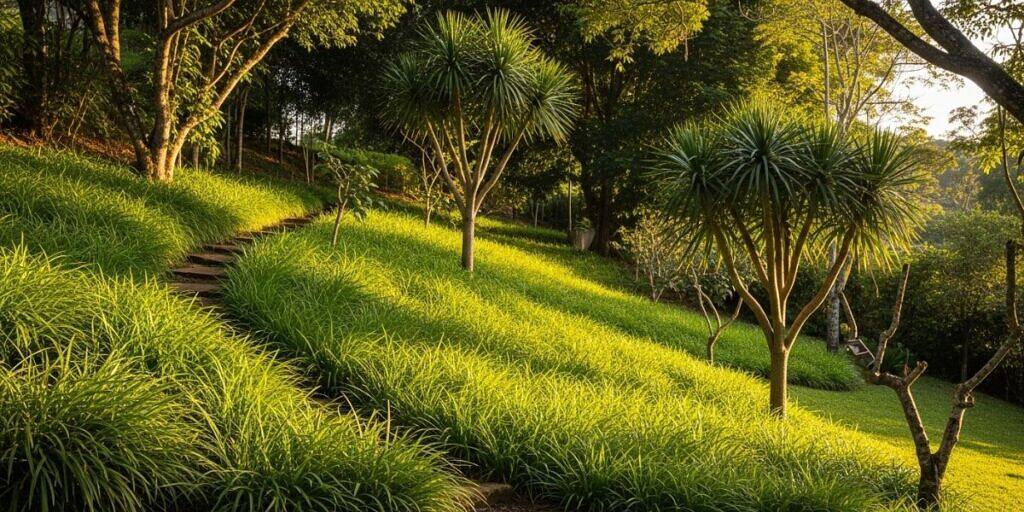
Have you ever looked at that steep bank at the back of your yard and thought, “this is only going to give me a headache”? Let me tell you, a well‑designed slope can become the most breathtaking feature in your landscape. You’ll see that it’s not that complicated to turn a problematic hillside – that turns into mud every time it rains – into a vibrant green carpet that doesn’t even need irrigation. And the secret? It’s not luck. It’s understanding that working against gravity takes technique, not magic.
But before you start planting anything, you need to understand something fundamental: the water running downhill is not your friend, it’s your main enemy. It carries away fertile soil, uproots plants, and turns your slope into an expensive disaster. That’s why we’re going to start with the technical foundations that make the difference between a slope garden that lasts and one that collapses in the first storm.
Technical fundamentals: drainage, retention and erosion control on slopes
The first thing you need to accept is that physics doesn’t negotiate. When water picks up speed going down a slope, it builds enough energy to carry off soil, rocks, and even entire plants. This is why simply “throwing some soil and planting” usually doesn’t work on a slope.
For inclines steeper than about 30 degrees – basically any bank where you need to hold on to climb – using coconut fiber erosion control blankets or geogrids stops being optional and becomes essential. These materials keep the soil in place until plant roots establish and create their own natural reinforcement network. Look for products sold as “coconut fiber blanket,” “coir blanket,” or “non‑woven geotextile.” To secure them, you’ll need U‑shaped steel landscape staples or stakes made from treated wood.

The invisible drainage system that saves your slope garden
Here’s something crucial: there’s no point in holding the soil if water keeps building up underneath. It’s like trying to hold a water balloon – at some point, it bursts. That’s why professionals who know what they’re doing always install an invisible drainage system before any planting.
The technique is to install perforated PVC drains (those corrugated pipes with small holes) wrapped in a geotextile fabric – commonly known on the market as Bidim or non‑woven geotextile fabric.
You can place them at the base of the slope or create a “herringbone” pattern to cover larger areas. This prevents water from saturating the face of the slope and triggering landslides.
Another technique for a garden on slope is “combing” the terrain. Instead of leaving the slope as a smooth ramp, create small contour lines – micro-terraces that slow down the water. Each contour works as a natural barrier, turning a rush of water into a controlled trickle.

Design strategy: choosing species and visual rhythm for a garden on slope
Now comes the step where many people go wrong: choosing the plants. It is common to see garden on slope projects that look like a patchwork quilt – a little bit of everything, with no clear criteria. The result? It looks more like a plant ID test than a cohesive garden. The golden rule for a garden on slope is: fewer species, more impact.
My favorite strategy is to work with three functional layers:
- Vigorous groundcovers at the base, creating a dense carpet that holds the soil
- Medium-height plants to create rhythm and break monotony
- Deep-rooted stabilizers planted strategically as “living anchors”
Below are some species widely used in a garden on slope. But before you start buying, check whether they are considered invasive in your region, and whether there are native species that are better suited. Often, simply observing what appears spontaneously on natural, stable slopes, or what has been successfully used by experienced landscape designers, can give you a good idea of what to choose. Native plants generally win in long-term adaptation and resilience, in addition to ecological benefits.
Groundcovers that really work in full sun
If your garden on slope is in full sun for most of the day, you have excellent options. Arachis repens – the creeping peanut often used in public landscapes – is one of my favorites for large areas. It not only covers the soil but also fixes nitrogen, naturally enriching the ground. And here is a major advantage: it is stoloniferous, meaning it spreads on its own, filling in empty spaces.
For anyone who wants more color, Evolvulus glomeratus – commonly known as blue daze – creates a beautiful visual effect with its small blue flowers contrasting against the foliage. And if you need something practically indestructible, Sphagneticola trilobata (creeping oxeye) can handle almost anything: scorching sun, drought, and occasional foot traffic. However, be aware that this ground cover is considered invasive in many regions, so use it with caution.
For shaded or partially shaded slopes
On slopes that remain in the shade of walls or trees, one of the most reliable choices is Ophiopogon japonicus – the well-known mondo grass (in lightly shaded areas, perennial peanut also performs well). Its root system is dense and fibrous, creating a true containment mesh in the slope garden. In addition, the dark color of the foliage creates a dramatic contrast that enhances any plants around it.
Chlorophytum comosum – the familiar spider plant so often grown in containers on porches and patios – is another excellent option for a slope garden. The arching leaves create a natural cascading effect, perfect for embankments. And there is more: it quickly produces offsets that you can keep replanting, expanding the groundcover without spending an extra cent.
The true anchors: stabilizing plants
Here is a fact that may sound exaggerated, but is absolutely true: Chrysopogon zizanioides – known as vetiver grass – develops roots that can reach about ten feet (3 meters) deep. These roots act like “living columns” that permanently anchor the soil. Vetiver should be planted at strategic points – never randomly – creating an invisible stabilization network throughout the slope garden.

Aesthetic composition of the slope garden: how to create a beautiful landscape (not just a functional one)
A well-designed slope garden does not have to look like a “technical area disguised as a garden.” On the contrary, when the layout is carefully planned, it can become the most striking visual feature of the property. The key is to treat the slope as a composition of masses and rhythms, and not just as a place to “fill with random plants.”
Start with the visual reading: from where will this slope be seen?
Before choosing plants, look at the slope garden the way a landscape designer studies a stage.
Will the slope be seen mainly from below (from the garden), from above (from a balcony, terrace, or outdoor living area), or from the side (as you approach the house)? This point of view determines the design.
From a distance, what really stands out are masses of color and volume. At close range, textures and fine details become more important. This helps avoid a common mistake: investing in delicate, highly detailed species in areas where no one gets close enough to notice them.
Fewer species, stronger visual impact
The aesthetic logic of slopes is similar to the technical logic: simplifying usually works better. Instead of using many species in small quantities, it is best to work with repeated blocks of a few plants, creating bands, drifts, or waves of vegetation. The result is more elegant, easier to read, and also easier to maintain.
A practical guideline is to define one dominant groundcover species, one or two intermediate species to create rhythm, and a few accent plants in strategic spots. This creates unity without monotony.
Texture, color, and height: the trio that gives depth to the design
Slopes can look visually flat when everything has the same height and the same texture. To avoid this, combine fine foliage with broad leaves, deep greens with brighter greens, and low, spreading groundcovers with pockets of medium-height volume. This controlled contrast creates depth and movement in slope landscaping, even in small areas.
The goal is not to turn the slope into a plant collection, but into a coherent composition. In landscape design, well-planned repetition conveys intention; too much variety suggests improvisation.
Plan for beauty all year, not just on planting day
A slope can look beautiful in the first month and then lose visual strength later, when some species slow down, flower less, or leave gaps. To avoid this, it is worth combining steady, reliable groundcovers with seasonal flowering plants or species with striking texture. This way, the slope landscaping maintains visual presence even outside the peak flowering season.
Finishing touches greatly enhance the final result
Well-defined edges, clean transitions to paths or lawns, access points for maintenance, and, where appropriate, subtle lighting make a significant difference. The finishing work is what transforms a planted slope into a true landscape project.

(geocélulas)
Step‑by‑step timeline for proper slope planting
Now that you understand the “why,” let’s move on to the “how.” And be warned: the order of the steps matters just as much as the steps themselves. Skipping stages or changing the sequence will compromise the entire result.
1. Soil preparation and contour marking
Start by clearing the entire slope. Remove debris, dead roots, and large stones that could interfere with planting. Then use a water level hose or a laser level (if available) to mark the contour lines. These horizontal reference lines will guide all your slope planting and the installation of erosion control blankets.
If your slope is very steep or long, consider creating micro‑terraces—small steps about 8 to 12 inches high (20 to 30 cm). This not only makes the work easier, but also creates natural pockets for water retention and infiltration.
2. Installation of erosion control blankets and fastening systems
This is where many people go wrong. The blanket must be unrolled from top to bottom, never the other way around. Overlap the edges by at least 4 inches (10 cm)—as if you were laying shingles on a roof. This prevents water from seeping between the seams and washing soil away.
Use U‑shaped staples every 20 inches (50 cm) along the length of the slope and every 3 feet (1 m) across its width. If the slope is very steep, reduce this spacing. The blanket needs to be secure, but not over‑stretched—leave a slight slack so it can accommodate the natural settling of the soil.
3. Opening inclined planting pockets and staggered (quincunx) layout
Here is the key detail that separates amateurs from professionals: do not plant in straight vertical holes. Make H‑ or V‑shaped cuts in the blanket and dig the planting pockets angled back into the slope, creating a negative angle. This forms a small basin that holds rainfall exactly where you need it—around the roots.
The quincunx pattern— that staggered zigzag where each plant sits between two plants in the previous row—maximizes visual coverage and encourages a natural growth flow. Leave 8 to 12 inches (20 to 30 cm) between plants, depending on the species.
A practical tip from extensive experience in slope planting: mix water‑retaining polymers into the potting mix—those gels often sold as “planting gel” or “water‑retaining crystals.” On slopes, where irrigation is difficult, this can be the difference between success and failure.
4. Mulch groundcover for protection against heavy rains
The final step—and one of the most important for effective slope planting—is to apply a generous layer of mulch between the transplants.
Pine bark, dry straw or even composted sawdust work very well. Mulching protects the soil from the direct impact of raindrops, which can be surprisingly destructive on sloped surfaces.
Apply a layer of 1.2 to 2 inches (3 to 5 cm), taking care not to cover the plant crowns. In addition to erosion control, mulch conserves moisture, regulates soil temperature, and will gradually decompose, enriching the potting mix.
Long-term maintenance, slow-release fertilization and safety standards
Let’s address something nobody likes, but that is essential: safety. Working on a sloped garden is no joke. Wear boots with non-slip soles – rubber boots with lugs – and on very steep slopes, use a climbing harness with a safety rope anchored at the top. Injuries and accidents have no place in landscape design.
The fertilizing strategy that doesn’t waste money
On flat ground, you can use almost any fertilizer. On a sloped garden, you cannot. Rain will wash a good portion of the nutrients downhill before plants can absorb them. That’s why you should always use slow-release fertilizers – products like Osmocote, Basacote or similar. They release nutrients gradually over several months, ensuring your plants are fed consistently.
Apply the fertilizer directly into the planting holes, never broadcast over the surface. On a sloped garden, gravity does not forgive laziness.
Pruning and maintenance: the bottom‑up technique
One thing learned in practice: always prune sloped gardens from the bottom up. This allows you to better visualize the overall design of the garden and prevents cut branches from falling on you or on other plants. And of course, always use protective equipment – safety glasses and gloves are mandatory.
Routine maintenance involves removing invasive plants before they establish, replenishing mulch when needed, and watching for signs of localized erosion. If you notice small gullies forming, do not ignore them. Fill them immediately with potting mix and reinforce the area with more plants.
Frequently asked questions about the conservation and design of sloped gardens
Can I plant trees on sloped gardens?
Yes, but with care. Small trees with deep taproots (that grow vertically) help with stabilization. Large trees or species with very shallow roots can make conditions worse, creating unstable areas. Always consult a professional to evaluate each situation.
How long does it take for a sloped garden to become fully stabilized?
Under ideal conditions, with vigorous groundcovers, you will have satisfactory visual coverage in 6 to 8 months.
But full soil stabilization – when the roots form a truly effective mesh – takes about 18 to 24 months. Patience is part of the process.
What if I can’t use erosion control blankets because of budget?
A more economical alternative is hydroseeding – a mixture of seeds, fertilizer, and natural binders that is applied as a slurry. It’s not as efficient as erosion control blankets, but it works on slopes with moderate grades. Another option is to use old burlap sacks or coffee bags, cut and pinned in place with wooden or bamboo stakes – rustic, but functional.
Do I need to irrigate the slope garden after planting?
For the first 60 days, yes. After that period, if you selected appropriate species and created the sloped planting pockets correctly, the slope garden itself will capture rainwater efficiently. Well‑designed slope gardens are practically self‑sufficient.

The harmony between technique and nature in your slope garden
Gardening on slopes leaves an important lesson: nature does not need to be tamed, but understood. A slope is often a scar in the landscape — created by grading, erosion, or construction. However, when slope garden management respects natural forces instead of fighting them, that same change in level can become an element of great beauty and functionality.
With planning, technique, and patience, it is possible to transform an unstable area into an effective, durable, low‑maintenance planting design. More than just an aesthetic feature, a slope garden can help retain soil, reduce erosion, and enhance the value and usability of the entire space.
If you have a problematic slope waiting for a solution, it is worth starting with the basics: understanding drainage, assessing the soil type, choosing suitable plants, and following the process calmly. And, when necessary, seeking professional support for the most technical stages — especially in situations with structural or safety risks. The results usually make it worthwhile: a slope garden that is more stable, functional, and beautiful.
The greatest challenge of a slope garden may lie in the grade, the soil, or the plant selection. But often, correctly organizing the problem is already the first step toward finding a good solution. And every well‑designed slope garden begins exactly like this: with a sound technical decision and the first plant in the right place.