Summer in many regions comes as a full package: intense heat, dry winds that seem to pull the moisture from everything, heavy humidity that clings to your skin in others, and sudden downpours that appear without warning. In the garden, this turns into two main issues: the potting mix dries out quickly on the surface and the plant sends confusing signals (wilting in the sun, perking up at night, looking a bit “sad,” and you try to make up for it with more water).
That’s where the most common — and most well‑intentioned — mistake comes in: you look at the surface and think, “poor thing, it must be thirsty.” And you decide to give it “a little water” every day.
This sounds like care. But in practice, it’s often the beginning of a silent problem: waterlogged roots, starved of oxygen, functioning poorly. And when the root system isn’t working, the plant goes into drama mode: it wilts, turns yellow, stops growing and… seems to ask for more water. A perfect cycle to push you into doing exactly what makes the situation worse.
Enjoyed this guide? There's more where it came from.
Understanding why plants behave the way they do is what turns guesswork into a thriving garden. That's exactly what we share in the Shrubz newsletter — free, straight to your inbox:
- Seasonal care reminders timed to your gardening calendar
- Propagation and pruning techniques, explained step by step
- Pest and disease alerts — catch problems before they spread
Let’s fix this with a simple (and liberating) idea: in a pot, the goal of watering is not just “to wet the soil.” It’s to keep the root system functioning. And roots function properly when they have both water and air in the right place.
First things first: what is “potting mix” (and why this term matters)
In gardening, we often use the term potting mix. If you’ve never really thought about it, it’s very straightforward:
Potting mix is the growing medium inside the container — where the roots live. It can be anything from a basic soil blend to a more technical mix with pine bark, coconut fiber, perlite, coarse sand, charcoal, peat, and other components.
Why does this term matter? Because regular garden soil is not always suitable for containers. In the ground, soil has layers, natural drainage, and a huge volume. In a pot, the system is small and closed. If you use only garden soil, it makes the potting mix heavy and compact, which essentially turns it into a waterlogged sponge. And roots are not meant to live inside a saturated sponge.
The “affectionate” mistake in a single sentence
Watering too frequently and too shallowly (the famous “little daily drink”).
This phrase sums up overwatering. However, this scenario is disastrous in the medium and long term, because it keeps the potting mix constantly damp — especially when the pot has poor drainage (too few holes or clogged holes), when the plant is placed in a decorative cachepot with no drainage hole (pretty, but treacherous), or when you use the classic combo: saucer always full of water + heavy potting mix. That’s the full recipe for a struggling plant.
Notice I haven’t even mentioned plant species yet. That’s because this mistake is “universal”: it affects everything from tropical foliage to herbs. The only difference is how quickly each one starts to complain.
Why does this kill the plant? The physiology behind the disaster
1) Roots need to breathe (and pots show no mercy)
Roots are not drinking straws. They don’t “suck up water” automatically just because they’re wet. Roots are living tissues that carry out cellular respiration — and to breathe, they need oxygen.
In a well-structured potting mix, there are micropores and macropores: tiny spaces between the particles. Some of these spaces are filled with water and some are filled with air. That’s what keeps the balance: enough water to hydrate + enough air for the root to function.
When you water too often and don’t let the pot “breathe” between one watering and the next, what happens is simple:
- The air pores fill with water → oxygen levels crash.
- The root goes into hypoxia (oxygen deficiency) → it slows down and becomes vulnerable.
- The wet, low-oxygen environment favors opportunistic fungi (Pythium, Phytophthora, Rhizoctonia, and other typical container-garden villains).
- End result: root rot and, later on, the aboveground part of the plant starts to collapse.
In everyday terms: the problem isn’t “too much water in a single day.” The real issue is too much water for many days in a row, with no break, no full drainage, and no aeration in the potting mix.
2) “But the surface is dry!”
This is the number one summer trap: the top of the potting mix is misleading.
On hot days, with wind or direct sun, the top few inches (top few centimeters) of the potting mix dry out fast. But the most important roots — the ones responsible for most of the absorption — are usually in the middle and lower part of the container. So you touch the surface, it feels dry, and you water again — while the bottom is still moist or even waterlogged.
The pot basically turns into a weird sandwich:
- A top layer that’s always wet (because you water lightly and often),
- A middle layer that’s constantly damp (the root system never gets a “break”),
- The bottom accumulating water (where drainage is slower and oxygen levels are lower).
This pattern is perfect for two very common problems:
- Fungus gnats — they love constantly moist potting mix on the surface.
- Weak roots — because they never go through the full “thorough soak / good drainage / ideal dry-down” cycle.

3) In summer, the pot becomes a “heat trap”
Containers heat up when exposed to direct sun. Dark pots heat up even more. Small pots heat up a lot more. That changes everything because:
- Roots are sensitive to temperature spikes.
- Hot potting mix loses dissolved oxygen more quickly.
- Water + heat + low oxygen = ideal environment for root stress.
That’s why you might see a plant wilting even though the potting mix is wet. It’s not “thirst.” It’s roots struggling in a poor environment. And this is exactly the kind of wilting that makes people water more — which only makes things worse.
The misleading wilting cycle (that makes you water the wrong way)
This pattern is so common you can almost predict it:
- The sun gets intense → the plant wilts in the middle of the day.
- You water “just to be safe.”
- It seems to perk up (often because the temperature drops later, not because the extra water fixed it).
- With frequent watering, the potting mix stays too wet for too long.
- The root system weakens and absorbs water less efficiently.
- The plant wilts even more, despite water being present.
- You water again… and complete the cycle.
Key point: wilting at midday in summer is not proof of thirst. Many plants reduce turgor on purpose as a strategy to cut down on transpiration.
The honest test is different:
- Does it regain firmness by late afternoon or at night? If so, it may just be heat and high transpiration.
- Is it still wilted in the morning? That usually signals a more serious type of stress (true lack of water, damaged roots, or both).
In other words, before you water on impulse, it’s worth observing for a bit. Summer doesn’t call for haste; it calls for better watering judgment and a healthier watering schedule.
The 5 “harmless” details that turn watering into plant murder
1) Decorative cachepot with no drainage hole (the disguised aquarium)
A cachepot looks great, but it was never meant to be a real plant pot. If it has no drainage hole, it doesn’t drain. And if it doesn’t drain, water builds up at the bottom—even if you can’t see it.
The right way to use a cachepot is simple: inner nursery pot with drainage + outer cachepot. After watering, always check if there’s water sitting at the bottom. If there is, remove it. Do not negotiate with this step: standing water in a cachepot is the plant-care equivalent of “I’ll just smoke one cigarette”.
2) Saucer constantly filled with water (capillary action is ruthless)
A saucer has two legitimate jobs: protect the floor and catch the water that drains out right after watering. That’s it. What it is not: a permanent water reservoir.
If the saucer keeps water in it, the potting mix pulls that water up by capillary action (like a cloth soaking up liquid). The result: the bottom of the pot stays constantly wet, even if the surface looks dry. It’s one of the fastest ways to create root rot in summer.
Practical rule: after watering, wait 10–20 minutes and empty the saucer.

3) Heavy potting mix (garden soil + lots of fine organic matter)
This is a very common mistake: “I used a really dark, rich soil.” In the ground, that can be fine. In a container, it’s often a disaster for your houseplants.
A heavy potting mix compacts. Once compacted, it loses its air pores. Without air pores, it holds too much water and provides very little oxygen. And then we’re back to the core problem: roots without oxygen.
A helpful mindset: in containers, structure comes before fertility. You can always add nutrients with fertilizer; you can’t fix a structurally bad potting mix just by wishing for healthier houseplants.
4) Small pot for a large plant (extremes in the same container)
A large plant in a small pot is an unstable system: it heats up more, the top layer dries out very quickly, but the bottom can stay waterlogged if you water on impulse. It’s the worst of both worlds: temperature stress + oxygenation stress for your houseplants.
If you notice the pot dries out “within hours” on the surface and the plant is constantly going through ups and downs, take a closer look: the issue may not be thirst. It may be a pot that’s far too small for the root volume.
5) Panic watering, without checking first
“I watered yesterday, but today is so hot…”—and there goes more water.
In summer, this happens because we confuse heat with thirst. And since the surface dries out fast, you assume you’re late with the watering.
What solves this is not memorizing a schedule. It’s replacing guesswork with simple measurement — and that starts in the next section.
How to water correctly in summer (without becoming a slave to a schedule)
If you keep only one idea from this article, let it be this:
You don’t “decide the frequency” of watering. You decide the criterion.
The frequency ends up being a consequence of the weather, pot size, plant type, potting mix, and the spot where it’s growing.
In other words: summer doesn’t require you to become a walking water timer. It requires you to stop guessing.
Main rule: “watering thoroughly” is different from “watering often”
In a pot, efficient watering has a very clear signature: it wets the entire volume of the potting mix and then allows the pot to drain and dry at the right pace.
Poor watering also has a signature: it only moistens the top and keeps the interior at a constant, lukewarm moisture level — that “comfortably damp middle ground” that feels safe, but is the fastest route to weak roots.
So before we talk about “how many times”, let’s talk about “how”.

The most reliable (and cheapest) method: deep moisture testing
Most people get watering wrong because they only look at the surface. In summer, that’s almost a guarantee of confusion. That’s why you should use one of these three simple and effective tests:
1) The finger test (good for most foliage houseplants)
Push your finger into the potting mix (this is technique, not poetry):
- Tropical foliage and indoor plants (pothos, philodendron, monstera, prayer plants): test at about 1.25–2 in (3–5 cm).
If it still feels moist, do not water. - Herbs and vegetables in containers: 0.75–1.25 in (2–3 cm) is usually enough, because they dry out faster.
2) The skewer test (great for deeper pots and for succulents)
Use a bamboo skewer (or chopstick) and push it down close to the bottom of the pot. Wait a few seconds and pull it out:
- If the skewer comes out dark and damp, there is still water down there.
- If it comes out light and dry, it’s time to water (depending on the plant).
For succulents and cacti, this watering test is invaluable, because their “sweet spot” tends to be much drier than a beginner gardener’s instincts would allow.
3) The weight test (the most professional and most underestimated)
Pick up the pot right after a thorough watering. Feel the weight. Then, feel it again when it’s close to the point where it needs watering. In about 10–14 days you’ll learn the difference in your body. This method works very well for medium and small pots.
Practical tip: you don’t need to turn into a scientist. Choose ONE test and use it consistently. Sticking to a method is more important than “perfection.”
The watering technique that solves 80% of cases: deep watering + full drainage
Here’s the right way to water in summer. It’s a short sequence, but it’s a game‑changer for plant watering:
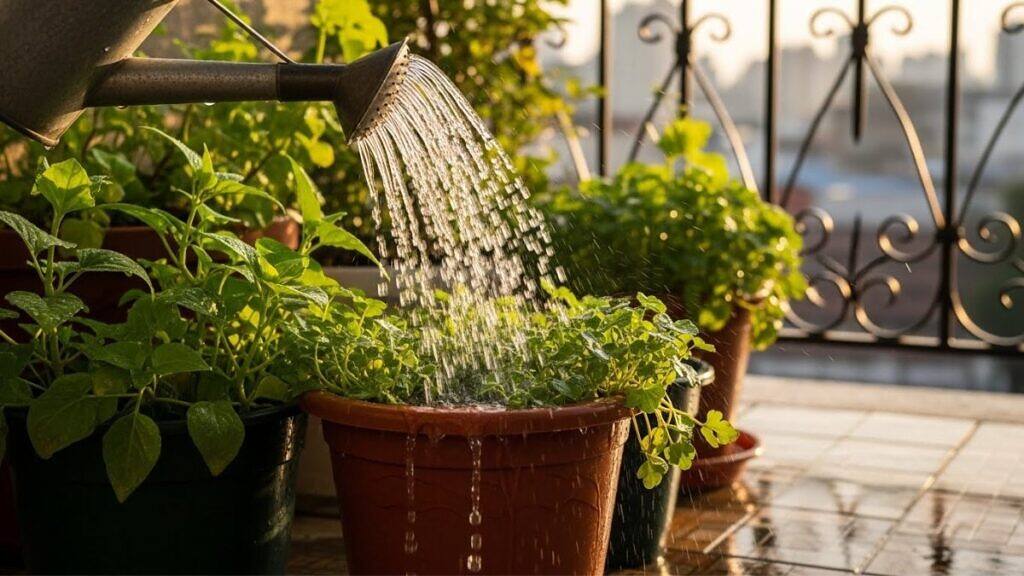
- Water slowly until water starts coming out through the drainage holes.
- Wait 1–2 minutes (this allows the potting mix to absorb moisture evenly).
- Water again, a bit more, to make sure there are no “dry pockets” in the root ball.
- Let it drain (don’t rush this step).
- Empty the saucer/outer cachepot after 10–20 minutes.
Why does this “water, pause, water again” method work so well? Because many potting mixes dry out inside and start to repel water. The water runs down the sides, wets the surface, and you think you’ve “watered.” The pause helps break that resistance.
If you do only this in 2026, you’ll already lose fewer plants.
Best time of day to water in summer
Timing matters. Not because “water drops burn leaves” (that myth is exaggerated in most situations), but because the pot is its own microclimate and your plant watering needs to be efficient.
- Early morning (best option): the pot starts the day hydrated with more stable oxygenation.
- Late afternoon (second best): it works, but avoid leaving the area too stuffy overnight, especially with plants that are more sensitive to fungal issues.
- Midday (avoid): evaporation is high and the thermal shock in the potting mix can stress roots, besides encouraging you to “water in a panic.”
If your routine only allows you to do plant watering at night, that’s fine—just pay extra attention to drainage, airflow, and excess water sitting in the saucer or cachepot.
“But my climate is different…” — how to adjust by region
Different regions and countries have very different summers, and that changes how fast a pot dries. The logic, however, is the same: test first, water thoroughly, and let it dry to the right point.
Humid regions and coastal areas (very humid air, slower drying)
When the air is humid, evaporation is lower. The pot may take longer to dry out, even in hot weather. Here, the risk is keeping the potting mix too wet for days without noticing.
Strategy: flawless drainage + longer intervals between waterings + good air circulation.
Hotter, drier and windy regions
Evaporation can be brutal: the surface can dry out in just a few hours. It’s the perfect environment to fall into the trap of “a little water every day”.
Strategy: deep watering + mulch (potting mix surface cover) + smart shade during the strongest sun hours (for plants that are not full-sun species).
Areas with heat waves and sudden downpours
You may get 3 days of intense sun followed by 2 days of rain. If your plant is exposed to rain, your watering routine has to become a “flexible rule”.
Strategy: watch the weather and cut back on watering when it rains, and always check saucers and cachepots (rainwater fills them too!).
In short: the more humid the air and the more frequent the rain, the higher the risk of overwatering. The windier and drier the air, the higher the risk of the mistake “watering too lightly and too often”.
How to know if the problem has already started (quick and honest diagnosis)
Diagnosing issues in a pot is a game of reading signs. The most common mistake is assuming yellowing = lack of water. In summer, yellowing is usually “roots complaining”. Let’s break it down:
Signs of too much water (and roots under stress)
- Yellow, limp leaves, especially the oldest ones (lower leaves).
- Potting mix with a sour smell or a swampy, stagnant odor.
- Tiny gnats flying out of the pot when you touch it (a sign of constantly moist surface).
- Plant not growing, with no vigor, even though it “has water”.
- Paradoxical wilting: the plant wilts even though the potting mix is still moist.

Signs of underwatering (real thirst)
- Wilted leaves that do not regain turgor overnight.
- Potting mix pulling away from the sides of the pot (it shrinks and forms gaps).
- Water runs straight down the sides without soaking in (hydrophobic/over-dried potting mix).
- Crispy, dried tips in very dry conditions (taking the species’ natural needs into account).
The catch: overwatering can also cause “thirst symptoms”, because rotted roots cannot absorb water properly. So before watering on impulse, use a depth test to check the potting mix below the surface.
Rescue: what to do if you suspect overwatering
The good news: many cases of overwatering have a solution, especially when you catch the problem early. The bad news: if you keep watering “to save” the plant, you actually speed up the damage.
Plan A (mild): controlled drying
Ideal when the plant looks “off” but has not collapsed yet.
- Stop watering until the potting mix dries to the proper level for that specific plant.
- Ensure good air circulation and adequate light (without scorching it if it is not a full-sun plant).
- Remove any standing water from saucers and decorative cachepots.
Plan B (moderate): improve aeration without full repotting
This works when the overwatering problem is linked to poor drainage and compacted potting mix, but the plant still has viable roots.
- Raise the pot on pot feet or small supports so the bottom can breathe.
- Carefully create a few channels in the potting mix with a thick skewer or stick to increase air penetration.
- If the drainage holes are clogged, clear them out (yes, that alone can save an overwatered plant).

Plan C (advanced): repotting with root inspection
When there is a strong odor, leaf drop, and clear signs of root rot, a more thorough intervention is the most effective way to fix overwatering.
- Gently remove the plant from the pot and examine the root system.
- Healthy roots tend to be firm; rotting roots are dark, mushy, and fall apart easily.
- Trim damaged roots with a clean (and, if possible, sterilized) tool.
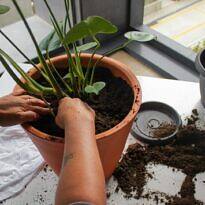
- Repot into a container with truly effective drainage and a more airy potting mix.
After repotting, it is very tempting to water heavily. Resist that. Water only as needed and allow the plant to recover. After this kind of “surgery” for overwatering, less is more.
What almost no one does in summer, but should: reduce evaporation without drowning the plant
If you want to water less often without causing overwatering, the answer is not “soak the plant every day.” The key is to reduce stress and evaporation in a smart way.
1) Mulch (topdressing the potting mix)
Mulch is a protective layer on top of the potting mix. It reduces water loss and helps stabilize temperature without causing overwatering.
Examples:
- Foliage and ornamental containers: pine bark, coarse coconut fiber, dried leaves.
- Succulents: gravel or small stones (helps keep the base drier and prevents crown rot and fungi).
2) Smart shade (for plants that are not full sun)
For part-shade plants, summer heat can be very harsh. Filtered shade, 30–50% shade cloth, or protection during the most intense hours of the day reduces wilting and prevents the chain reaction of “watering out of panic.” The right amount of shade is essential for healthy plants in pots.
3) Air circulation (especially indoors)
Indoors, still air keeps the potting mix wet for much longer, which increases the risk of fungal diseases and fungus gnats. Moderate ventilation helps the potting mix dry in a more natural way and keeps potted plants healthier.
Special cases: when overwatering changes disguise
Succulents and cacti
The “affection” here often looks like watering a tiny bit, very often. It seems safe, but it creates weak, shallow roots and slow rot. The best way to water potted succulents and cacti is to:
- water thoroughly,
- let all excess water drain away,
- and only water again when the potting mix is truly dry (check with a wooden skewer or by the weight of the pot).
Orchids
Orchids do not live in regular “soil.” They grow in very airy material (bark, charcoal, fiber). Watering every day in a closed, stuffy spot is a recipe for damaged roots. Allowing good air circulation and letting the medium dry slightly between waterings is the golden rule for orchids in pots.
Herbs (basil, parsley, mint, rosemary)
Herbs like consistency, but they hate mud. In small containers during hot summer weather, you may need to water frequently — but always with a deep watering and excellent drainage. The real mistake is the daily “little splash on top,” which only keeps the surface moist while the bottom of the pot stays waterlogged.
Quick checklist: stop watering like this (and do this instead)
If you’re in the “give me a summary I can use today” group, here it is:
- Stop: giving plants a light sprinkle from above every day.
Do instead: deep watering + complete drainage. - Stop: leaving water sitting in saucers or decorative cachepots.
Do instead: empty them 10–20 minutes after watering. - Stop: deciding based only on a dry surface.
Do instead: use the finger/skewer test + check the weight of the pot. - Stop: using heavy potting soil that compacts easily.
Do instead: choose a lighter, more open potting mix (structure first). - Stop: watering in a rush, in the middle of the day.
Do instead: water early in the morning (ideal) or late in the afternoon.
The right kind of care is giving the roots oxygen
In summer, taking good care of a plant in a pot is not about “adding more water out of anxiety.” It is understanding that a container is a small, fast-changing system, where the roots of potted plants need the right balance of water and air to stay healthy.
The well‑intentioned mistake happens when you try to compensate for the heat with frequent, shallow watering, keeping the potting mix constantly damp. Instead, switch to a far smarter routine: test, water deeply, let it drain, and then allow the soil to dry to the right point.
You’ll lose fewer plants, spend less effort, and — as a bonus — stop living in “emergency mode” every time the temperature climbs.