
Have you ever spotted a dark, spiky little bug moving quickly through a cluster of aphids and thought about squashing it? You may have been about to get rid of one of your best helpers. Beneficial insects and other garden allies work every day: hunting pests, pollinating flowers, and turning fallen leaves into fertile soil. Once you learn to recognize them, the urge to spray gives way to a more observant and effective way of gardening.
I recommend watching the garden before taking action. An aphid colony gets your attention, but it also sends out signals that attract lady beetles, hoverflies, and lacewings. Very often, the solution is already on its way—landing on a flower or hiding under a leaf.
The role of beneficial insects and animals in garden balance
In a healthy garden, many jobs are happening at once. Some animals prey on aphids, caterpillars, and mites; others move pollen from flower to flower; and some live in the layer of leaves on the ground, helping break down organic matter.
Together, they reduce imbalances. When there is food, shelter, water, and no broad-spectrum pesticides, the natural enemies of garden pests stay nearby. The goal is not to make the garden insect-free, but to keep any one species from becoming a problem.
ID guide: who the natural predators of garden pests are
Lady beetles and their hunting larvae

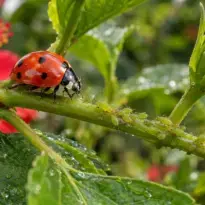
Lady beetles in the family Coccinellidae, such as Cycloneda sanguinea and Harmonia axyridis, are rounded and may be bright red or orange. Both adults and larvae feed on aphids, soft scale insects, whitefly nymphs, and sap-sucking mites.
The larva often surprises gardeners. It looks like a tiny alligator: an elongated body, gray to black, with yellow or orange spots and six active legs near the front. A single larva can eat 200 to 400 aphids before pupating. Don’t remove it from the plant—it’s hunting.
Lacewings and debris-carrying larvae
Lacewings, in the family Chrysopidae, are sometimes known for their debris-carrying young. The adults have pale green, delicate wings marked with many veins, prominent golden eyes, and a slow flight at dusk.
The larvae have curved jaws like tiny sickles. Many carry the remains of prey and bits of debris on their backs, a camouflage that explains the nickname. They feed on aphids, thrips, caterpillar eggs, and mites. A leaf with one of these lacewing larvae is not dirty—it’s occupied by a predator.
Enjoyed this guide? There's more where it came from.
Understanding why plants behave the way they do is what turns guesswork into a thriving garden. That's exactly what we share in the Shrubz newsletter — free, straight to your inbox:
- Seasonal care reminders timed to your gardening calendar
- Propagation and pruning techniques, explained step by step
- Pest and disease alerts — catch problems before they spread
Hoverflies: pollinators with predatory larvae
Hoverflies are flower flies. The adults hover in midair and have black-and-yellow stripes on the abdomen, mimicking bees or wasps. They feed on nectar and pollen, contributing to pollination.
The larvae are very different: they look like tiny translucent or pale green slugs, with no visible legs. They crawl through dense aphid colonies and suck out the contents of these pests. If you see one of these larvae on an infested growing tip, let it keep working.
Earwigs and predatory stink bugs
Earwigs, such as Doru luteipes, have a dark brown to reddish body and forceps at the tip of the abdomen. Those pincers may look alarming, but earwigs are nighttime hunters of eggs and newly hatched caterpillars, as well as mites and aphids. During the day, they stay hidden in crevices and leaf sheaths.
There are also predatory true bugs, including species of Podisus and Orius. They have a stout rostrum—the piercing-sucking mouthpart—projecting forward. They hunt defoliating caterpillars, thrips, mites, and smaller bugs. Plant-feeding bugs, by contrast, tend to have a slimmer rostrum angled downward.
Parasitoid micro-wasps and aphid mummies

Parasitoid micro-wasps measure from 1/25 in to 5/8 in (1 to 15 mm). These beneficial insects lay their eggs inside aphids, caterpillars, and pest eggs. The wasp larva develops inside the host, interrupting the pest’s life cycle.
The easiest sign to spot is an aphid mummy: a swollen, dry aphid that turns bronze or straw-colored, with a small round hole on top. That exit hole shows the adult wasp has emerged. Don’t throw away a leaf with aphid mummies on it—it’s sheltering future pest hunters for your garden.
Hunting wasps, spiders, and vertebrates in biological control
Paper wasps and other wasps in the families Vespidae, Sphecidae, and Pompilidae collect caterpillars to feed their larvae. Many are solitary and avoid close contact. Jumping spiders, crab spiders, and web-building spiders capture mosquitoes, flies, borers, small beetles, and adult moths.
Toads, tree frogs, and house geckos also help with pest control. Toads and tree frogs hunt slugs, young giant African snails, cockroaches, and ground beetles at night. Geckos search for caterpillars, stink bugs, moths, and mosquitoes on walls, trunks, and vine supports. Flycatchers, wrens, sparrows, and bananaquits look for eggs, pupae, and caterpillars among leaves and tree bark.
The garden’s top pollinators
Stingless native bees, carpenter bees, and solitary bees
Jataí, iraí, and mirim are stingless native bees that visit the flowers of vegetables, fruiting plants, and ornamentals. Because they don’t pose a stinging risk, they coexist well with children and pets.
Carpenter bees in the genera Xylocopa and Centris, along with solitary bees, perform buzz pollination. They vibrate the flower to release pollen, an essential job for tomatoes, eggplant, and passion fruit. Without pollination, the flower may still look beautiful, but it won’t set fruit.
Butterflies, moths, and hummingbirds
Butterflies visit flowers during the day, while many moths work at night. Both can reach deep tubular corollas that short-tongued bees can’t access.
Hummingbirds seek out tubular flowers in bright red, orange, or pink shades, usually with little to no fragrance. Salvias, shrimp plants, and hibiscus may receive these visits. As the bird searches for nectar, it brushes against the flower’s structures and carries pollen from bloom to bloom.
Soil decomposers: earthworms, pill bugs, and microfauna
Earthworms create tunnels that help air move into the soil. They break down plant debris and leave castings—small granules rich in beneficial microorganisms, phosphorus, and potassium that roots can readily use.
Pill bugs, also called roly-polies, are terrestrial crustaceans. They break down dry leaves, bark, and decaying wood, speeding up humus formation. They do not attack healthy living roots. At most, they may nibble very tender tissue when confined without dry leaves and other debris to feed on.
Springtails and oribatid mites are too small to draw much attention, but they play an important role in the early stages of breaking down fungi and organic matter in leaf litter—that layer of fallen leaves that builds up on top of the soil.
How to attract and keep beneficial insects in your garden
Companion plants and flowers that attract natural enemies
Open-faced flowers provide pollen and nectar that small beneficial insects can easily access. That feeds adult hoverflies and micro-wasps, which then go looking for pests where they can lay their eggs.
- Fennel, cilantro, and dill have umbrella-shaped flower clusters that hoverflies and micro-wasps actively seek out.
- Marigolds, zinnias, cosmos, yellow daisies, and sunflowers offer easy-access pollen and nectar.
- Basil allowed to bloom, rosemary, and marjoram attract native bees and hoverflies.
- Nasturtium works as a trap crop: it attracts aphids and caterpillars to itself, concentrating food for lady beetles and lacewings before they move through the rest of the garden.
Permanent mulch and preserving soil moisture
Keep a 2 to 4 in (5 to 10 cm) layer of dry leaves, composted pine bark, or dry weed and shredded grass clippings over the soil. This mulch helps conserve moisture and provides shelter for earwigs, earthworms, pill bugs, toads, and predatory beetles.
Bare soil heats up quickly and loses moisture fast. A garden swept so clean that not a single leaf remains may look tidy, but it drives away much of the life working in the soil.
Safe water sources and shelters for beneficial insects in the garden

Use shallow ceramic saucers with gravel, smooth pebbles, or expanded clay. Add water only halfway up the stones, creating safe landing spots for bees and wasps. Change the water every two days to prevent mosquito breeding.
For solitary bees and small hunting wasps, use untreated hardwood blocks with holes 5/32 in (4 mm), 1/4 in (6 mm), and 5/16 in (8 mm) wide and 4 to 6 in (10 to 15 cm) deep, without drilling all the way through the wood. Bundles of bamboo tied horizontally also work, as long as they are placed about 3 ft (1 m) above the ground and protected from heavy rain and intense sun.
A step-by-step approach: how to control pests without killing beneficial insects
Step 1: physical control and mechanical pest removal

Start with the simplest method. Knock aphids off with a targeted spray of water aimed at the leaves. Remove large caterpillars and snails by hand while wearing gloves. If a shoot tip is heavily infested, prune it selectively and discard the removed portion.
These measures solve many small outbreaks without harming ladybugs, pollinators, or soil life.
Step 2: contact sprays and oils applied at dusk
When an infestation persists, a solution of mild coconut soap or insecticidal soap, diluted to 1% to 2% in water, can work against aphids and soft-bodied scale insects. It dissolves the waxy coating that protects these pests.
Emulsified vegetable oil and cold-pressed neem oil should be limited to critical hot spots. Apply soap or oil only in the late afternoon, targeting the pest on lower leaves. Do not spray open flowers. If the product hits a bee or ladybug, it can harm it too.
Bordeaux mixture, copper fungicides, and sulfur can be used in a localized way for fungal diseases and mites. Avoid saturating the soil, since that affects microorganisms and small animals living there.
Step 3: microbial bioinsecticides with Bacillus thuringiensis
For leaf-chewing caterpillars, there are commercial formulations with Bacillus thuringiensis, known as BT. It is a bacterium that affects the gut of caterpillars, without toxicity to bees, ladybugs, spiders, birds, or pets.
Use the formulation labeled for home garden use and follow the label for rate, timing, and application precautions.
Step 4: eliminating broad-spectrum synthetic pesticides
Broad-spectrum neurotoxic insecticides, such as commercial pyrethroids and neonicotinoids sold for home use, kill predators and pollinators along with the pest. The result is often pest resurgence: the population comes back even stronger, with no ladybugs, wasps, or spiders left to keep it in check.
Costly mistakes home gardeners make that destroy beneficial insects
- Killing ladybug larvae because they are mistaken for pest caterpillars.
- Removing leaves with aphid mummies, which eliminates parasitic wasps before they emerge.
- Hoeing and sweeping everything clean, leaving the soil bare and dry.
- Spraying soap or neem in the morning or late afternoon, when bees and hoverflies are visiting flowers.
- Destroying webs in shrubs and hedges just for appearance, removing natural traps for moths and mosquitoes.
The gardener’s best tip: the 5-Day Waiting Rule
When you find the first colony of aphids or scale insects in spring, wait five days before applying any spray. I know that sounds hard. But that window gives ladybugs, lacewings, and hoverflies time to detect the signals left by the pest and find your garden.
If you eliminate every aphid on day one, predators will not find food or a place to lay eggs. A little patience helps the garden build its own pest-control team.
Frequently asked questions
How can you tell a ladybug larva from a pest caterpillar?
A ladybug larva has six jointed legs only at the front of the body, a rough, tiny-alligator look, and moves quickly while hunting for aphids.
Caterpillars of moths and butterflies have six true legs up front plus fleshy prolegs along the abdomen, and they typically chew along leaf edges.
Do predatory wasps pose a risk to children and pets?
Most biocontrol wasps are tiny solitary parasitoid wasps, as small as a needle tip and unable to sting people, or solitary hunting wasps that fly off when someone gets close. Paper wasp nests usually only need to be relocated if they’re directly in the way or attached to low door frames.
Do pill bugs eat the roots of newly planted seedlings?
No. Pill bugs feed on fallen leaves, rotting wood, and other decaying organic matter. They only nibble very tender living tissue when they’re confined and there isn’t enough organic material available in the soil.
Do soapy water or neem oil kill beneficial insects?
They can on direct contact. Soap spray can suffocate a ladybug or bee that gets hit, and neem can repel pollinators when applied to flowers. That’s why it’s best to spot-treat the pest at dusk, after bees and hoverflies have settled in.
When the garden starts to defend itself
A garden with flowers, leaf litter on the soil, safe water, and a few shelters becomes less dependent on constant intervention. Ladybugs hunt, bees pollinate, earthworms work the soil, and spiders capture whatever flies between the branches.
Take a few minutes to observe before pruning, raking, or applying any product. The more beneficial insects and other allies you protect, the fewer pests you’ll need to fight.