
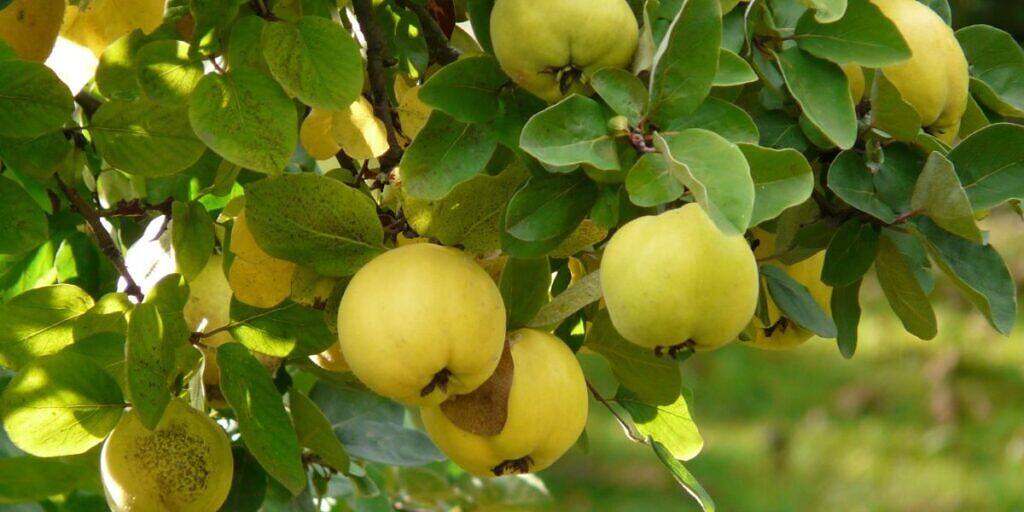
The Quince (Cydonia oblonga) is a small fruit tree that also works very well as an ornamental tree in temperate and subtropical gardens. Its canopy tends to be rounded and irregular, with branches that are often twisted, giving the overall structure added visual interest. In addition to its productive value, the species stands out for its spring bloom, leaf texture, and the presence of golden-yellow, aromatic fruits at the end of the season.
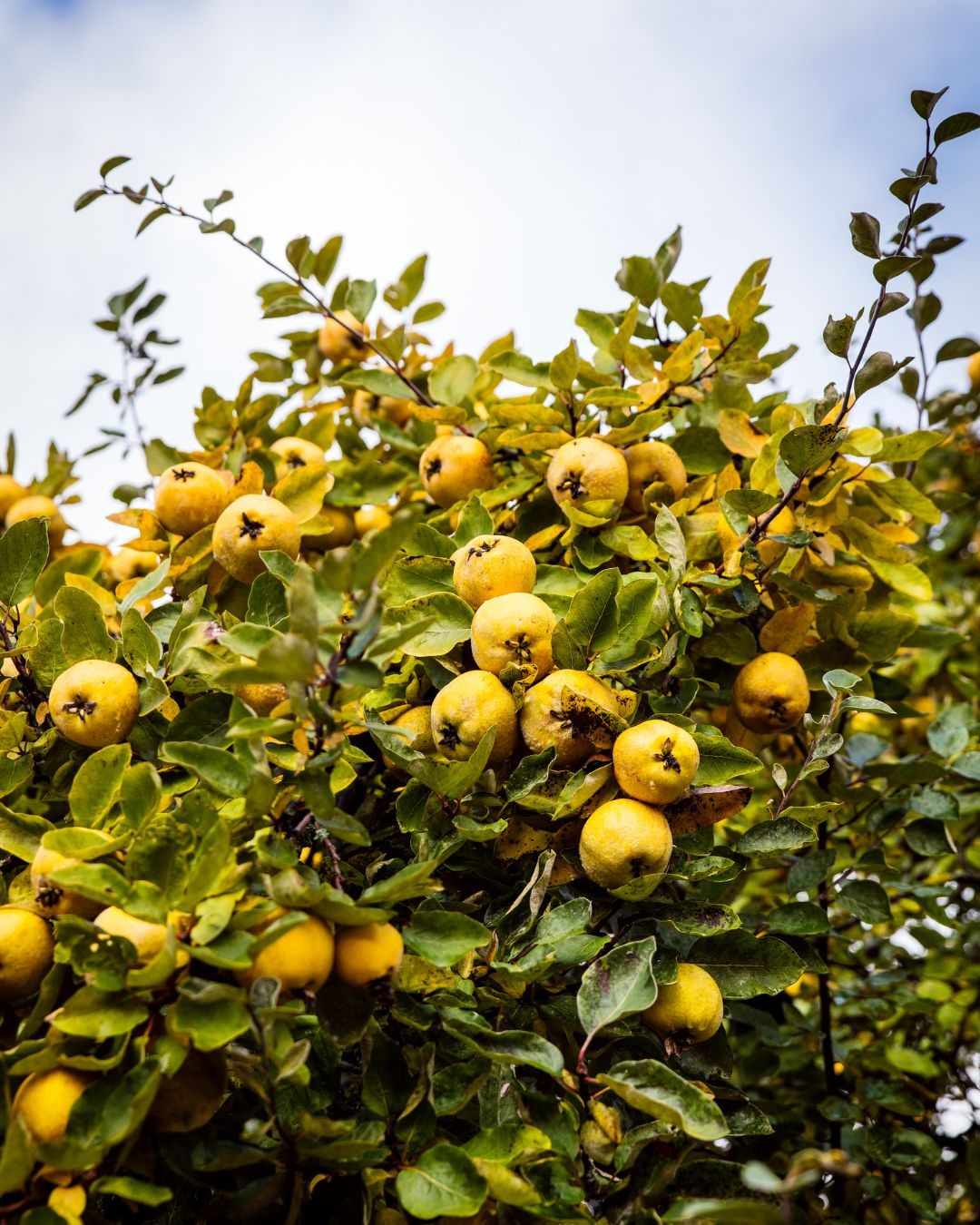
Although it appears less often today in commercial orchards than apple and pear, Quince remains relevant in projects that seek seasonal variation and the identity of a home orchard (especially in gardens with a more rustic style, such as the cottage style). In winter, when the leaves fall, the plant reveals the architecture of its branches and a trunk with bark that may peel in plates, adding visual texture. In spring, solitary flowers appear (clearly visible among the new leaves), and the cycle is completed with fruiting in autumn, when the ripe fruits can perfume the surrounding area. It is a resilient species, capable of tolerating heavier soils than other fruit trees, making it a strategic choice for various planting contexts.
Origin, Habitat, and Etymology
Quince has deep roots in the history of civilization, being native to the rocky slopes, valleys, and forest edges of the Caucasus and Central Asia. Its original distribution covers regions that today include Iran, Turkey, Armenia, Azerbaijan, and Georgia. In these places, the species evolved in mountainous, high-altitude regions, where winters are harsh and well defined, a crucial factor for breaking dormancy and ensuring vigorous fruit production. It is a plant adapted to moisture-retentive soils, yet one that benefits from the drainage found on natural mountain slopes.
The etymology of the genus Cydonia is a direct tribute to classical history, deriving from “Kydonia,” an ancient and influential city-state on the island of Crete (modern-day Chania). In antiquity, fruits from this region were considered the highest quality, which led the Greeks to associate the plant with that locality. The specific epithet oblonga is a descriptive botanical term that may refer to the plant’s leaves, which are longer than they are wide, or to the oblong shape of the fruits.
Landscape Use of Quince
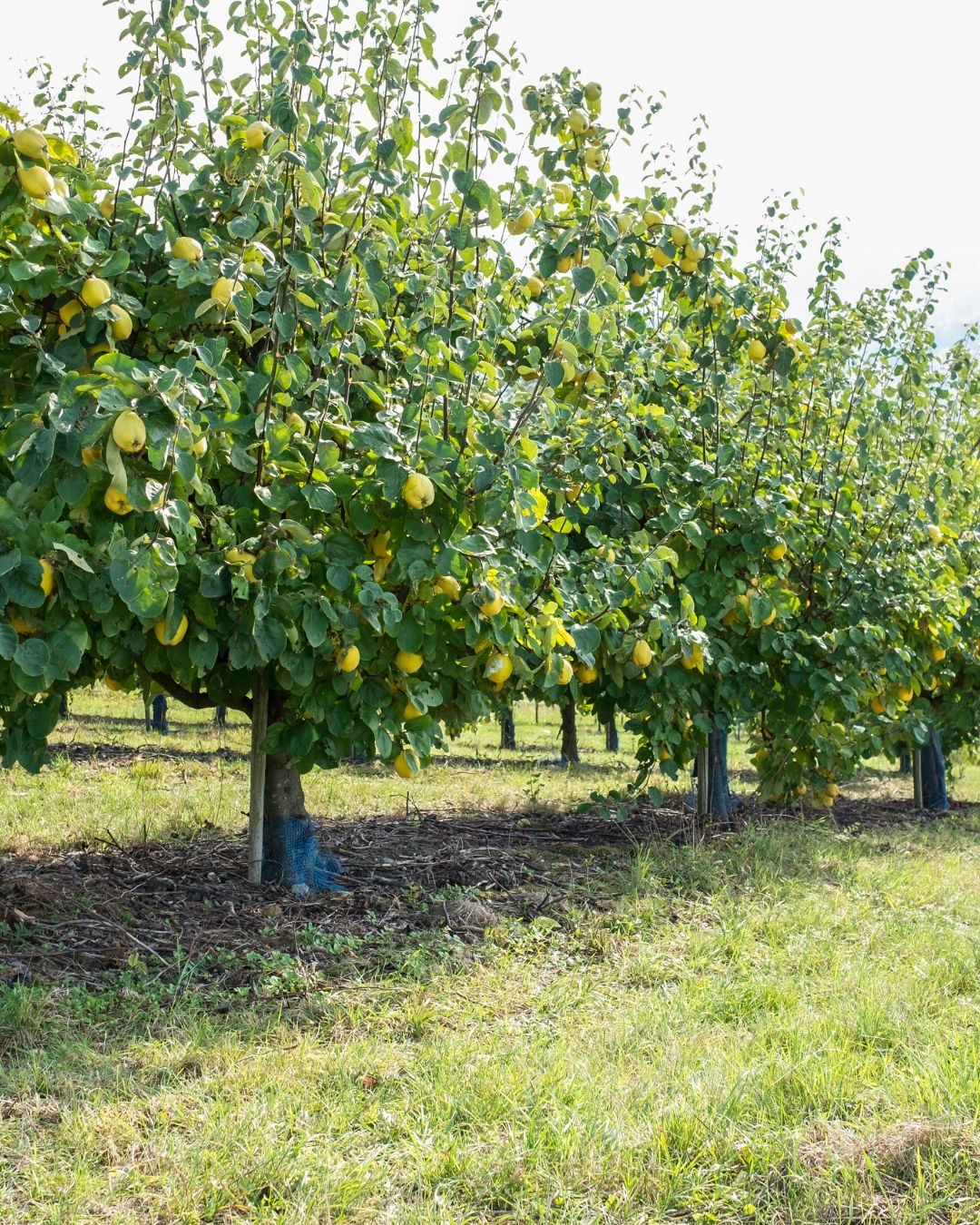
In landscaping, Quince is valued as a specimen tree (feature plant) or as part of ornamental orchards. Its twisted silhouette and somewhat irregular growth give it a unique personality, ideal for English-style or rustic gardens, although it also pairs well with Mediterranean gardens. When planning the planting site, it should be considered that the tree reaches between 13 and 20 feet in height (4 to 6 meters), requiring spacing of 15 to 20 feet (4.5 to 6 meters) between seedlings to ensure sunlight reaches the entire canopy and air circulation helps minimize fungal diseases. Its growth rate is moderate, which makes it easy to control its size through annual pruning.
Perennial herbaceous plants, such as Lavandula angustifolia (lavender), Nepeta cataria (catnip), or Salvia officinalis (sage), are ideal companions as ground cover beneath Quince. In addition to the aesthetic contrast between the gray-green of the herbs and the dark green of Quince, these species attract essential pollinators for fruit set and help conceal the base of the trunk, which can become somewhat bare over time. In larger gardens, repeating Quince trees can create a low avenue, visually striking both during flowering and fruiting.
Beyond the garden, Quince can also be successfully grown in large containers on sunny patios or balconies, provided more compact varieties or grafted seedlings on dwarf rootstocks are used. Its solitary flowers, a delicate pinkish white, are occasionally used in rustic floral arrangements, although their longevity is limited. The true ornamental spectacle, however, remains in the garden, where the plant acts as a living calendar, marking the passing seasons with clear changes in color and texture.
How to Care for Quince: Growing Guide
- Light: Full sun is essential. To ensure Quince blooms abundantly and its fruits reach the ideal sugar content and fragrance, it needs at least 6 to 8 hours of direct sunlight daily. Insufficient light results in etiolated branches (weak and elongated) and a higher incidence of fungi on the leaves.
- Soil: Unlike many fruit trees, Quince tolerates clayey, heavy soils, as long as they do not remain waterlogged. The ideal soil is deep, rich in organic matter, and has good moisture retention. The pH should be between 6.0 and 6.8 (slightly acidic to neutral).
- Watering: Watering should be deep and regular, especially during the first two years after planting and during fruit development in summer. The soil should be kept slightly moist, but never saturated. During prolonged dry periods, water stress can cause premature fruit drop.
- Fertilization: Applying NPK 10-10-10 at the beginning of spring is recommended, spreading the fertilizer over the area under the canopy, while avoiding direct contact with the trunk. It is vital to avoid excess Nitrogen (N), which stimulates very lush, soft vegetative growth, making the plant extremely vulnerable to bacterial attacks and pests. Organic fertilization with well-rotted compost or worm castings in autumn is excellent for maintaining soil health.
- Pruning: Essential for plant health and productivity. It should be carried out in winter (dormant season). The main objective is open-center pruning, removing inner branches to open the center of the tree and allow light and air to enter. Always remove suckers (shoots that emerge from the base) and crossed or diseased branches.
- Thinning: Like other fruit trees, removing excess small fruits shortly after flowering reduces alternate bearing (one year producing heavily and the next lightly), while also producing larger and sweeter fruits.
- Chilling Requirement: Quince needs a winter chilling period (between 100 and 450 hours below 7°C) to flower. In tropical regions without a well-defined winter, the plant may have difficulty producing quality fruit.
How to Propagate Quince
Quince can be propagated in several ways, with hardwood cuttings being the most common and effective method for amateur gardeners. In late winter, cuttings are taken from healthy branches from the previous year (about pencil-thick and 20-30 cm long). These cuttings are buried two-thirds of their length in a light, moist potting mix. This method ensures that the new plant retains all the genetic characteristics of the mother plant, such as fruit flavor and size.
Another very efficient method is layering, taking advantage of the plant’s natural tendency to produce roots on branches that touch the ground. Simply pin a flexible branch to the ground, cover part of it with soil, and keep it moist until roots develop, allowing the new plant to be cut free and transplanted. At commercial scale, grafting is often used, with productive varieties grafted onto selected rootstocks to control vigor, increase precocity, or improve resistance to soil-borne diseases. After rooting or grafting and final planting, Quince normally begins producing fruit between 2 and 4 years, depending on the cultivar, rootstock, and management.
Propagation by seeds is technically possible, but not recommended for those seeking high-quality fruit, since the resulting plants are genetically variable. However, if you want to try, the seeds need to undergo a cold stratification process (kept in the refrigerator in a moist medium) for 60 to 90 days to simulate winter and break dormancy. Seed-grown seedlings take much longer to begin producing and are used mainly as a base for grafting.
Botanical Description and Identification of Cydonia oblonga
Quince is a deciduous shrub or tree (leafless in winter), with woody texture and a size that rarely exceeds 6 meters (19.7 feet). Its trunk is often twisted, giving the species a picturesque appearance. The leaves are alternate, simple, with an oval to oblong blade, measuring 6 to 11 cm (2.4 to 4.3 inches). A crucial identifying feature is the difference between the leaf surfaces: the upper (adaxial) surface is dark green and smooth, while the lower (abaxial) surface is densely covered with a whitish, velvety fuzz called tomentum.
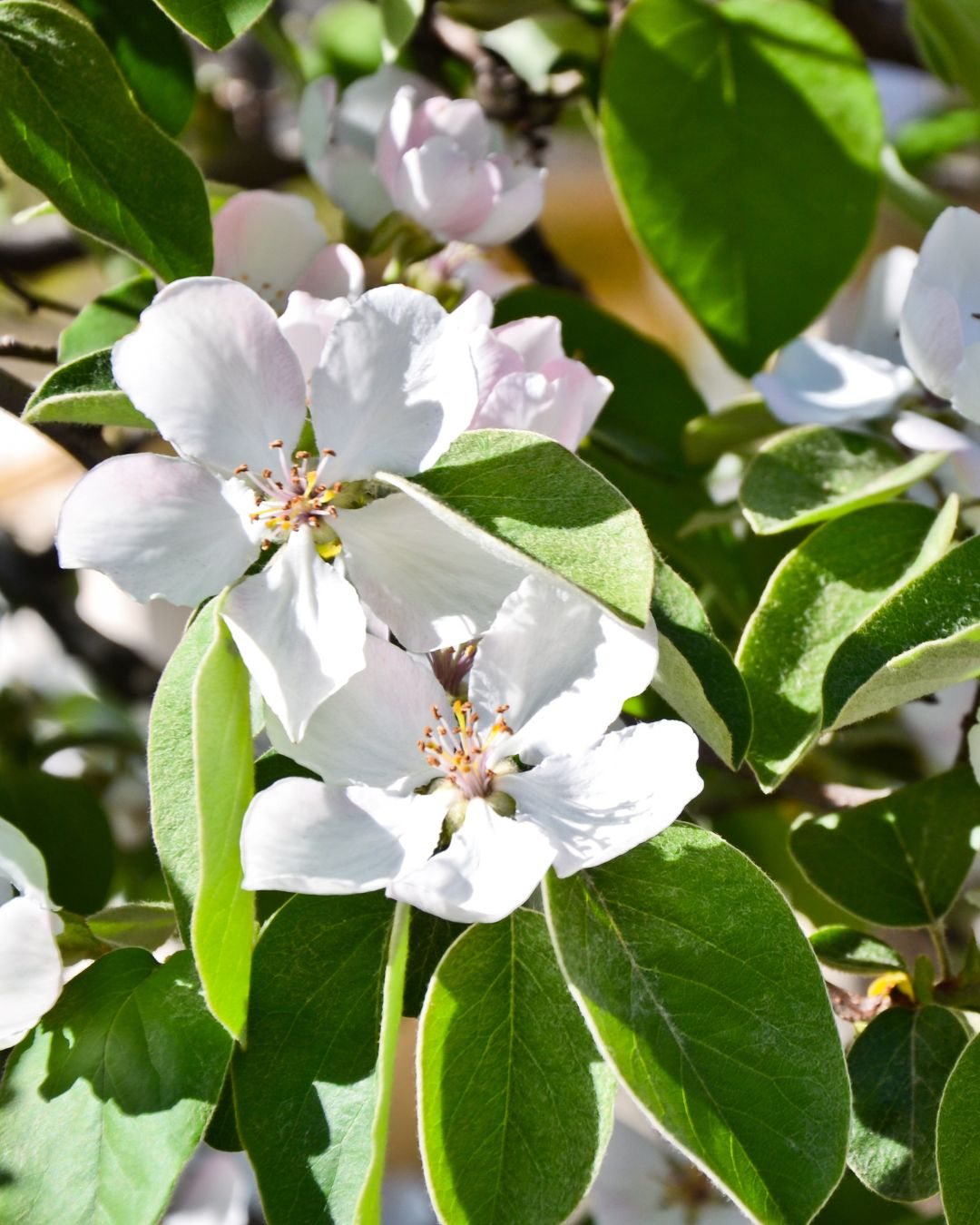
As flowers are solitary and terminal, appearing after the first leaves emerge in spring. They have 5 petals ranging from pure white to pale pink, with a diameter of 1.6 to 2 in (4 to 5 cm). The center of the flower displays numerous stamens with purplish anthers, creating a delicate visual contrast. Pollination is insect-mediated, mainly by bees, although most varieties are self-fertile, which means a single tree can bear fruit on its own.
The fruit is a pome with a variable shape (pear-shaped or globose), reaching 2.8 to 4.7 in (7 to 12 cm). When ripe, the skin takes on a bright golden-yellow hue and is initially covered by a grayish indumentum (fuzz) that can be removed by rubbing the fruit. The flesh is firm, yellowish, rich in sclereids (stone cells that give it a slightly gritty texture), and has an extremely intense floral aroma. The seeds are small, brown, and housed in the central core, protected by a leathery endocarp.
Main Varieties and Cultivars
- ‘Vranja’: One of the favorites for landscaping thanks to its strong vigor and broad leaves. It produces large, pear-shaped fruits that are highly aromatic and internationally awarded.
- ‘Portugal’: Famous for the superior quality of its flesh, which, interestingly, turns a deep blood-red after cooking. It is the classic variety for making fine jellies.
- ‘Smyrna’: A Turkish cultivar with smoother, lemon-yellow fruit skin. It is valued for its tender flesh (once cooked) and its transportability.
- ‘Champion’: Excellent for smaller gardens because it has a more compact habit and begins producing early. Its fruits are more rounded, resembling large apples.
- ‘Meech’s Prolific’: As the name suggests, it is highly productive. It also stands out ornamentally for its flowers, which are considerably larger than the average of other varieties.
Pests, Diseases, and Solutions
The biggest phytosanitary challenge for Quince is Fire Blight (Erwinia amylovora). The symptoms are dramatic: branches, flowers, and fruits look as if they have been scorched by fire, wilting and darkening rapidly. There is no effective chemical cure; the solution is drastic pruning, cutting 12 in (30 cm) below the affected area. It is essential to disinfect pruning shears with 70% alcohol after every cut so the bacteria do not spread to other parts of the plant or to other trees.
Another common problem is leaf spot caused by the fungus Diplocarpon mespili. It appears as small brown spots with black dots in the center of the leaves and can cause premature leaf drop. Control involves thorough garden sanitation, removing and burning all leaves that fall in autumn to eliminate the spores. In severe cases, copper-based fungicide applications (Bordeaux mixture) in late winter and early spring help prevent infection.
Fun Facts
Quince is surrounded by symbolism. In Ancient Greece, it was the fruit dedicated to Aphrodite, the goddess of love and fertility. Historians believe that the famous “Apple of Discord” and the legendary “Golden Apples” of the Garden of the Hesperides were actually Quinces, since the common apple (Malus domestica) was not yet widely cultivated in those regions at the time of the myths. Offering a Quince to someone was considered a gesture of love and a wish for marital happiness.
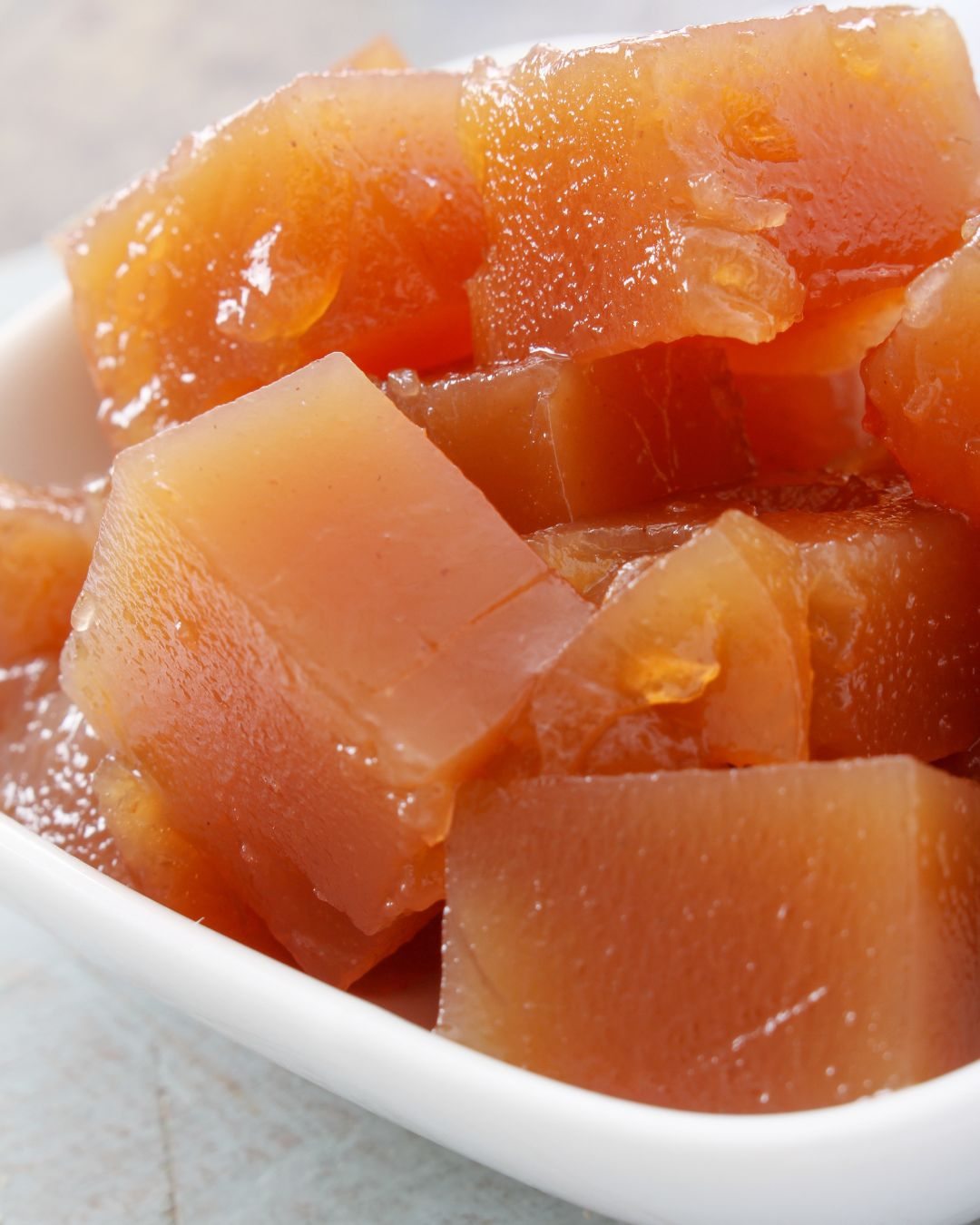
In cuisine, quince has a curious linguistic legacy: the English word “marmalade” ultimately traces back to the Portuguese “marmelada,” from “marmelo,” the Portuguese name for quince. In Portugal, quince was traditionally cooked with sugar to make a firm, preservable paste, a preparation that later influenced similar fruit preserves. Due to its very high natural pectin content, quince is an excellent natural thickening agent, reducing the need for added thickeners in jellies and preserves. Raw, the fruit is rarely eaten because it is very hard and astringent — often described as mouth-puckering — but heat transforms its texture and brings out a complex, distinctive flavor.
From a medicinal and cosmetic standpoint, Quince seeds have an interesting ethnobotanical use: when soaked in water, they release a clear mucilage. Historically, this substance was used as a hair-setting gel and to soothe irritation of the skin and throat. However, caution is needed: the seeds contain cyanogenic glycosides, substances that can release cyanide if chewed in large quantities. Therefore, use should preferably be external or under guidance, keeping processed Quince fruits safe for food consumption.