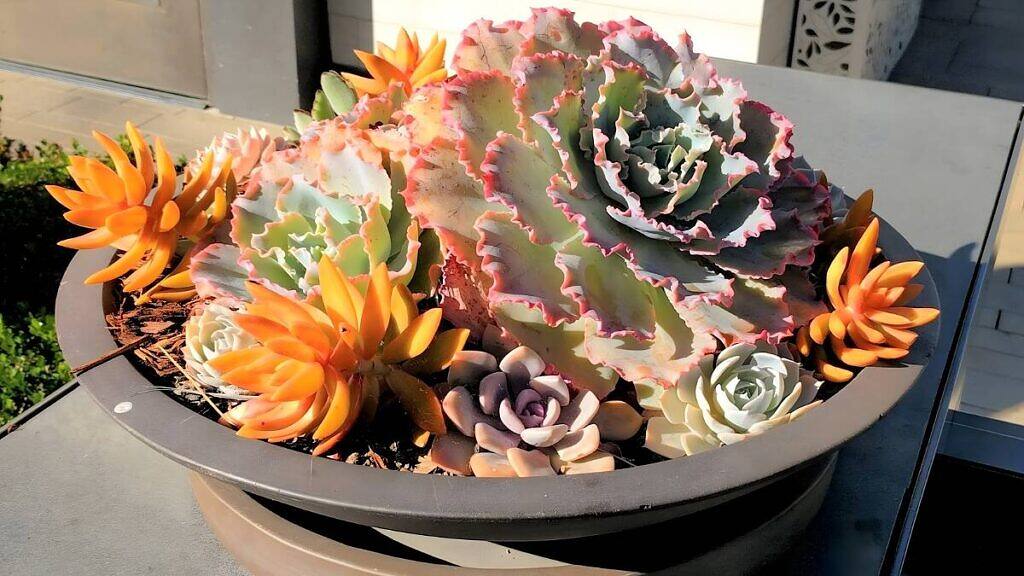
Large giant succulents have become highly coveted among many collectors: rosettes over 16 in (40 cm) in diameter, thick stems, fleshy leaves, often colorful and full of character. But to achieve this sculptural size in a pot, it takes much more than a “green thumb”: you need technical care, proper light, a very well-drained potting mix, and a lot of patience.
What exactly is a giant succulent?
The term “giant” is not a formal botanical concept, but rather a practical way of separating plants that grow larger than average, especially among rosette-forming succulents such as Echeveria and its hybrids. In this article we will focus only on giant succulents within the Crassulaceae family, but keep in mind that other families, such as Asparagaceae, especially the subfamily Agavoideae, also include many giant species and cultivars.
Enjoyed this guide? There's more where it came from.
Understanding why plants behave the way they do is what turns guesswork into a thriving garden. That's exactly what we share in the Shrubz newsletter — free, straight to your inbox:
- Seasonal care reminders timed to your gardening calendar
- Propagation and pruning techniques, explained step by step
- Pest and disease alerts — catch problems before they spread
Rosette diameter and overall size
In practice, collectors usually refer to giant succulents as those that:
- form rosettes that can exceed 12–16 in (30–40 cm) in diameter in a well-grown container;
- develop a thick, elongated stem (often resembling a small trunk);
- have broad, long, heavy leaves with a large volume of stored water;
- tend to grow taller or wider than typical miniature tray-size succulents.
Within this group, you will mainly find hybrids related to Echeveria gibbiflora (the well-known “gibbifloras”), Kalanchoe, and intergeneric hybrids such as some large Graptoveria and Sedeveria.

Growth, stem, and growth habit
Another important feature of giant succulents is their growth habit. Many giants:
- develop an upright, thickened stem that may become woody over time (lignification);
- can produce secondary rosettes along the stem (offsetting);
- flower abundantly when well established, on long flowering stalks.
This larger size demands more container space, better air circulation, and careful watering and drainage management to prevent fungal problems and the plant toppling over.
Major groups and cultivars of giant succulents in containers
The universe of giant succulents (those that comfortably fill a 16–24 in (40–60 cm) container) is dominated by collector-grade hybrids and selections. And here lies the catch: many trade names vary from grower to grower, and different clones may circulate under the same “nickname.” For anyone who collects (or sells), it is best to treat the label as a starting point, not as a definitive taxonomic statement.
In the market, this becomes especially clear with the so‑called “gibbifloras”: the term has turned into an umbrella for thick‑stemmed, large‑leaved Echeveria, often with no clearly defined cultivar. Their care, however, usually follows a very predictable pattern: very bright light, an extremely fast‑draining potting mix, and strict watering discipline (in other words: no daily fussing over the pot).

The Echeveria gibbiflora group and collector “gibbifloras”
The so‑called “gibbifloras” are, in essence, Echeveria gibbiflora and its large, showy hybrids. In the trade, this label is often used broadly for any Echeveria that has:
- a tall, thick stem;
- very large, fleshy leaves;
- the ability to reach 16–20 in (40–50 cm) in diameter (or more), under good conditions.
These giant succulents demand strong sun and a highly drained potting mix to maintain a compact shape and intense color, often with reddish or purplish tones under controlled light stress. In shade or even bright shade, they tend to:
- stretch their stems (etiolation);
- open the rosette too wide, losing that tight, sculpted outline;
- turn greener and duller, with much less color contrast.
Many of these giant succulents descend from formal breeding programs (including famous lines selected for pronounced caruncles, the “warty” bumps on the leaves), and there are now regional selections and hybrids with better performance in heat and irregular rainfall patterns common in many warm and semi‑arid climates.

“Maunas” (carunculated or not): when texture becomes a surname
In the trade, it is common to find giant succulents with a rosette shape sold under names like “Mauna,” “Mauna Loa,” and similar labels. In many cases, these are hybrids related to the gibbiflora complex. The key point is that “Mauna” is rarely a true botanical identification; it is mainly a commercial label used for large succulent rosettes.
- Echeveria ‘Mauna Loa’: a classic collector’s hybrid, known for its prominent caruncles and very ruffled frills. One detail that confuses beginners with this giant succulent: young leaves can emerge relatively smooth and gradually “develop” the warty texture as the plant matures.
- Echeveria ‘Etna’: often placed in the same group as the carunculated Maunas; in general, it is treated as a benchmark for large, irregular caruncles on mature plants.
- Echeveria ‘Monalisa’: frequently confused with Maunas, but it tends to have more elongated leaves and a crease/notch at the tip (a “heart”-shaped apex), with less dramatic frills.
- “Mauna” types (trade name): some growers distinguish forms that differ from ‘Mauna Loa’, with broader leaves, softer frills and, most importantly, a reduced or complete absence of caruncles on the foliage.
Quick differentiation checklist (handy when you’re standing at the nursery bench)
- Large, irregular warty bumps on the leaves? Likely ‘Mauna Loa’ or ‘Etna’.
- Smoother, longer leaves with a little “heart” or notch at the tip? It leans toward ‘Monalisa’.
- Broad leaves, gentle frills, few or no caruncles, a robust and tighter rosette? Likely one of the “Mauna” trade types without strong carunculation.

Caruncles: when the plant “grows up” (and stops fooling you)
Caruncles are not dirt, nor fungus, nor a greenhouse defect: they are outgrowths of the leaf epidermis that are typical of certain hybrids in the gibbiflora group of giant succulents.
The classic behavior is instability: young plants may not show the warty bumps until they mature, and some growers report that techniques such as beheading (cutting off the rosette) can stimulate offsets with a more “adult” appearance. This helps explain why two succulents “with the same name” can look quite different side by side on the bench.
Controlled stress: collector-grade color doesn’t come from shade and heavy fertilizer
To maximize coloration (red, purple and pink tones), the usual path is: high light levels (with proper acclimation), good day–night temperature swings, and controlled water scarcity. Excess nitrogen, on the other hand, tends to keep the succulent green with softer tissues — great for “growing on”, terrible for “collecting”.
Echeveria ‘Hakuhou’ and other powdery “snow-dust” succulents
Echeveria ‘Hakuhou’ is a classic, highly coveted example among succulent collectors and is often used as a reference for larger, more robust rosettes with farina (the white waxy coating). In general, this succulent responds very well to:
- strong sun (with careful acclimation);
- a very gritty, mineral, extremely fast-draining potting mix;
- balanced, regular fertilization, without overdoing it.
On the other hand, it struggles with:
- too much shade (it loses compactness and color);
- constant moisture trapped in the center of the rosette, encouraging fungal issues;
- a potting mix that gets waterlogged and takes too long to dry.
From a “serious collection” standpoint, the farina on a succulent is almost like an asset: it acts as protection and also as a kind of premium finish. The problem is that touching the plant removes the farina, and it does not grow back the same way. In other words, handling these succulents too affectionately is the fastest route to devaluing a ‘Hakuhou’ without even noticing.
One practical detail: some large, heavily farinose succulents are frustrating to propagate from individual leaves. In cultivation, many collections prefer propagation from stem cuttings and, when necessary, techniques like beheading (with careful callusing) to maintain vigor and produce new rosettes.
Large variegated succulents (stunning, slow and a bit dramatic)
Variegation in large succulents — such as variegated E. gibbiflora and variegated Graptoveria ‘Supreme’ — usually comes with a price: slower growth and greater sensitivity to direct sun in the lighter areas (higher risk of sunburn).
In hot climates, it’s usually necessary to provide protection during the most intense hours of sun (light shade cloth) and use an even more free‑draining potting mix, so the plant doesn’t “compensate” for stress by producing soft, weak tissue.
Graptoveria, Pachyveria and related hybrids: plenty of volume with less fuss
In addition to gibbiflora types, intergeneric hybrids are on the radar for anyone who wants strong visual impact with more predictable care. These giant succulents tend to root easily, grow fast, and form clumps over time — excellent for large containers and mixed arrangements.
- Graptoveria ‘Fred Ives’: widely available in cultivation. It grows very fast, becomes huge, and shifts from bronze to purple/pink depending on light and cold. If you want to “fill a pot” without weekly therapy, this giant succulent will cooperate.
- Graptoveria ‘Douglas Huth’: a hybrid associated with Echeveria × Graptopetalum paraguayense, with gray‑pink leaves and very high productivity in offsets.
- Graptoveria ‘Albert Baynes’: often confused with ‘Douglas Huth’; in general it appears as a “very similar, but not quite the same” plant — and without traceable origin, visual ID can easily turn into a philosophical debate among collectors.
- Pachyveria ‘Powder Puff’ (and similar cultivars): heavily coated with farina, with chubbier leaves and a tendency to form clumps; excellent for those who like a matte look and a stable, compact shape in a giant succulent.

Sedeveria ‘Harry Butterfield’ and Sedum nussbaumerianum: giant succulents beyond the classic “luxury rosette”
If the goal is to have a large mass of foliage (upright, trailing, or shrubby), these two work as very efficient alternatives:
- Sedeveria ‘Harry Butterfield’ (often sold under trade names): a trailing plant with large, pointed, light‑green leaves. It is a heavy plant and needs a deep hanging basket with a strong hook. A classic mistake is growing it in a small pot (the pot loses that battle in the first year).
- Sedum nussbaumerianum: a fast-growing shrubby type, famous for taking on a coppery to orange hue in strong sun. In wide, well-drained containers, it forms impressive clumps. If you already grow Sedum spectabile, the same “likes sun and wants to dry well” logic will sound familiar.
Another important point: in the trade, it is often mistaken for Sedum morganianum, but the overall size and leaf shape are quite different.
Giant rosette Kalanchoe (“Elephant’s ear”): K. luciae, K. thyrsiflora and K. tetraphylla
Within Crassulaceae, few succulents fill a large pot with as much sculptural presence as the giant rosette Kalanchoe often called elephant’s ear. In the nursery trade, the core of these giant succulents usually revolves around Kalanchoe luciae (the classic “flapjack”, with broad blades that turn red in intense sun), K. thyrsiflora (frequently confused with K. luciae before it blooms) and K. tetraphylla, which may appear labeled as “paddle” even when the ID is, let’s say, optimistic.
For collectors, the goal is less about “winning the name debate” and more about understanding the group’s care pattern: very bright light to keep the rosette firm and colorful, a highly free-draining potting mix, and infrequent watering (let it dry thoroughly between waterings), avoiding water sitting in the crown. The variegated forms — especially K. luciae ‘Fantastic’ — are slower-growing and more sensitive to direct sun on the pale areas, but they still become giant pot specimens with patient care. And yes, in many of these kalanchoes, the rosette that flowers may complete its life cycle; the good news is that the plant usually compensates with lateral offsets, so the “end” often turns into propagation (any drama is optional).

Giant Aeonium (collector cultivars and hybrids)
If the gibbifloras are “ground-level rosettes”, Aeonium is a “rosette on a trunk”: these giant succulents develop woody stems and concentrate large rosettes at the top, creating volume and strong architecture in tall containers.
Among the true giants for any serious collection, standouts include Aeonium arboreum ‘Zwartkop’ (also sold as ‘Schwarzkopf’, the iconic deep purple form), Aeonium ‘Cyclops’ (a large-rosetted hybrid, often cited as one of the most vigorous in the genus), and variegated cultivars such as ‘Sunburst’, which create a striking display in large containers — with the caveat that variegated plants require more careful acclimation and are prone to scorching during the harshest hours of direct sun.
A detail that adds authority to any care guide (and helps avoid mistakes): Aeonium behaves more like an “Atlantic” plant than a typical “desert” succulent. In intense heat, it may enter semi-dormancy and pause growth, so watering is usually more generous during active growth (milder weather) and more restrained at the peak of heat, always with excellent drainage. In pots, this translates into a plant that loves bright light and good air circulation, but not necessarily the “noon oven” effect in full sun.
Cotyledon orbiculata: the giant with “pig’s-ear” leaves
Cotyledon orbiculata is the kind of succulent that looks like it was cast from porcelain: thick, fleshy leaves, usually glaucous (grayish/blue-green), with a reddish edge when it receives enough sun. Although it does not form a perfectly geometric rosette like many Echeveria, it produces terminal rosettes and robust clusters at the tips of its branches, developing the stature of a shrubby succulent in a large pot — ideal for anyone who wants volume and presence without relying solely on rare hybrids.
This succulent giant is notoriously variable in leaf shape (more rounded, more elongated, with different thicknesses), which opens the door to confusion and assorted trade names; for that reason, it often makes sense to treat it as “C. orbiculata and cultivated forms.” In cultivation, it responds well to high light, a mineral-rich potting mix, and spaced-out watering; the classic mistake is keeping it constantly moist out of “pity for the plant,” when this succulent giant actually prefers to dry out gracefully between waterings.
These groups complement the gibbifloras with giant succulents that offer different visual languages: the sculptural, colorful rosettes of Echeveria, the monumental “paddle” leaves of Kalanchoe, the tree-like rosettes of Aeonium, and the matte, glaucous volume of Cotyledon — a solid arsenal for large containers without stepping outside the world of high-impact Crassulaceae.
How to achieve size without etiolation
Growing large is one thing; growing large, compact, and healthy is another challenge entirely. The main enemy of giant succulents in pots is etiolation.
Direct sunlight in the right dose
To keep rosettes firm and well defined, it is essential to provide an average of 4 to 6 hours of direct sun per day, adjusting according to the succulent giant species and your local climate.
In general:
- morning sun is gentler and ideal for acclimation;
- midday sun is more intense and, in very hot regions, may require light shade;
- only bright indirect light is rarely enough for gibbifloras and related succulents to reach their best size and color.
Acclimation must be gradual, especially for newly purchased plants or those shipped by mail. A safe protocol is:
- week 1: very bright location, but with no direct sun;
- week 2: morning sun until around 9 a.m.;
- week 3: extend exposure until about 10–10:30 a.m.;
- after that: gradually increase sun exposure time, watching closely for any signs of sunburn.
These gradual changes help the succulent adjust its physiology, including photoprotection mechanisms and the typical metabolism of succulents (such as CAM-type photosynthesis).
Ventilation: moving air for giant plants
The larger the rosette, the more important ventilation becomes. Still air and high humidity trapped between large leaves encourage fungal diseases, including common problems in succulent cultivation, such as so‑called “pigeon’s eye,” which forms circular lesions on the leaves.
To reduce risks:
- avoid letting rosettes touch each other;
- arrange shelves so that wind or a draft can pass through the whole group of pots;
- indoors, simple cross‑ventilation (windows on opposite walls) already helps a lot;
- do not place large pots pressed against fully closed, damp walls.
In larger collections, even a basic ceiling or wall‑mounted fan set on low speed can make a significant difference in the overall health of your succulents.
Potting mix and drainage: the foundation of success with giant succulents
In climates with marked rainy seasons, drainage is a critical factor. An unsuitable potting mix compacts, holds water for too long, and can literally “cook” the roots of large succulents.
Well‑drained potting mix recipe for giant succulents
A very efficient formula for containers with large succulents is:
- 3 parts good‑quality garden soil (or a peat‑based potting mix);
- 2 parts carbonized rice hulls;
- 1 part crushed lump charcoal (pieces about 1–1.2 in / 2–3 cm);
- optional: a small amount of perlite, vermiculite, or broken terracotta pieces to further improve aeration.
Carbonized rice hulls play a key role in the potting mix: they keep the soil light and porous and help prevent compaction, while also supplying silica, which contributes to stronger cell walls. The medium‑grade charcoal, in turn, creates air channels and improves drainage for the succulent roots.
Fine charcoal dust or worm castings, however, should be used sparingly, as excess can “cement” the potting mix and trap too much moisture.
A simple test is to moisten the potting mix, squeeze a handful in your hand, and then open it:
- if it turns into a solid block of mud, the mix is wrong (too much clay / overly compacted soil);
- if it crumbles easily, that is a sign of good physical structure.

Pot, drainage holes, and drainage layer
For giant succulents, the container needs to match the size of the plant, but without going overboard:
- the diameter should always be slightly larger than the rosette, leaving room for growth;
- the height must be sufficient to accommodate the roots comfortably and a drainage layer;
- multiple drainage holes are essential; never rely on a single tiny hole in the center.
At the bottom of the pot, you can add a layer of:
- fine gravel, lightweight stones, or broken terracotta shards;
- followed by the light, well-structured potting mix described above.
For heavy trailing plants such as Sedeveria ‘Harry Butterfield’, hanging baskets for giant succulents need reinforced hooks and sturdy materials. The potting mix should be even lighter (a higher proportion of porous materials), so the whole arrangement does not become impossible to move.
Watering and fertilizing giant succulents in containers
No giant succulent will thrive if you simply “forget to water” it. At the same time, overdoing water and fertilizer is a sure recipe for fungal problems and deformation. If you notice signs of pests or disease, consult a reliable guide to pest and fungus control.
How to water: the intelligent “dry, then drench” method
The general rule is straightforward for giant succulents: water thoroughly, but space out the watering sessions.
In practice:
- water thoroughly until it starts draining out of the holes at the bottom of the pot (so the entire root ball is hydrated);
- then wait for the potting mix to dry out almost completely before watering again.
Watering frequency will vary with climate and season:
- rainy summer outdoors: often there is no need for additional manual watering; it is more important to ensure excellent drainage and check that the pot is not sitting in water;
- drier winter: increase the interval between waterings, using the light wrinkling of the lower leaves as a practical indicator;
- indoor environments: potting mix usually dries out more slowly; touch the potting mix with your finger or insert a wooden skewer or chopstick to check moisture in the deeper layers.
Avoid watering “just a little every day”: this keeps the surface layer moist and the bottom constantly wet, a perfect combination for root fungi and problems such as crown rot.

Fertilizing giant succulents: growth vs. color and compactness
When growing giant succulents, fertilizing generally follows two main phases:
- Growth phase (young plants, still developing):
You can use balanced fertilizers, such as a 10-10-10 NPK formula, or well‑stabilized organic fertilizers (for example, Bokashi), always in moderate doses. The goal is to stimulate root and leaf development without overdoing nitrogen, which can make the tissues too soft. - Maintenance and color phase (plants already large and established):
At this stage, formulas with less nitrogen and more phosphorus and potassium, such as a 4-14-8 NPK blend or specialized cactus and succulent fertilizers, help maintain compact growth and intensify color without excessively pushing vegetative growth.
Slow‑release fertilizers (such as Osmocote‑type formulations) are widely used by growers because they are safer: they release nutrients over several months, reducing the risk of root burn and sudden fluctuations. For liquid applications, low‑dose fertigation every two weeks is usually sufficient for giant succulents.
In practice, less is more: excess fertilizer on giant succulents can lead to soft leaves, etiolation, and even loss of ornamental traits, such as the wavy shapes of mutations like Echeveria ‘Crispate Beauty’, which require a more restrained approach.
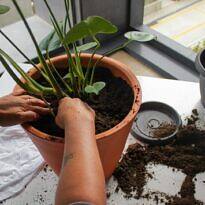
Planting, repotting and acclimating giant succulents
Large plants suffer more from sudden environmental changes. For this reason, planting and repotting should be done calmly and carefully.
- When receiving plants by mail or delivery:
- clean the roots and remove any dry or damaged leaves;
- plant in dry potting mix, without watering for the first 3–5 days (to allow the roots to callus and heal);
- keep the plant in a very bright spot, but out of direct sun during the first week;
- begin gradual acclimation to full sun starting in the second week, as described earlier.
- When repotting already large specimens:
- take the opportunity to inspect the roots and remove any rotten or very dark sections;
- trim damaged roots with a clean tool and allow them to dry for 1–2 days before repotting;
- when moving to larger pots, increase the diameter gradually, avoiding “oceans” of moist potting mix around a small root ball.
For tall-stemmed giants, it is common to perform decapitation (cutting off the rosette for replanting) when the stem becomes very long and out of proportion. The base usually produces new rosettes, and the top will root well in a light potting mix, as long as it is allowed to callus for a few days before planting.
Common mistakes that keep succulents from becoming giant
Several recurring issues can limit growth or deform giant succulents:
- Insufficient light: leads to overly open rosettes, thin leaves, and elongated stems.
Even if the plant manages to “survive,” it will rarely reach its full mature size. - Heavy potting mix: clay-rich soils or compacted garden soil encourage root rot and fungal attacks.
- Chronically undersized pots: root-bound plants have reduced growth potential, especially in naturally vigorous hybrids.
- Excess water: very frequent watering, without allowing the potting mix to dry properly between waterings, opens the door to fungal diseases, especially in warm, humid climates.
- Lack of air circulation: giant succulents crowded together on stuffy shelves are much more prone to leaf spot problems, including circular spots often called “pigeon’s eye.”
- Overfertilizing: often done in the hope of “fattening up” the plant quickly; the result can be weak, tender tissue, prone to pests, rot, and breakage.
In naturally slow-growing cultivars, such as mutations with very ruffled leaves, the collector’s anxiety is usually the biggest enemy: forcing extra water and fertilizer in an attempt to speed up what is, by nature, a very slow process.

Giant succulents in garden beds
Although the focus here is on growing giant succulents in containers, many giant succulents look even more impressive when planted directly in well-designed garden beds.
Advantages of planting in beds
- greater volume of soil available for the root system;
- more stable soil temperature compared with pots exposed to full sun;
- possibility of landscape compositions with contrasting textures and colors.
For this to work well, the bed needs:
- amended, well-structured soil, with plenty of drainage material mixed in (similar to a container potting mix, but on a larger scale);
- a slightly raised grade compared with the surrounding area (a gently elevated bed) to prevent rainwater from pooling;
- adequate direct sun, in line with the light requirements of the chosen species.
A common approach is to create islands of giant succulents in sunny spots, combining central gibbiflora types with groups of Graptoveria and Sedum nussbaumerianum around them, forming a gradient of heights and colors.
Practical summary for giant succulent collectors
To wrap up, here is a condensed checklist of the essentials for anyone who wants to grow their plants to maximum size, especially in containers:
- Choose the right group: gibbifloras, hybrids such as Echeveria ‘Hakuhou’, elephant-ear types, Graptoveria, and trailing cultivars like Sedeveria ‘Harry Butterfield’ are classic examples of giant succulents or plants with substantial volume.
- Light is everything: 4–6 hours of direct sun (or very bright full-spectrum grow lights), with slow acclimation, is key to compact rosettes and intense colors.
- Light, well-draining potting mix: use a high-quality potting mix blended with coarse materials such as carbonized rice hulls or similar amendments and horticultural charcoal in an appropriate particle size, avoiding anything that compacts. See more about unsuitable soil for cultivation.
- Thoughtful watering: water deeply but infrequently, allowing the potting mix to dry out between waterings; avoid light daily sprinkles.
- Fertilizer in moderation: a small amount of balanced fertilizer while young and formulations with lower nitrogen once mature are usually sufficient for giant succulents.
- Ventilation and space: giant succulents dislike being crowded; ensure good air circulation and avoid rosettes touching each other.
- Be cautious with trade names: record the origin and commercial name and, whenever possible, confirm taxonomic information in reliable databases such as Plants of the World Online (Kew) or other recognized botanical references.
- If you notice any signs of disease, refer to our article on controlling pests and fungi in succulents.
With these pillars in place—light, drainage, ventilation, and patience—giant succulents stop being just oversized plants in catalog photos and become true living sculptures in your garden, balcony, or patio.