Why Do Plant Leaves Turn Yellow? Understand the Warning Sign
Do you know that feeling of looking at a plant you care for so lovingly and noticing that the leaves are turning yellow? I have been through this countless times, and I can tell you: chlorosis is one of the most common warning signs in the garden, but also one of the most misunderstood. Most people rush to the watering can, thinking the plant is thirsty, when in fact it may be exactly the opposite.
Leaf yellowing is not a disease in itself, but a symptom. It is as if the plant were telling us: “Hey, something here is not working!” It may be a lack of nutrients, excess water, unsuitable soil pH, diseases, or even microscopic pests sucking the life from the leaves. The good news is that, with careful observation, it is possible to find out exactly what is happening and reverse the situation in most cases.
In my garden, I learned that each type of yellowing tells a different story. Older leaves at the base turning yellow indicate one thing, while pale new growth reveals something completely different. It is like deciphering a code that the plant is trying to transmit to us.
What Is Chlorosis and How Does It Affect Plant Health and Energy
Chlorosis is, technically speaking, the loss or insufficient production of chlorophyll. But what does that really mean for your plant? Chlorophyll is the green pigment responsible for photosynthesis, that magical process in which the plant transforms sunlight, water, and carbon dioxide into energy and oxygen.
Without enough chlorophyll, the plant literally runs out of energy to grow, bloom, and defend itself against disease. It is as if you tried to run a marathon without eating properly — the body simply cannot keep up. The plant begins to weaken, the leaves lose firmness, growth stops, and it becomes vulnerable to fungi and opportunistic pests.

The chemical process behind chlorosis can happen in two ways:
- Enzymatic degradation: The chlorophyll already present in the leaves breaks down faster than the plant can replace it
- Blockage in synthesis: The plant cannot produce new chlorophyll molecules, usually because essential elements such as iron or magnesium are lacking
I have seen many gardenias and azaleas suffering from iron chlorosis in alkaline soils. Even with iron present in the soil, the high pH “locks” the nutrient, making it unavailable to the roots. The plant is starving in the middle of abundance.
It is worth making an important counterpoint for our Brazilian reality: in most of the country, the problem is not high pH, but rather excessive soil acidity. In very acidic soils (pH below 5.5), elements such as aluminum and manganese become more soluble and can reach toxic levels for the roots.
The result? Even with nutrients available, the plant cannot absorb them properly. This leads to chlorosis symptoms that can easily be confused with calcium, magnesium, or even phosphorus deficiency. I have seen this happen in vegetable gardens and landscapes where the soil seemed “rich,” but the plants kept yellowing. In these cases, the correction is not to add more fertilizer, but to reduce acidity with lime, always with caution and, if possible, based on a soil analysis.
Differential Diagnosis: How to Identify the Cause of Yellow Leaves by Location
Here is the secret that completely changed the way I diagnose problems in the garden: the location of the yellowing reveals the cause. Really, this is almost magical once you understand the logic behind it.
Plants are intelligent organisms. When a nutrient is lacking, they make “choices” about where to allocate resources. Some nutrients can be moved from old leaves to new ones (we call these mobile nutrients), while others remain fixed where they were deposited (immobile nutrients).
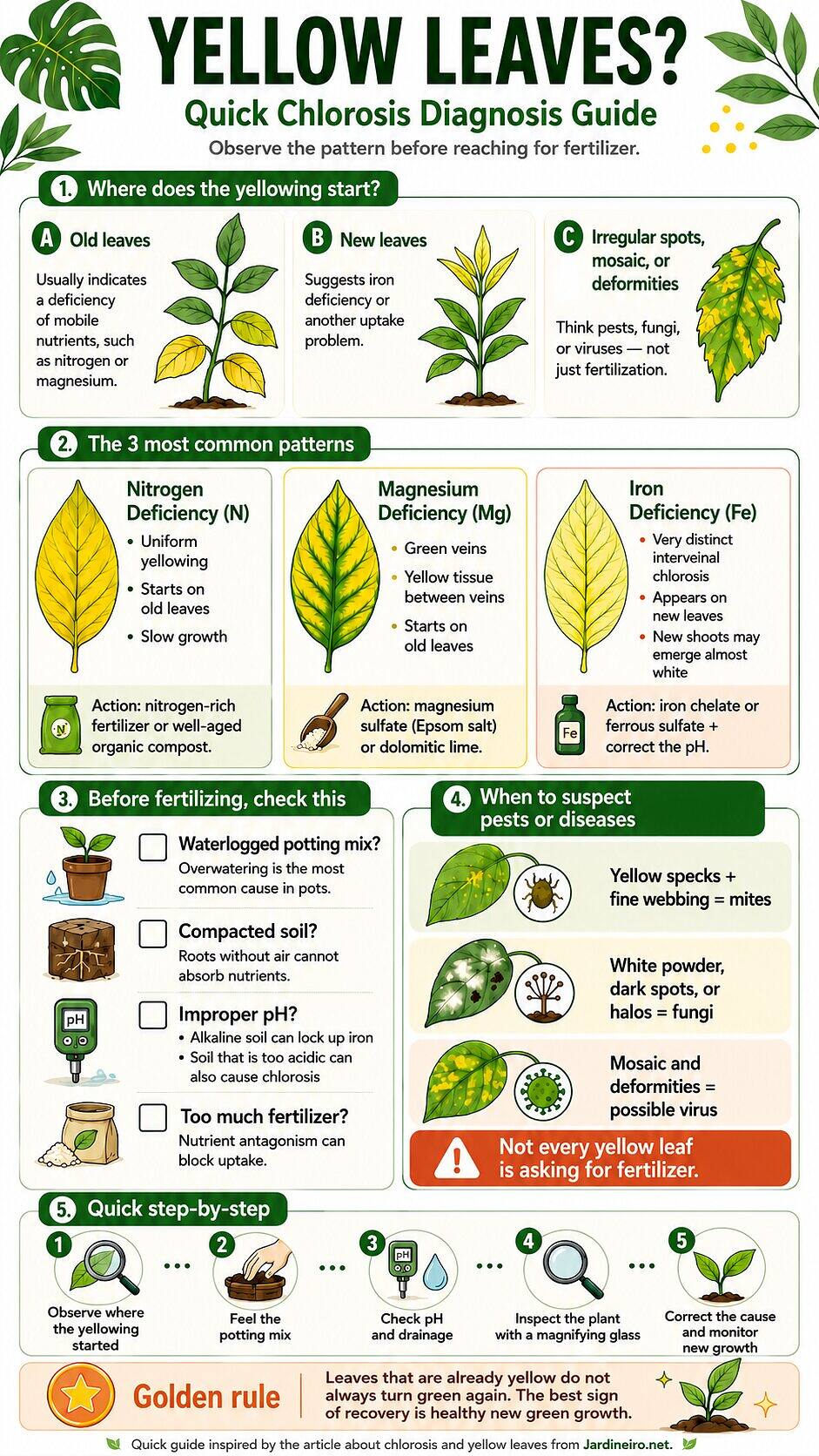
Symptoms on older leaves (from the base upward):
When yellowing starts in the older leaves, closer to the base of the plant, we are usually dealing with a deficiency of mobile nutrients. The plant is “robbing” these elements from mature leaves to feed new growth. It is a survival strategy, but it indicates that something needs to be corrected urgently.
Symptoms on new leaves (shoot tips and buds):
When new shoots and young leaves emerge yellow or whitish, we are probably dealing with a problem involving immobile nutrients. The plant simply cannot transport them from older leaves, and the new tissues develop without the elements needed to produce chlorophyll.

Step by step to distinguish nitrogen, magnesium, and iron deficiency
I’m going to share with you the method I use in my garden to identify which nutrient is missing. Take your plant, observe the leaves carefully, and compare them with these descriptions:
Nitrogen (N) deficiency:
- Uniform yellowing across the entire leaf, starting with the older leaves
- The whole plant takes on a pale, burnt-looking appearance and grows slowly
- The newer leaves may still be green, but they are small and weak
- Solution: fertilizers rich in nitrogen such as urea, Chilean nitrate, or organic amendments like well-aged cattle manure.
Magnesium (Mg) deficiency:
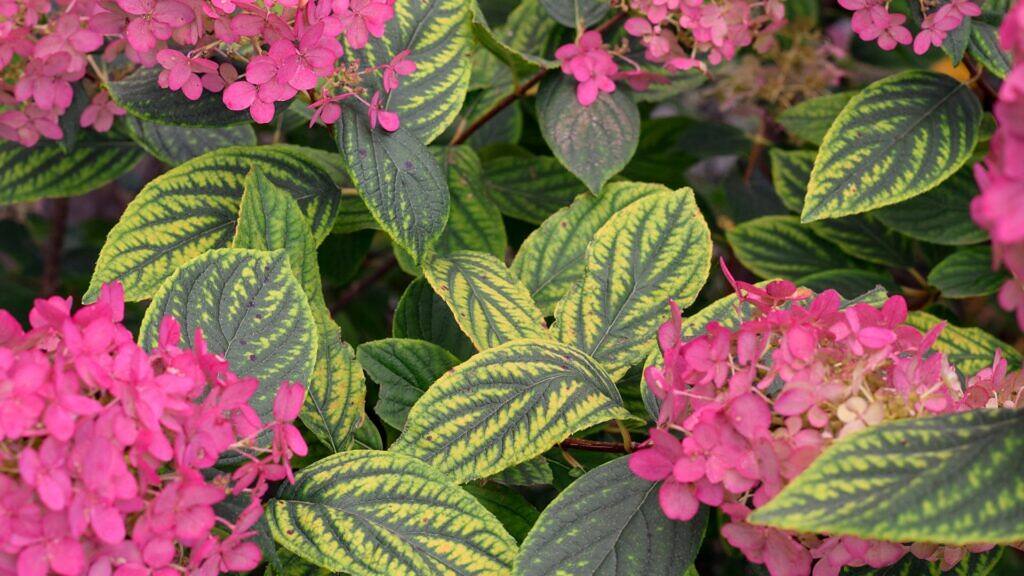
- Interveinal chlorosis: the veins stay green, but the tissue between them turns yellow
- It starts on older leaves and progresses upward
- In severe cases, the edges may turn brown and necrotic
- Common in acidic soils or when there is excess potassium or calcium (antagonism)
- Solution: magnesium sulfate (Epsom salt), dolomitic limestone, or complete fertilizers with magnesium
Iron (Fe) deficiency:
- Very distinct interveinal chlorosis on young leaves (veins remain very green, tissue turns bright yellow)
- New shoots emerge almost white in severe cases
- It is the most common cause of chlorosis in alkaline soils (pH above 7.0)
- Acid-loving plants such as azaleas, gardenias, hydrangeas, and blueberries are especially sensitive
- Solution: iron chelate or ferrous sulfate.
In my garden, I always keep a stock of ferrous sulfate, lime, and aged manure or organic compost on hand. These four products solve 80% of the chlorosis cases I face.

The danger of nutrient antagonism and the importance of soil balance
I discovered this in the worst possible way: more fertilizer does not always mean healthier plants. In fact, excess of one nutrient can completely block the uptake of another, creating artificial deficiencies even in rich soils.
This is called nutrient antagonism, and it is more common than you might think. For example:
- Excess calcium blocks magnesium (which is why lime should not be overused)
- Excess potassium competes with magnesium and calcium
- Excess phosphorus can induce zinc and iron deficiency
- Too much nitrogen reduces the uptake of copper and boron
I had a hydrangea bed that was always yellowing. Adding more fertilizer only made it worse. When I finally tested the soil pH, I found it was 7.5 – far too alkaline. The iron was there, but completely “locked up” by the high pH. The solution was to gradually acidify the soil with elemental sulfur and peat, not to add more fertilizer.
Balance is much more important than quantity. Often, the correction involves reducing fertilizers, not increasing them.

Management mistakes, compaction, overwatering, and the impact of pH on chlorosis
Can I tell you how many plants I have killed with “too much love”? Overwatering is by far the most common cause of yellow leaves in container plants – and the sad part is that most people respond by watering even more.
When the soil becomes waterlogged, air can no longer circulate around the roots. And roots need oxygen to breathe and absorb nutrients. Without oxygen, they literally drown and die. Dead roots absorb nothing – neither water nor nutrients. The result is a yellowed, wilted plant that looks thirsty, but is actually drowning.
Signs of overwatering:
- Sudden generalized yellowing
- Wilted leaves even though the soil is moist
- A moldy or rotten smell coming from the potting mix
- Presence of fungus gnats around the pot
Soil compaction:
Compacted soil also pushes out air and prevents root growth. Feel the soil: if it is hard as concrete, roots cannot expand and nutrient uptake is impaired. The solution is to gently aerate the soil with a fork or skewer, or repot into a lighter potting mix.
The phantom pH:
Here is something many people do not notice: even if you prepare a perfect potting mix, tap water can gradually alter the pot’s pH. If your water is highly alkaline (common in areas with hard water), each watering raises the pH and makes iron unavailable.
I bought a 3-in-1 pH meter for less than R$ 30 and it was one of the best investments I made. I found out my water was at pH 8.2 – not good at all for azaleas and gardenias, which prefer a pH between 5.0 and 6.0.
Potting mix salinization:
That white crust that appears on the surface of the pot? It is a buildup of fertilizer salts.
Excess salts burn the roots and cause chlorosis by reverse osmosis — the plant loses water instead of absorbing it. If you see this crust, stop fertilizing and flush the potting mix with plenty of water.

How to treat yellow leaves and restore the vibrant green in your garden
Now comes the practical part: how to reverse chlorosis and see your plants shine again. Treatment varies depending on the cause, but I’ll give you a general step-by-step process that works:
1. Stop and observe before acting:
Resist the temptation to start fertilizing or watering without understanding the problem. Use the differential diagnosis I taught you: where is the yellowing? On old or new leaves? Uniform or interveinal?
2. Check soil moisture:
Insert your finger about 2 in (5 cm) into the potting mix. Is it waterlogged? Stop watering immediately and let it dry almost completely before the next watering. Is it too dry? Rehydrate gradually; don’t drown the plant all at once.
3. Test the pH:
If you suspect iron deficiency or have acid-loving plants, test the pH. To lower it (acidify): use elemental sulfur or peat moss. To raise it (alkalize): use agricultural lime. But go slowly — abrupt pH changes stress the roots.
4. Correct the specific deficiency:
- Nitrogen deficiency: Apply worm castings or an NPK fertilizer with a higher N content (the first number). Results appear in 1–2 weeks
- Magnesium deficiency: Dissolve 1 tablespoon of magnesium sulfate (Epsom salt) in 1 quart (1 liter) of water and water the plant. Repeat every 2 weeks
- Iron deficiency: Use iron chelate or ferrous sulfate according to the instructions on the package. I prefer foliar application for faster results, but be careful: it can stain stone floors
5. Remove severely affected leaves:
Leaves that are already 70% yellow will not recover. Remove them with sterilized pruning shears (I use 70% alcohol) so the plant does not waste energy trying to restore them. This also prevents opportunistic fungi.
6. Improve soil structure:
If the problem is compaction, add organic matter (worm castings, coconut coir) and perlite or coarse sand to improve drainage and aeration. In containers, consider repotting into fresh potting mix.
Emergency treatment for iron chlorosis:
When I have a severely chlorotic azalea or gardenia, I do this: I apply iron chelate foliarly (spray on the leaves) for a quick result, and at the same time I work on acidifying the soil with sulfur for long-term correction. New shoots start growing green in 7–10 days.
When the problem is not nutrition: pests, fungi, and viruses that also cause chlorosis
Not every yellow leaf is asking for fertilizer. Pests and diseases also directly interfere with chlorophyll production, often perfectly mimicking a nutrient deficiency. The difference is that, in these cases, fertilizing does not solve the problem — and may even make the situation worse. Aphids, whiteflies, and spider mites, for example, feed on plant sap, removing essential nutrients and causing spotty or patchy chlorosis. Over time, the damage accumulates, the leaves lose vigor, and the plant enters a cycle of progressive weakening.
Fungi also enter this equation. Diseases such as powdery mildew, rust, and leaf spot compromise leaf tissues and reduce their ability to carry out photosynthesis. Yellowing, in this case, is usually accompanied by additional signs: white powder, dark spots, yellow halos, or necrotic areas. Here, observing the details makes all the difference. Unlike nutrient deficiency, which tends to follow cleaner patterns (such as interveinal chlorosis), fungal diseases leave irregular marks and develop over time.
And there is an even trickier group: viruses. Viral infections can cause mosaic chlorosis, deformities, and irregular growth. The leaves develop yellow patterns interspersed with green, as if they were “unevenly mottled.” There is no curative treatment for plant viruses — control relies on prevention, elimination of vectors (such as insects), and, in more severe cases, removal of the infected plant to protect the others. Therefore, whenever chlorosis comes with deformities or unusual patterns, it is worth suspending any immediate nutritional correction and investigating further before acting.

Essential tools and safety precautions in treating yellowing plants
Having the right tools makes diagnosis and treatment much easier.
Here is my basic kit, which I recommend for any gardener:
Diagnostic tools:
- 3-in-1 pH and moisture meter: It costs between R$ 20 and R$ 50 and is essential. It measures pH, moisture, and even light levels in some models. See a model I like here.
- Handheld magnifying glass: Essential for identifying spider mites and aphids, which cause spotty chlorosis (yellow patches). Spider mites leave very fine webs and tiny yellow dots on the leaves.
- High-quality pruning shears: Sharp blades make clean cuts that heal better. Always sterilize with 70% alcohol between plants.
Products I always keep on hand:
- Ferrous sulfate (for emergency chlorosis treatment caused by iron deficiency and very alkaline pH)
- Organic compost (my base for organic fertilization)
- Magnesium sulfate/Epsom salt
- Aged cattle manure
- Neem oil or potassium soap (for pests)
- Elemental sulfur (to acidify soils)
Safety first:
Some important precautions I have learned over the years:
- Wear gloves: Chemical fertilizers can cause dermatitis and allergies.
- Be careful with iron-based products: They permanently stain stone floors, marble, and light-colored ceramic tiles. Apply carefully and clean up immediately if spilled.
- Store products away from children and pets: Fertilizers can be toxic if ingested or inhaled. Keep them in a high, locked place. Keep the containers tightly closed and away from moisture.
- Do not mix products without knowledge: Some combinations can trigger dangerous chemical reactions or neutralize their effects.
- Respect the dosages: More is not better. Excess can burn roots and kill the plant.
I always work in a ventilated area and wash my hands thoroughly after handling any product, even organic ones. It may seem excessive, but I have seen many cases of irritation that could have been avoided with these simple precautions.
Frequently asked questions about chlorosis treatment and yellowing leaves
Do yellow leaves always indicate a nutrient deficiency?
No! In fact, overwatering is the most common cause in potted plants. Pests such as spider mites and aphids also cause spotty yellowing. Always check soil moisture and inspect the plant with a magnifying glass before fertilizing.
Can I use iron chelate on any plant?
Yes, but it is especially important for acid-loving plants (azaleas, gardenias, hydrangeas, blueberries) grown in alkaline soils. In other plants, iron deficiency is less common.
How long does it take for the plant to regain its green color?
It depends on the cause. Foliar iron application shows results in 7-10 days on new growth. Nitrogen correction takes 1-2 weeks. Leaves that are already yellow usually do not turn green again—watch the new growth to see whether the treatment is working.
Should I remove all yellow leaves?
Remove only those that are severely affected (more than 70% yellow). Partially yellow leaves are still photosynthesizing, and removing them all at once would stress the plant too much.
Does foliar fertilizer work better than soil application?
For rapid correction of micronutrients (iron, magnesium), yes. Foliar absorption is immediate. But for macronutrients (nitrogen, phosphorus, potassium) and long-term correction, soil fertilization is more effective.
How do I know if my water pH is causing chlorosis?
If you grow acid-loving plants and they develop progressive chlorosis even when well fertilized, test the water pH. Above 7.5, it may be alkalinizing the potting mix. The solution is to use rainwater, filtered water, or periodically acidify the potting mix.
Can acidic soil also cause yellow leaves?
Yes, and it is the most common situation in Brazil. In very acidic soils (low pH), elements such as aluminum and manganese can become toxic to the roots, impairing the absorption of essential nutrients. The result can be chlorosis similar to a nutrient deficiency. In these cases, the solution is not to fertilize more, but to correct the pH with lime, gradually and under guidance.
Can I prevent chlorosis?
Yes! Keep the pH appropriate for each type of plant, do not overwater, use well-drained potting mixes, fertilize regularly with balanced fertilizers, and monitor pests. Prevention is always easier than treatment.
Cultivating a keen eye to keep your garden always vigorous and healthy
Do you know what completely changed my relationship with the garden?
It was understanding that each plant is constantly communicating with me – I just needed to learn how to read the signs.
Yellow leaves are not a failure; they are a conversation. They are your plants saying, “Hey, I need an adjustment here.” And now you have the tools to understand exactly what they are asking for. Observe where the yellowing starts, test the soil, check the moisture, and you will get the diagnosis right most of the time.
Start today. Pick up your plants and truly look at them. Stick your finger into the potting mix (substrate). If you have a pH meter, run the test. You will be surprised by how much you can discover in five minutes of careful observation.
In my garden, I learned that healthy plants do not demand perfection – they ask for attention, balance, and respect for their natural rhythm. Sometimes, the best action is to do nothing and let the soil dry out. Other times, it is that precise application of iron chelate that transforms pale shoots into vibrant foliage in a week.
And remember: those yellow leaves you are seeing now are just one chapter in your plant’s story, not the end of it. With the right treatment and a little patience, you will see the green returning, new shoots emerging strong, and your garden regaining all that vitality that made you fall in love with it.
Now it is your turn. Choose a yellowing plant, diagnose the problem using what you learned here, and give it exactly what it needs. You will be surprised by the plant recovery capacity when we finally understand what they are trying to tell us.